 Back
Chapter 10: Gases – Properties, Laws, and Applications
Study Guide - Smart Notes
 Tailored notes based on your materials, expanded with key definitions, examples, and context.
Gases: Physical Properties and Characteristics
Characteristics of Gases
Gases are a fundamental state of matter characterized by their ability to expand and fill any container, their compressibility, and their tendency to form homogeneous mixtures with other gases. Most gases encountered in general chemistry are composed of non-metallic elements, have simple molecular formulas, and possess low molar masses.
Compressibility: Gases can be compressed much more easily than solids or liquids.
Homogeneous Mixtures: Two or more gases mix uniformly, regardless of their identities.
Low Molar Mass: Most common gases have low molar masses.
Formula | Name | Characteristics |
|---|---|---|
HCN | Hydrogen cyanide | Very toxic, slight odor of bitter almonds |
H2S | Hydrogen sulfide | Very toxic, odor of rotten eggs |
CO | Carbon monoxide | Toxic, colorless, odorless |
CO2 | Carbon dioxide | Colorless, odorless |
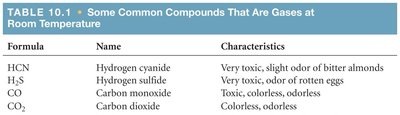
Example: Carbon dioxide (CO2) is a colorless, odorless gas commonly found in the atmosphere.
Pressure and Its Measurement
Definition and Units of Pressure
Pressure is the force exerted by gas molecules as they collide with the surfaces of their container. Atmospheric pressure is the force exerted by the atmosphere on a given surface area.
Common Units: atm, mm Hg, torr, Pa, kPa, bar
Conversion Factors: 1 atm = 760 mm Hg = 760 torr = 1.01 × 10⁵ Pa = 101.325 kPa = 1.01325 bar
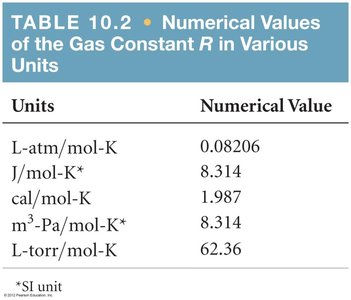
Numerical Values of the Gas Constant R
Units | Numerical Value |
|---|---|
L-atm/mol-K | 0.08206 |
J/mol-K | 8.314 |
cal/mol-K | 1.987 |
m3-Pa/mol-K | 8.314 |
L-torr/mol-K | 62.36 |
Example: Atmospheric pressure at sea level is approximately 1 atm.
Gas Laws
Boyle’s Law: Pressure-Volume Relationship
Boyle’s Law states that the volume of a fixed amount of gas at constant temperature is inversely proportional to its pressure.
Equation:
Combined Form:
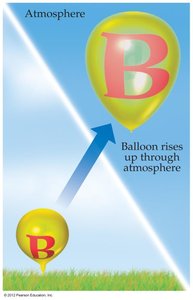
Example: If the pressure on a gas increases, its volume decreases proportionally.
Charles’s Law: Temperature-Volume Relationship
Charles’s Law states that the volume of a fixed amount of gas at constant pressure is directly proportional to its absolute temperature.
Equation:
Combined Form:
Example: Heating a gas at constant pressure causes its volume to increase.
Avogadro’s Law: Quantity-Volume Relationship
Avogadro’s Law states that the volume of a gas at constant temperature and pressure is directly proportional to the number of moles of the gas.
Equation:
Standard Temperature and Pressure (STP): T = 0°C, P = 1 atm, 1 mol gas = 22.4 L
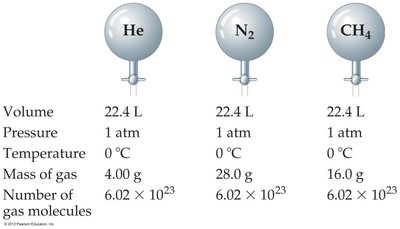
Example: At STP, 1 mole of any ideal gas occupies 22.4 L.
The Ideal-Gas Equation
Combining Gas Laws
The ideal-gas law combines Boyle’s, Charles’s, and Avogadro’s laws into a single equation describing the state of an ideal gas:
Equation:
Variables: P = pressure, V = volume, n = moles, R = gas constant, T = temperature (K)
Example: Calculate the number of moles of CO2 generated in a reaction using the ideal-gas law.
Gas Mixtures and Partial Pressures
Dalton’s Law of Partial Pressures
Dalton’s Law states that the total pressure of a mixture of gases equals the sum of the partial pressures of each individual gas.
Equation:
Partial Pressure: where is the mole fraction
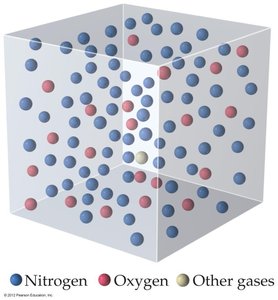
Example: In a mixture of O2 and CH4, calculate the partial pressure of each gas and the total pressure.
Kinetic-Molecular Theory of Gases
Postulates of Kinetic-Molecular Theory (KMT)
The KMT explains the behavior of gases at the molecular level:
Gases consist of large numbers of molecules in continuous motion.
The combined volume of all molecules is negligible compared to the container volume.
Attractive and repulsive forces between molecules are negligible.
The average kinetic energy of molecules is proportional to the absolute temperature.
Example: Increasing the temperature increases the kinetic energy and pressure of a gas.
Molecular Effusion and Diffusion
Effusion and Graham’s Law
Effusion is the escape of gas molecules through a tiny hole. Graham’s Law relates the rates of effusion of two gases to their molar masses:
Equation:
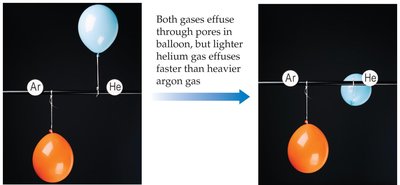
Example: Helium effuses faster than argon due to its lower molar mass.
Diffusion
Diffusion is the spread of one substance throughout a space or another substance. Lighter gases diffuse more rapidly than heavier gases.
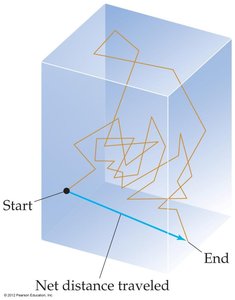
Example: Perfume molecules diffuse throughout a room.
Root-Mean-Square (rms) Speed
The rms speed of gas molecules is a measure of their average speed and is given by:
Equation:
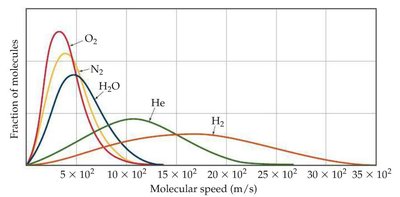
Example: Calculate the rms speed of O2 molecules at 25°C.
Gas Stoichiometry and Law of Combining Volumes
Law of Combining Volumes
When gases react, the ratios between the volumes of reactants and products can be expressed in simple whole numbers, provided the volumes are measured at the same temperature and pressure.
Example Reaction: N2 (g) + 3 H2 (g) → 2 NH3 (g)
At STP: 1 mol gas = 22.4 L
Example: Calculate the volume of NH3 produced from given volumes of N2 and H2 at STP.
Additional info: The notes include practice problems and stepwise calculations for gas stoichiometry, density, and partial pressures, reinforcing the application of gas laws in quantitative chemistry.
