 Back
BackChapter 10: Gases – Properties, Laws, and Applications
Study Guide - Smart Notes
 Tailored notes based on your materials, expanded with key definitions, examples, and context.
Gases: Properties and Behavior
Characteristics of Gases
Gases are one of the fundamental states of matter, characterized by their ability to expand and fill any container. Despite differences in chemical properties, most gases share similar physical properties:
Composed mainly of non-metallic elements
Simple molecular formulas and low molar masses
Highly compressible
Form homogeneous mixtures with other gases
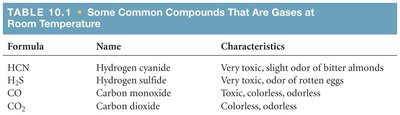
Examples of Common Gases at Room Temperature:
Formula | Name | Characteristics |
|---|---|---|
HCN | Hydrogen cyanide | Very toxic, slight odor of bitter almonds |
H2S | Hydrogen sulfide | Very toxic, odor of rotten eggs |
CO | Carbon monoxide | Toxic, colorless, odorless |
CO2 | Carbon dioxide | Colorless, odorless |
Pressure and Its Measurement
Definition and Units of Pressure
Pressure is the force exerted by gas molecules as they collide with the surfaces of their container. Atmospheric pressure is the force exerted by the atmosphere on a given surface area.
Common units: atm, mm Hg, torr, Pa, kPa, bar
Conversion: 1 atm = 760 mm Hg = 760 torr = 1.01 × 10⁵ Pa = 101.325 kPa = 1.01325 bar
Gas Laws
Variables Defining a Gas
The state of a gas is defined by four variables:
Pressure (P)
Volume (V)
Temperature (T)
Amount (n, in moles)
Boyle’s Law: Pressure-Volume Relationship
At constant temperature, the volume of a fixed amount of gas is inversely proportional to its pressure.
Mathematical form:
As pressure increases, volume decreases, and vice versa.
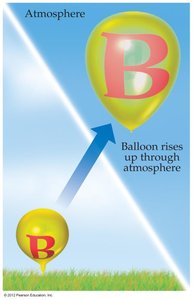
Charles’s Law: Temperature-Volume Relationship
At constant pressure, the volume of a fixed amount of gas is directly proportional to its absolute temperature (in Kelvin).
Mathematical form:
As temperature increases, volume increases.
Avogadro’s Law: Quantity-Volume Relationship
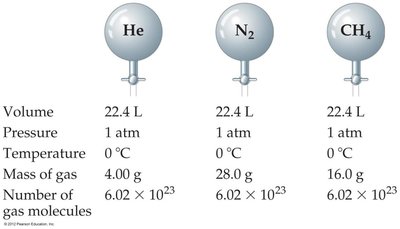
At constant temperature and pressure, the volume of a gas is directly proportional to the number of moles of gas present.
Mathematical form:
At STP (0°C, 1 atm): 1 mol gas = 22.4 L
The Ideal Gas Law
Combining the Gas Laws
The ideal gas law combines Boyle’s, Charles’s, and Avogadro’s laws into a single equation:
Equation:
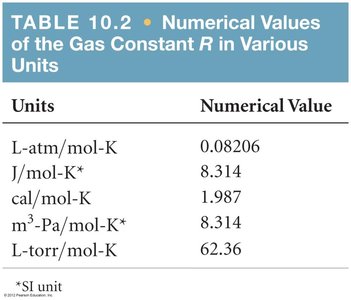
R is the gas constant; its value depends on the units used.
Units | Numerical Value |
|---|---|
L·atm/(mol·K) | 0.08206 |
J/(mol·K) | 8.314 |
cal/(mol·K) | 1.987 |
m3·Pa/(mol·K) | 8.314 |
L·torr/(mol·K) | 62.36 |
Applications of the Ideal Gas Law
Solving for any variable (P, V, n, T) when the others are known
Relating changes in state: (when n is constant)
Gas Mixtures and Partial Pressures
Dalton’s Law of Partial Pressures
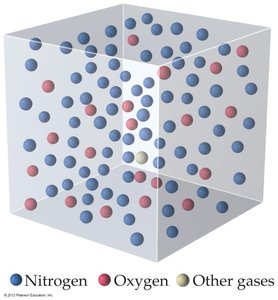
In a mixture of gases, each gas exerts a pressure as if it were alone. The total pressure is the sum of the partial pressures:
Equation:
Partial pressure relates to mole fraction: where
Kinetic-Molecular Theory of Gases
Postulates of Kinetic-Molecular Theory (KMT)
KMT explains the macroscopic properties of gases by considering their molecular motion:
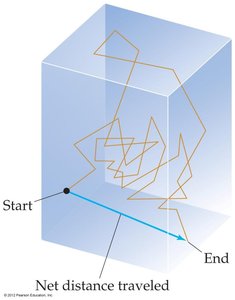
Gases consist of many molecules in constant, random motion.
The volume of individual molecules is negligible compared to the total volume.
Intermolecular forces are negligible.
Average kinetic energy is proportional to absolute temperature.
Explaining Gas Laws with KMT
Increasing volume at constant temperature decreases pressure (fewer collisions with container walls).
Increasing temperature at constant volume increases pressure (molecules move faster, more collisions).
Effusion and Diffusion of Gases
Effusion and Graham’s Law
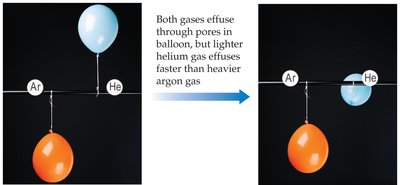
Effusion is the process by which gas molecules escape through a tiny hole. Graham’s Law relates the rates of effusion of two gases to their molar masses:
Equation:
Lighter gases effuse faster than heavier gases.
Diffusion
Diffusion is the spread of one substance throughout another. Lighter gases diffuse more rapidly than heavier ones.
Molecular Speeds and Root-Mean-Square (rms) Speed
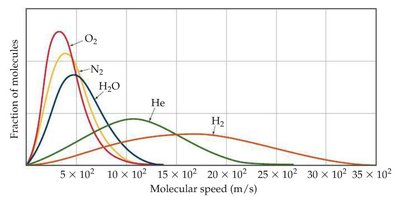
The speed of gas molecules is described by the root-mean-square speed ():
Equation:
Where R is the gas constant, T is temperature in Kelvin, and M is molar mass in kg/mol.
Gas Stoichiometry and Law of Combining Volumes
Law of Combining Volumes
At constant temperature and pressure, the volumes of reacting gases and their products are in simple whole-number ratios.
Example:
1 volume N2 reacts with 3 volumes H2 to produce 2 volumes NH3
At STP, 1 mol gas = 22.4 L
Sample Calculations
Use the ideal gas law to relate volume, pressure, temperature, and moles in stoichiometric calculations.
Convert between grams, moles, and volumes as needed for chemical reactions involving gases.
Summary Table: Key Equations
Boyle’s Law:
Charles’s Law:
Avogadro’s Law:
Ideal Gas Law:
Dalton’s Law:
Graham’s Law:
Root-mean-square speed:
