 Back
BackChapter 10: Gases – Properties, Laws, and Kinetic Molecular Theory
Study Guide - Smart Notes
 Tailored notes based on your materials, expanded with key definitions, examples, and context.
Gases: Properties and Behavior
What Is a Gas?
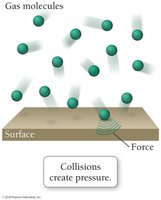
Gases are a phase of matter composed of particles (atoms or molecules) that move randomly and rapidly within their containers. These particles travel in straight lines until they collide with the container walls or with each other, resulting in elastic collisions. The force exerted by these collisions on surfaces is experienced as pressure.

Gas Pressure
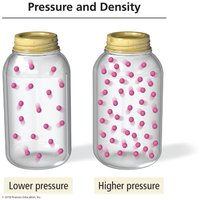
Pressure is defined as the force exerted per unit area by gas molecules as they strike the surfaces around them. The pressure of a gas depends on:
Number of gas particles in a given volume
Volume of the container
Average speed (kinetic energy) of the gas particles
Atmospheric Pressure Effects
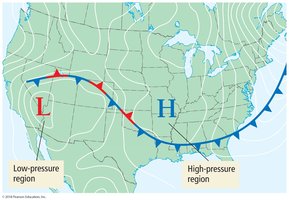
Atmospheric pressure varies with altitude and weather conditions. High-pressure regions are associated with clear weather, while low-pressure regions are linked to unstable weather. Atmospheric pressure decreases with increasing altitude due to the lower number of gas particles per unit volume.
Units of Pressure
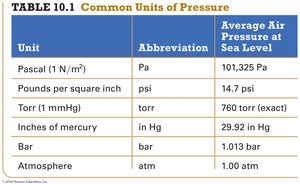
Pressure can be measured in several units. The most common are:
Unit | Abbreviation | Average Air Pressure at Sea Level |
|---|---|---|
Pascal (1 N/m2) | Pa | 101,325 Pa |
Pounds per square inch | psi | 14.7 psi |
Torr (1 mmHg) | torr | 760 torr (exact) |
Inches of mercury | in Hg | 29.92 in Hg |
Bar | bar | 1.013 bar |
Atmosphere | atm | 1.00 atm |
Gas Laws
Basic Properties of Gases
The four basic properties of a gas are:
Pressure (P) – measured in atmospheres (atm)
Volume (V) – measured in liters (L)
Temperature (T) – measured in Kelvin (K), where K = °C + 273
Amount (n) – measured in moles (mol)
These properties are interrelated, and changing one affects the others. The simple gas laws describe the relationships between pairs of these properties.
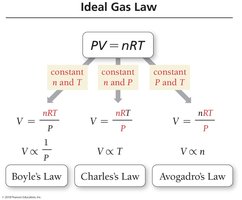
Boyle’s Law: Pressure and Volume
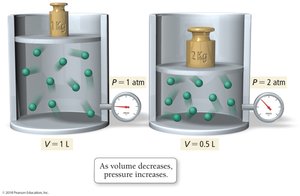
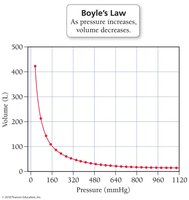
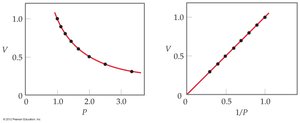
Boyle’s Law states that the volume of a fixed amount of gas at constant temperature is inversely proportional to the pressure:
As pressure increases, volume decreases, and vice versa.
Mathematically:
Charles’s Law: Volume and Temperature
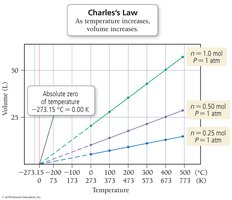
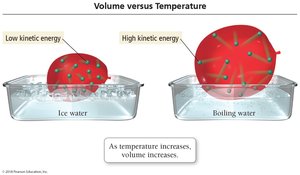
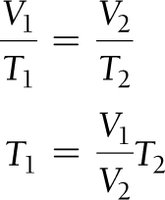
Charles’s Law states that the volume of a fixed amount of gas at constant pressure is directly proportional to its absolute temperature (in Kelvin):
As temperature increases, volume increases.
Mathematically:
Avogadro’s Law: Volume and Moles
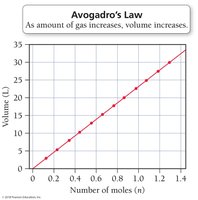
Avogadro’s Law states that the volume of a gas is directly proportional to the number of moles (n) of gas, at constant temperature and pressure:
As the amount of gas increases, volume increases.
Mathematically:
The Ideal Gas Law
The relationships described by Boyle’s, Charles’s, and Avogadro’s laws can be combined into the Ideal Gas Law:
P = pressure (atm)
V = volume (L)
n = moles of gas
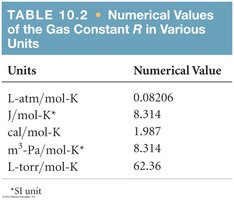
R = ideal gas constant (0.0821 L·atm/mol·K)
T = temperature (K)
Standard Temperature and Pressure (STP) and Molar Volume
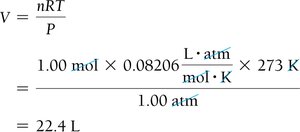
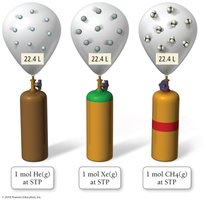
Standard conditions (STP) are defined as 1 atm pressure and 273 K (0°C) temperature. At STP, one mole of any ideal gas occupies 22.4 L (molar volume).
Density and Molar Mass of Gases
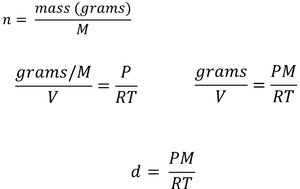
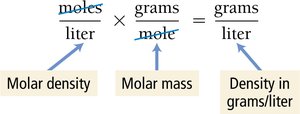
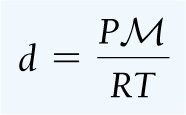
The density (d) of a gas is its mass per unit volume, usually in g/L. The density can be calculated using the ideal gas law:
P = pressure
M = molar mass
R = ideal gas constant
T = temperature
Mixtures of Gases and Partial Pressures
In a mixture of gases, each gas exerts a pressure independently of the others, called its partial pressure. Dalton’s Law of Partial Pressures states:
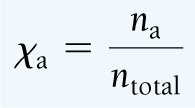
The partial pressure of each component can be calculated using the ideal gas law for that component. The mole fraction () of a component is the ratio of its moles to the total moles in the mixture:
Kinetic Molecular Theory of Gases
Postulates of Kinetic Molecular Theory
The kinetic molecular theory explains the behavior of gases based on the following assumptions:
Gas particles are in constant, random motion.
The volume of individual particles is negligible compared to the container volume.
Collisions between particles and with container walls are perfectly elastic (no energy lost).
There are no intermolecular attractions or repulsions between particles.
The average kinetic energy of gas particles is proportional to the absolute temperature (Kelvin).

Molecular Velocities and Temperature
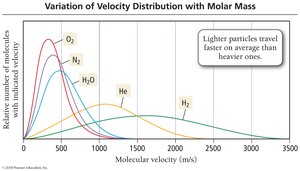
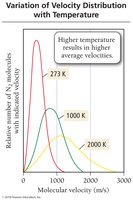
Not all gas molecules move at the same speed. The distribution of molecular speeds follows a pattern called the Boltzmann distribution. The root-mean-square (rms) velocity is used to describe the average speed:
As temperature increases, the average velocity increases.
Lighter molecules move faster than heavier ones at the same temperature.
Mean Free Path, Diffusion, and Effusion
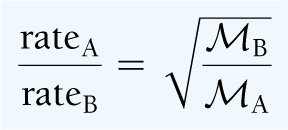
The mean free path is the average distance a molecule travels between collisions. Diffusion is the process of gas molecules spreading out from high to low concentration, while effusion is the escape of gas molecules through a small hole into a vacuum. The rates of diffusion and effusion are inversely proportional to the square root of the molar mass (Graham’s Law):

Real Gases and Deviations from Ideal Behavior
Real Gases
Real gases deviate from ideal behavior at high pressures and low temperatures. The ideal gas law assumes no intermolecular attractions and that gas molecules occupy no volume. At high pressures, the finite volume of molecules becomes significant, and at low temperatures, intermolecular attractions reduce the pressure below ideal predictions.
Van der Waals Equation
To account for real gas behavior, the Van der Waals equation modifies the ideal gas law by introducing constants a (for intermolecular attractions) and b (for molecular volume):
a and b are Van der Waals constants, unique for each gas.
Summary of Gas Properties
Gases expand to fill their containers and take their shape.
They have low density and are compressible.
Gas mixtures are always homogeneous.
