 Back
BackChapter 11: Gases – Properties, Laws, and Calculations
Study Guide - Smart Notes
 Tailored notes based on your materials, expanded with key definitions, examples, and context.
Gases: Properties and Kinetic Molecular Theory
Introduction to Gases
Gases are one of the fundamental states of matter, characterized by their ability to expand and fill any container. At room temperature, several elements and compounds exist as gases, including H2, N2, O2, F2, Cl2, noble gases, nonmetal oxides, and low-molecular-weight hydrocarbons.
Properties That Describe a Gas
Four main properties are used to describe the state of a gas: pressure (P), volume (V), temperature (T), and amount (n). These properties are interrelated and are essential for understanding gas behavior.
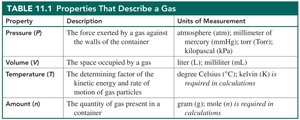
Kinetic Molecular Theory of Gases
The kinetic molecular theory provides a model for understanding the behavior of gases:
Gas particles are small and move randomly at high velocities.
Attractive forces between particles are negligible.
The actual volume of gas molecules is extremely small compared to the volume the gas occupies.
Gas particles are in constant, straight-line motion, colliding with container walls to exert pressure.
The average kinetic energy of gas molecules is proportional to the Kelvin temperature.
Pressure and Its Measurement
Definition of Pressure
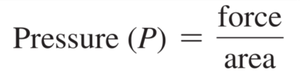
Pressure is defined as the force exerted by gas particles striking the walls of their container per unit area.
Units of Pressure
Common units for measuring gas pressure include:
Atmosphere (atm)
Millimeters of mercury (mm Hg)
Torr
Kilopascal (kPa)
Pounds per square inch (psi)
Conversion factors: 1 atm = 760 mm Hg = 760 torr = 101.325 kPa = 14.7 psi
Atmospheric Pressure and Barometers
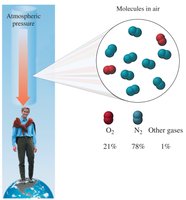
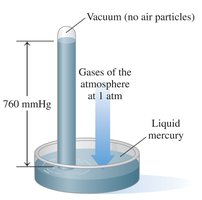
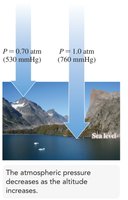
Atmospheric pressure is the pressure exerted by the weight of the air above us. It can be measured using a barometer, which typically uses mercury to indicate pressure in mm Hg.
Effect of Altitude on Atmospheric Pressure
Atmospheric pressure decreases as altitude increases because there is less air above the measurement point.
Sample Pressure Conversion
To convert between units, use the appropriate conversion factor. For example, to convert 475 mm Hg to atm:

Gas Laws
Boyle’s Law: Pressure and Volume
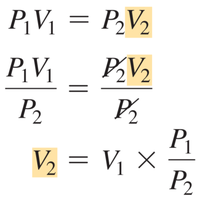
Boyle’s law states that the pressure of a gas is inversely related to its volume when temperature and amount of gas are constant. As pressure increases, volume decreases, and vice versa.
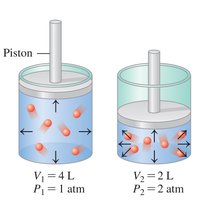
The mathematical expression is:
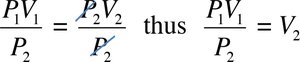
Example: Calculating Volume When Pressure Changes
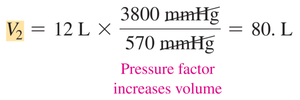
Given a 12-L tank at 3800 mm Hg, what volume will the gas occupy at 570 mm Hg?
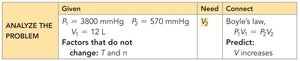
Applications in Health: Breathing Mechanism
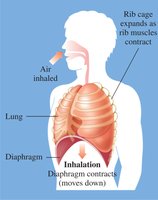
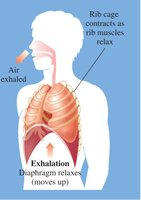
During inhalation, lung volume increases and pressure decreases, causing air to flow in. During exhalation, lung volume decreases and pressure increases, causing air to flow out.
Charles’s Law: Temperature and Volume
Charles’s law states that the volume of a gas is directly proportional to its Kelvin temperature when pressure and amount of gas are constant. As temperature increases, volume increases.
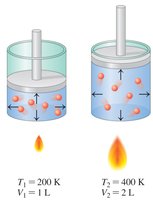
The mathematical expression is:
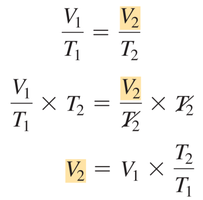
Example: Calculating Volume When Temperature Changes
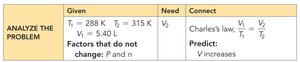
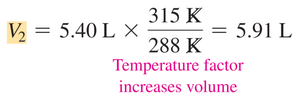
Given 5.40 L of helium at 15°C (288 K), what is the volume at 42°C (315 K)?
Gay-Lussac’s Law: Temperature and Pressure
Gay-Lussac’s law states that the pressure of a gas is directly proportional to its Kelvin temperature when volume and amount of gas are constant. As temperature increases, pressure increases.
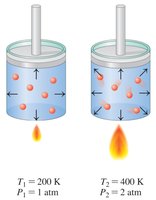
The mathematical expression is:
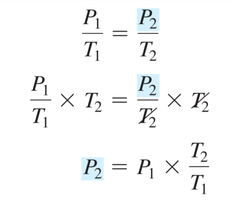
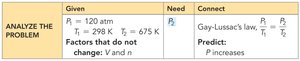
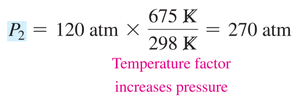
Example: Calculating Pressure When Temperature Changes
If an oxygen tank is at 120 atm and 25°C (298 K), what is the pressure at 402°C (675 K)?
The Combined Gas Law
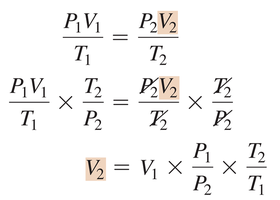
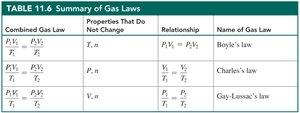
The combined gas law relates pressure, volume, and temperature when the amount of gas is constant. It is useful when two or more properties change simultaneously.

Example: Using the Combined Gas Law
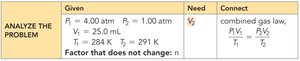
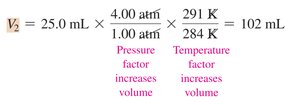
A 25.0-mL bubble at 4.00 atm and 11°C (284 K) is released. What is its volume at 1.00 atm and 18°C (291 K)?
Summary Table of Gas Laws
Avogadro’s Law: Volume and Moles
Avogadro’s law states that the volume of a gas is directly proportional to the number of moles of gas when temperature and pressure are constant. Doubling the number of moles doubles the volume.

The mathematical expression is:
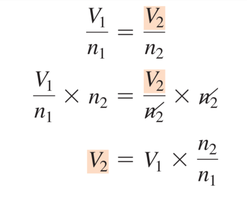
Example: Calculating Volume for a Change in Moles
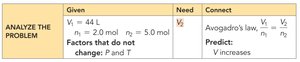
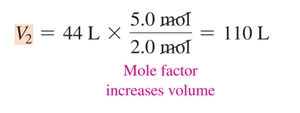
A weather balloon with 44 L and 2.0 mol helium is filled to 5.0 mol. What is the final volume?
The Ideal Gas Law
The ideal gas law combines all the properties of gases into a single equation: . It allows calculation of any one property if the other three are known. The gas constant R is 0.0821 L·atm/(mol·K).

Example: Using the Ideal Gas Law
What is the pressure of 0.350 mol N2O at 22°C in a 5.00-L container?


Dalton’s Law of Partial Pressures
Partial Pressure in Gas Mixtures
Dalton’s law states that the total pressure exerted by a mixture of gases is the sum of the partial pressures of each individual gas. Each gas behaves independently and exerts pressure as if it were alone in the container.
Composition of Air
Air is a mixture of gases, primarily nitrogen (N2), oxygen (O2), carbon dioxide (CO2), argon (Ar), and water vapor (H2O).
Concept Map: Gas Laws
The relationships among the various gas laws can be visualized in a concept map, showing how each law connects pressure, volume, temperature, and amount of gas.
