Back
Chapter 11: Liquids and Intermolecular Forces – Mini-Textbook Study Notes
Study Guide - Smart Notes
 Tailored notes based on your materials, expanded with key definitions, examples, and context.
Liquids and Intermolecular Forces
Introduction to Intermolecular Forces
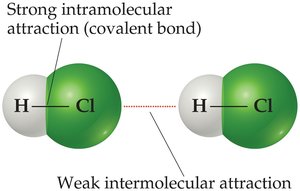
Intermolecular forces are the attractions between molecules, which are generally much weaker than the intramolecular forces (chemical bonds) that hold atoms together within a molecule. These forces are crucial in determining the physical properties of substances, such as boiling points, melting points, viscosity, surface tension, and capillary action.
States of Matter
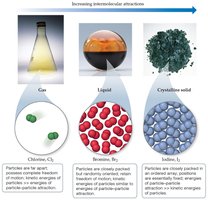
The primary difference between the states of matter (solid, liquid, gas) is the strength of intermolecular forces. Stronger forces bring molecules closer together, while kinetic energy keeps them apart and moving. The average kinetic energy is directly related to temperature.
Solids: Molecules are closely packed and vibrate in place.
Liquids: Molecules are less tightly packed and can move past each other.
Gases: Molecules are far apart and move freely.
Types of Intermolecular Forces
Intermolecular forces vary in strength and type. The main types, from weakest to strongest, are:
Dispersion Forces (London Dispersion): Present in all molecules, especially nonpolar ones.
Dipole–Dipole Forces: Occur between polar molecules.
Hydrogen Bonding: A special, strong dipole–dipole interaction when H is bonded to N, O, or F.
Dispersion and dipole–dipole forces are collectively known as van der Waals forces.
Dispersion Forces
Dispersion forces arise from temporary polarization of electron clouds in atoms or molecules. The tendency of an electron cloud to distort is called polarizability.
More electrons and larger molecular size increase dispersion forces.
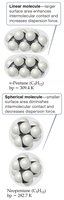
Molecular shape affects dispersion: compact shapes have less dispersion force than elongated shapes.
Polarizability and Boiling Point
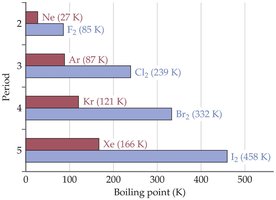
Substances that are easier to polarize (smaller, lighter molecules) have lower boiling points due to weaker intermolecular forces.
Dipole–Dipole Interactions
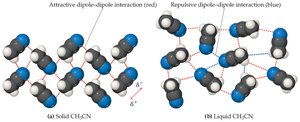
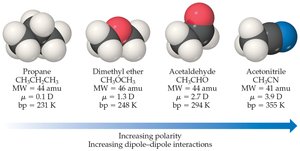
Polar molecules have a positive and a negative end (dipole), and these ends attract each other. For molecules of similar mass and size, greater polarity leads to higher boiling points.
Comparing Dipole–Dipole and Dispersion Forces
For molecules of similar size and shape, dipole–dipole interactions dominate. For molecules with very different sizes, dispersion forces are more significant in determining physical properties.
Trends in Boiling Points
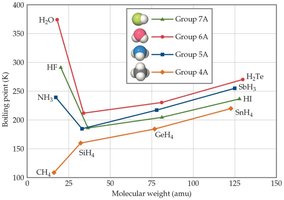
Within a group of elements, boiling points generally increase with molecular size. However, period 2 elements show unique trends due to hydrogen bonding.
Hydrogen Bonding
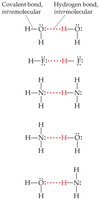
Hydrogen bonds occur when hydrogen is bonded to highly electronegative atoms (N, O, F). These bonds are much stronger than typical dipole–dipole interactions and significantly affect physical properties.
Hydrogen bonds are not true chemical bonds but strong intermolecular attractions.
They arise from the interaction between a nearly bare hydrogen nucleus and a small, electronegative atom.

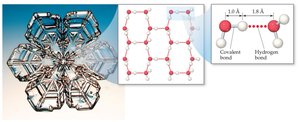
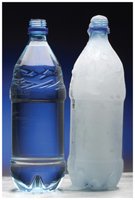
Ice vs. Liquid Water
Hydrogen bonding causes water molecules to be farther apart in ice than in liquid water, resulting in lower density for ice.
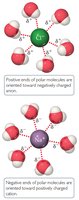
Ion–Dipole Interactions
Ion–dipole forces occur in solutions of ions and are responsible for the dissolution of ionic substances in polar solvents like water.
Determining Intermolecular Forces
All chemicals exhibit dispersion forces, but the strongest intermolecular force present dictates the extent of molecular attraction.
Generalizations about Intermolecular Force Strength
Comparable molar masses and shapes: dispersion forces are roughly equal.
Very different molar masses and no H-bonding: dispersion force determines stronger attractions.
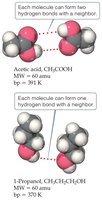
Liquid Properties Affected by Intermolecular Forces
Boiling Point and Melting Point
Both boiling and melting points are influenced by the strength of intermolecular forces. Stronger forces result in higher boiling and melting points.
Viscosity
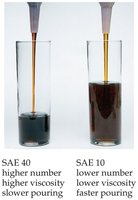
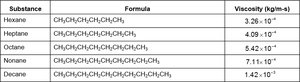
Viscosity is the resistance of a liquid to flow. It increases with stronger intermolecular forces and decreases with higher temperature.
Substance | Formula | Viscosity (kg/m·s) |
|---|---|---|
Hexane | CH3(CH2)4CH3 | 3.26 × 10⁻⁴ |
Heptane | CH3(CH2)5CH3 | 4.09 × 10⁻⁴ |
Octane | CH3(CH2)6CH3 | 5.42 × 10⁻⁴ |
Nonane | CH3(CH2)7CH3 | 7.11 × 10⁻⁴ |
Decane | CH3(CH2)8CH3 | 1.42 × 10⁻³ |
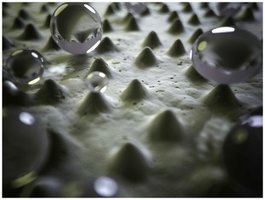
Surface Tension
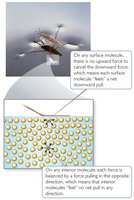
Surface tension is the inward force experienced by molecules at the surface of a liquid, causing phenomena like water beading on nonpolar surfaces.
Cohesion and Adhesion
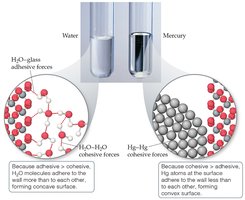
Cohesive forces bind similar molecules together, while adhesive forces bind a substance to a surface. These forces are important in capillary action.
Capillary Action
Capillary action is the rise of liquids in narrow tubes, driven by adhesive and cohesive forces. Water has stronger adhesive forces with glass, while mercury has stronger cohesive forces with itself.
Phase Changes and Energy
Phase Changes
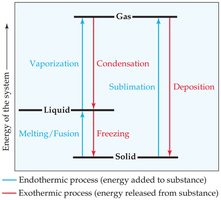
Phase changes involve the conversion between solid, liquid, and gas states. Energy is either absorbed or released during these changes.
Melting/Freezing
Vaporizing/Condensing
Subliming/Depositing
Energy Change and Change of State
The energy required for phase changes is defined as:
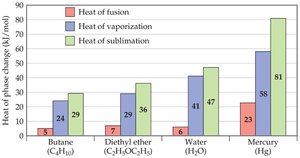
Heat of fusion: Energy to change a solid to a liquid at its melting point.
Heat of vaporization: Energy to change a liquid to a gas at its boiling point.
Heat of sublimation: Energy to change a solid directly to a gas.
Heating Curves
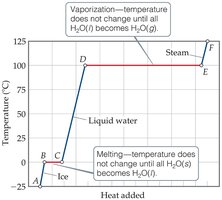
A heating curve is a graph of temperature versus heat added. During phase changes, temperature remains constant while heat is absorbed or released.
Within a phase:
During phase change: or
Supercritical Fluids
Critical Temperature and Pressure
Gases liquefy under pressure, but above a certain temperature (critical temperature), they cannot be compressed into a liquid. The state beyond this temperature and pressure is called a supercritical fluid.
Vapor Pressure
Vapor Pressure and Dynamic Equilibrium
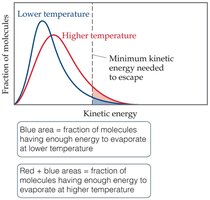
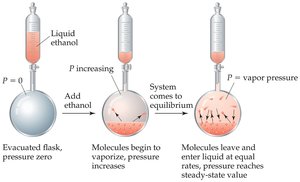
At any temperature, some liquid molecules have enough energy to escape into the gas phase. As temperature increases, more molecules can escape, increasing vapor pressure. Eventually, a dynamic equilibrium is reached where evaporation and condensation occur at equal rates.
Boiling Point and Vapor Pressure
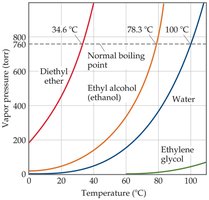
The boiling point is the temperature at which vapor pressure equals atmospheric pressure. The normal boiling point is defined at 760 torr.
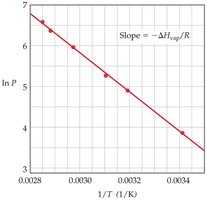
Clausius-Clapeyron Equation
The relationship between vapor pressure and temperature is given by the Clausius-Clapeyron equation:
Phase Diagrams
Phase Diagram Overview
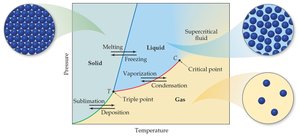
A phase diagram shows the states of matter under different conditions of temperature and pressure, including the triple point and critical point.
Phase Diagram of Water
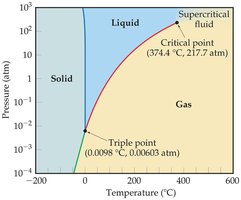
Water has a high critical temperature and pressure due to strong intermolecular forces. The melting curve for water has a negative slope, meaning the melting point decreases as pressure increases.
Phase Diagram of Carbon Dioxide
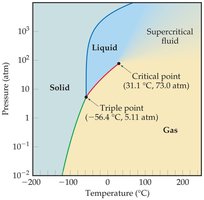
Carbon dioxide cannot exist as a liquid at pressures below its triple point (5.11 atm). It sublimes at normal atmospheric pressure.
Liquid Crystals
Intermediate States
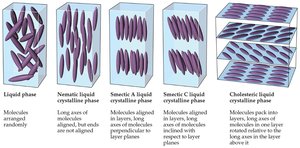
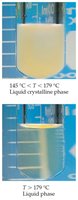
Some substances exhibit an intermediate state between solid and liquid, known as liquid crystals. These materials have some degree of molecular order.
Types of Liquid Crystals
Liquid crystals are classified based on their molecular order:
Nematic: Molecules are ordered in one dimension, along the long axis.
Smectic: Molecules are ordered in two dimensions, along the long axis and in layers.
Cholesteric: Nematic-like crystals are layered at angles to each other.