Back
BackChapter 11: Liquids, Solids, and Intermolecular Forces – Study Notes
Study Guide - Smart Notes
 Tailored notes based on your materials, expanded with key definitions, examples, and context.
Liquids, Solids, and Intermolecular Forces
Introduction to States of Matter
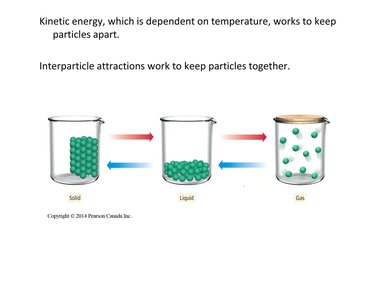
The physical state of a substance—solid, liquid, or gas—is determined by the balance between the kinetic energy of its particles and the strength of the intermolecular forces acting between them. Kinetic energy, which increases with temperature, tends to keep particles apart, while intermolecular attractions work to keep particles together.
Comparison of Gases, Liquids, and Solids
The three states of matter differ in density, shape, volume, and the strength of intermolecular forces. The following table summarizes these differences:
State | Density | Shape | Volume | Strength of Intermolecular Forces |
|---|---|---|---|---|
Gas | Low | Indefinite | Indefinite | Weak |
Liquid | Medium | Indefinite | Definite | Moderate |
Solid | High | Definite | Definite | Strong |
*Additional info: Table inferred from standard chemistry knowledge and slide structure.*
Kinetic Molecular Theory and States of Matter
According to kinetic molecular theory, the state of a substance depends on the balance between the kinetic energy of its particles and the energies of attraction between them. Higher kinetic energy (higher temperature) favors the gaseous state, while stronger intermolecular attractions favor the solid or liquid state.
Intermolecular Forces
Definition and Types
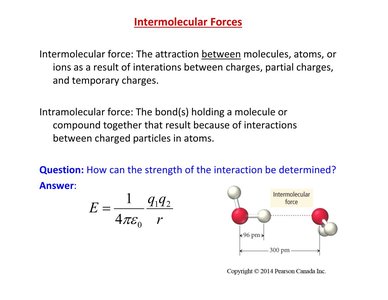
Intermolecular forces are the attractions between molecules, atoms, or ions due to interactions between charges, partial charges, or temporary charges. These are distinct from intramolecular forces, which are the bonds holding atoms together within a molecule.
The strength of an intermolecular interaction can be estimated by the equation:
Properties of Intermolecular Forces
Generally much weaker than ionic or covalent bonds.
The greater the intermolecular forces, the higher the boiling and melting points of a substance.
When a substance melts or boils, intermolecular forces are broken, not intramolecular bonds.
All intermolecular forces are electrostatic in nature, involving attractions between positive and negative species.
Types of Intermolecular Forces
1. Ion-Induced Dipole Forces
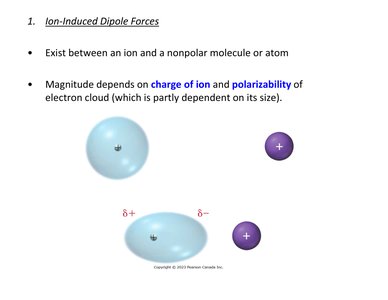
These forces exist between an ion and a nonpolar molecule or atom. The magnitude depends on the charge of the ion and the polarizability of the electron cloud of the nonpolar species.
2. Dispersion Forces (London Forces)
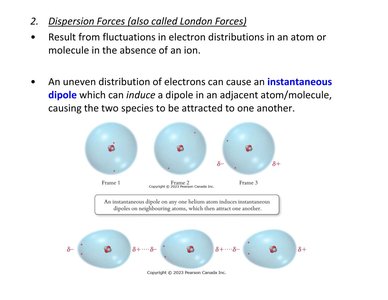
Dispersion forces arise from fluctuations in electron distributions, creating temporary dipoles that induce dipoles in neighboring atoms or molecules. These forces are present in all molecules and atoms, and their strength depends on the polarizability of the electron cloud.
Properties of Dispersion Forces
Present between all molecules/atoms.
Strength increases with the number of electrons (more polarizable).
Greater dispersion forces lead to higher boiling points.
Range from very weak (e.g., helium) to quite strong in large, neutral nonpolar molecules.
Effect of Molecular Shape on Dispersion Forces
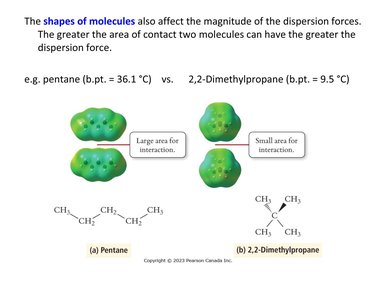
The shape of molecules affects the magnitude of dispersion forces. Molecules with a larger area of contact have stronger dispersion forces.
3. Dipole-Dipole Forces
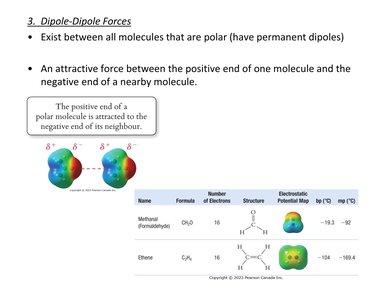
These forces exist between molecules that are polar (have permanent dipoles). The positive end of one molecule is attracted to the negative end of another.
General Rule for Intermolecular Attractions
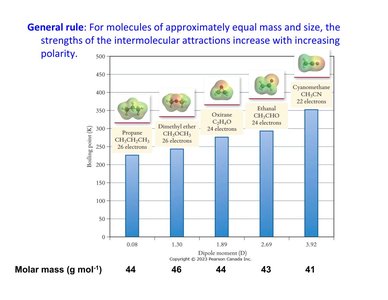
For molecules of similar mass and size, the strength of intermolecular attractions increases with increasing polarity.
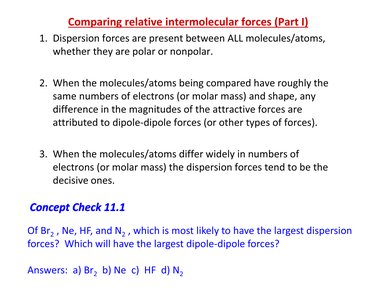
Comparing Relative Intermolecular Forces (Part I)
Dispersion forces are present between all molecules/atoms.
For similar mass and shape, differences in attractive forces are due to dipole-dipole or other forces.
When molecules differ widely in electron number or mass, dispersion forces dominate.
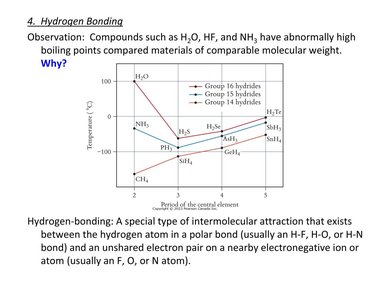
4. Hydrogen Bonding
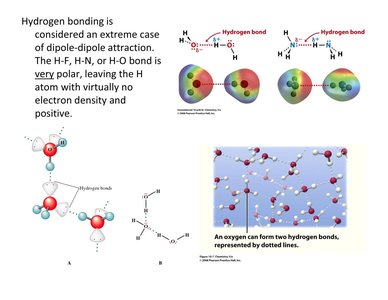
Hydrogen bonding is a special, strong type of dipole-dipole attraction that occurs when hydrogen is bonded to a highly electronegative atom (F, O, or N). Compounds like H2O, HF, and NH3 have abnormally high boiling points due to hydrogen bonding.
Comparing Intermolecular Forces (Part II)
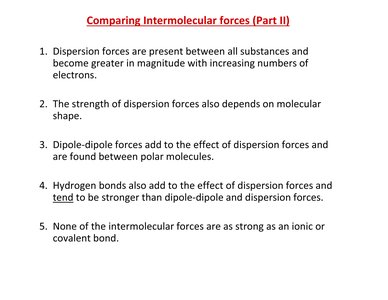
Dispersion forces are present in all substances and increase with more electrons.
Strength of dispersion forces also depends on molecular shape.
Dipole-dipole and hydrogen bonds add to dispersion forces in polar molecules.
Hydrogen bonds are generally stronger than dipole-dipole and dispersion forces.
No intermolecular force is as strong as an ionic or covalent bond.
5. Dipole-Induced Dipole Forces
These forces exist between a molecule with a permanent dipole and a nonpolar molecule. The strength depends on the polarity of the dipole and the polarizability of the nonpolar species.
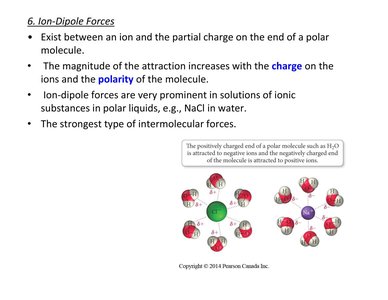
6. Ion-Dipole Forces
Ion-dipole forces occur between an ion and the partial charge on a polar molecule. The strength increases with the charge on the ion and the polarity of the molecule. These forces are especially important in solutions of ionic substances in polar liquids (e.g., NaCl in water) and are the strongest type of intermolecular force.
Comparison of Bonding and Nonbonding (Intermolecular) Forces
Force | Strength (kJ/mol) | Characteristics |
|---|---|---|
Ion-dipole | Moderate (10–50) | Occurs between ions and polar molecules |
Dipole-dipole | Weak (3–4) | Occurs between polar molecules |
London dispersion | Weak (1–10) | Occurs between all molecules, especially significant in large, nonpolar molecules |
Hydrogen bond | Moderate (10–40) | Occurs between molecules with O–H, N–H, and F–H bonds |
*Additional info: Table adapted from standard chemistry references and slide content.*
Properties of Liquids: Vapor Pressure and Phase Changes
Vapor Pressure
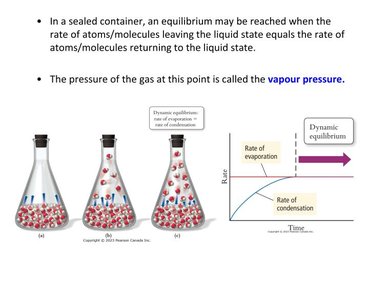
Vapor pressure is the pressure exerted by a vapor in equilibrium with its liquid (or solid) phase at a given temperature. Molecules at the surface of a liquid with enough kinetic energy can escape into the gas phase. As more molecules enter the gas phase, some return to the liquid, establishing a dynamic equilibrium.
Volatility, Vapor Pressure, and Temperature
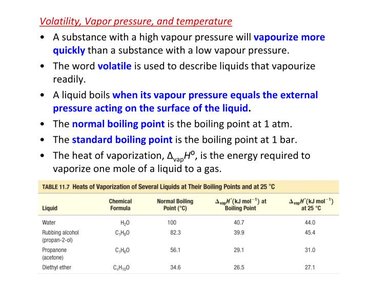
A substance with high vapor pressure vaporizes more quickly (is more volatile).
A liquid boils when its vapor pressure equals the external pressure.
The normal boiling point is at 1 atm; the standard boiling point is at 1 bar.
The heat of vaporization () is the energy required to vaporize one mole of liquid to gas.
Liquid | Chemical Formula | Normal Boiling Point (°C) | Standard Boiling Point (°C) | (kJ/mol) |
|---|---|---|---|---|
Water | H2O | 100.0 | 99.97 | 40.7 |
Rubbing alcohol | C3H8O | 82.1 | 80.7 | 45.4 |
Acetone | C3H6O | 56.1 | 56.0 | 29.1 |
Diethyl ether | C4H10O | 34.6 | 34.5 | 27.1 |
*Additional info: Table values inferred from slide and standard data.*
Clausius-Clapeyron Equation
The Clausius-Clapeyron equation relates the vapor pressure of a liquid to its temperature:
Where:
= pressure (any units)
= 8.314 J mol−1 K−1
= temperature (K)
= enthalpy of vaporization (J mol−1)
Relating Vapor Pressure to Temperature
The relationship between vapor pressure and temperature can be expressed as:
A plot of versus yields a straight line, allowing determination of from the slope.
Phase Changes
Phase changes are transformations between solid, liquid, and gas states, accompanied by changes in energy. Common phase changes include:
Fusion (melting): Solid to liquid (, )
Freezing: Liquid to solid (, )
Vaporization: Liquid to gas (, )
Condensation: Gas to liquid (, )
Sublimation: Solid to gas (, )
Deposition: Gas to solid (, )