 Back
BackChapter 12: Chemical Kinetics – Study Notes
Study Guide - Smart Notes
 Tailored notes based on your materials, expanded with key definitions, examples, and context.
Chemical Kinetics
Introduction to Chemical Kinetics
Chemical kinetics is the study of the rates at which chemical reactions occur and the mechanisms by which they proceed. Understanding kinetics is essential for controlling reactions in industrial synthesis, drug action, and biological systems.
Reaction rate: The change in concentration of a reactant or product per unit time.
Reaction mechanism: The sequence of elementary steps that make up the overall reaction.
Reaction Rates
Definition and Units
The rate of a chemical reaction is measured as the change in concentration (usually in molarity, M) over time (seconds, s):
For reactants: concentration decreases with time.
For products: concentration increases with time.
Units: M/s (mol/L·s).
Rates are always expressed as positive values.
Coefficients and Relative Rates
The rates at which reactants are consumed and products are formed are related by the stoichiometric coefficients in the balanced equation. For example:
For the reaction:
The rate of disappearance of O2 is five times that of C3H8.
Rate Laws
Introduction to Rate Laws
A rate law expresses the relationship between the reaction rate and the concentrations of reactants. For a general reaction:
Rate law:
k = rate constant; m and n = reaction orders (determined experimentally).
Determining Rate Laws: Method of Initial Rates
The method of initial rates involves measuring the initial rate of reaction for different initial concentrations of reactants. By comparing how the rate changes as concentrations are varied, the reaction order with respect to each reactant can be determined.
Experiment | Initial Concentration of NH4+ | Initial Concentration of NO2- | Initial Rate (mol/L·s) |
|---|---|---|---|
1 | 0.100 M | 0.0050 M | 1.35 × 10⁻⁷ |
2 | 0.100 M | 0.010 M | 2.70 × 10⁻⁷ |
3 | 0.200 M | 0.010 M | 5.40 × 10⁻⁷ |
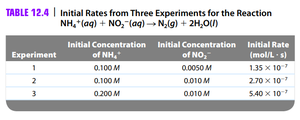
By comparing experiments where only one reactant concentration changes, the order with respect to each reactant can be deduced.
Integrated Rate Laws
Zero-Order, First-Order, and Second-Order Reactions
The integrated rate law relates reactant concentration to time. The form depends on the reaction order:
Zero-order: (linear plot of [A] vs. t)
First-order: or (linear plot of ln[A] vs. t)
Second-order: (linear plot of 1/[A] vs. t)
Zero-Order Kinetics
In zero-order reactions, the rate is independent of reactant concentration. The plot of [A] versus time is a straight line with a negative slope equal to –k.
![Zero-order reaction: [A] vs time plot](https://static.studychannel.pearsonprd.tech/study_guide_files/general-chemistry/sub_images/593caec5_image_2.png)
First-Order Kinetics
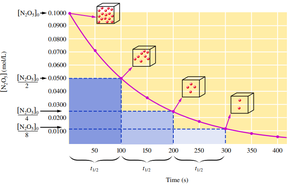
For first-order reactions, a plot of ln[A] versus time yields a straight line. The half-life is independent of the initial concentration.
![First-order reaction: ln[N2O5] vs time plot and data](https://static.studychannel.pearsonprd.tech/study_guide_files/general-chemistry/sub_images/593caec5_image_3.png)
Second-Order Kinetics
For second-order reactions, a plot of 1/[A] versus time is linear. The half-life depends on the initial concentration.
Graphical Determination of Reaction Order
If [A] vs. time is linear: zero-order.
If ln[A] vs. time is linear: first-order.
If 1/[A] vs. time is linear: second-order.
Reaction Mechanisms
Elementary Steps and Molecularity
A reaction mechanism is a sequence of elementary steps. Each step can be classified by its molecularity:
Unimolecular: Involves one molecule.
Bimolecular: Involves two molecules.
Termolecular: Involves three molecules (rare).
The rate-determining step is the slowest step, controlling the overall reaction rate.
Requirements for a Valid Mechanism
The sum of elementary steps must yield the overall balanced equation.
The mechanism must be consistent with the experimentally determined rate law.
The Collision Model and Activation Energy
Collision Theory
For a reaction to occur, molecules must collide with sufficient energy and proper orientation. The minimum energy required is the activation energy (Ea).
Only collisions with energy ≥ Ea are effective.
The fraction of effective collisions increases with temperature.
The Arrhenius Equation
The Arrhenius equation relates the rate constant to temperature and activation energy:
Linearized:
A plot of ln(k) versus 1/T yields a straight line with slope –Ea/R.
Catalysts
Role and Types of Catalysts
A catalyst increases the rate of a reaction by lowering the activation energy, without being consumed. Catalysts can be:
Homogeneous: Same phase as reactants.
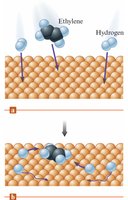
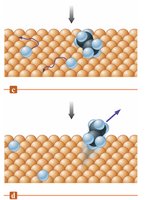
Heterogeneous: Different phase from reactants (often solid catalyst with gaseous or liquid reactants).
Heterogeneous Catalysis
Involves adsorption of reactants on the surface of a solid catalyst, reaction, and desorption of products.
Homogeneous Catalysis
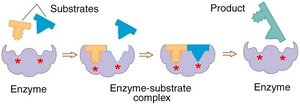
The catalyst and reactants are in the same phase, often in solution. Enzymes are biological catalysts that operate via this mechanism.
Summary Table: Kinetics for Zero, First, and Second Order Reactions
Order | Rate Law | Integrated Rate Law | Plot for Straight Line | Half-life Expression |
|---|---|---|---|---|
Zero | [A] vs t | |||
First | ln[A] vs t | |||
Second | 1/[A] vs t |
