 Back
BackChapter 13: Properties of Solutions – General Chemistry Study Notes
Study Guide - Smart Notes
 Tailored notes based on your materials, expanded with key definitions, examples, and context.
Properties of Solutions
Introduction to Solutions
Solutions are homogeneous mixtures composed of two or more pure substances. In a solution, the solute is uniformly dispersed throughout the solvent. The formation of solutions depends on the natural tendency toward mixing and the nature of intermolecular forces.
Solute: The substance dissolved in the solvent.
Solvent: The substance present in the greatest amount, which dissolves the solute.
Homogeneous mixture: Uniform composition throughout.
Natural Tendency Toward Mixing and Entropy Mixing of gases is a spontaneous process that increases the randomness (entropy) of the system. The tendency toward greater entropy favors the formation of solutions.
Entropy (S): A thermodynamic quantity representing the degree of disorder or randomness in a system.
Mixing increases entropy, making solution formation more likely.
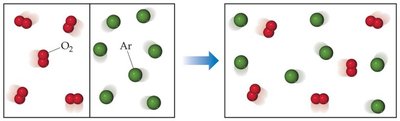
Intermolecular Forces in Solution Formation
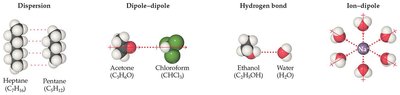
Intermolecular forces play a crucial role in the formation of solutions. The types of forces include dispersion, dipole-dipole, hydrogen bonding, and ion-dipole interactions.
Solute–solute interactions: Must be overcome to disperse solute particles.
Solvent–solvent interactions: Must be overcome to make room for solute particles.
Solvent–solute interactions: Occur as particles mix, stabilizing the solution.
Solvation and Hydration
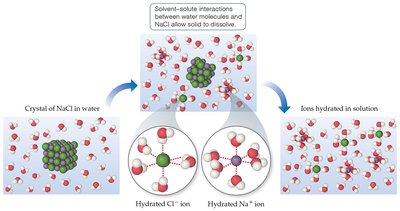
Solvation is the process by which solvent molecules surround and interact with solute ions or molecules. When water is the solvent, this process is called hydration.
Solvent molecules stabilize ions in solution by surrounding them.
Hydration is especially important for ionic compounds in water.
Energetics of Solution Formation
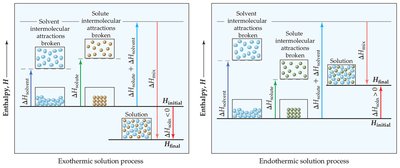
The formation of a solution involves changes in enthalpy (ΔH) and entropy (ΔS). The overall enthalpy change (ΔHsolution) is the sum of the energies required to separate solute and solvent particles and the energy released when solute and solvent interact.
Exothermic process: ΔHsolution < 0; solution formation releases heat and is usually spontaneous.
Endothermic process: ΔHsolution > 0; solution formation absorbs heat, but may still be spontaneous if entropy increases sufficiently.
Aqueous Solution Versus Chemical Reaction
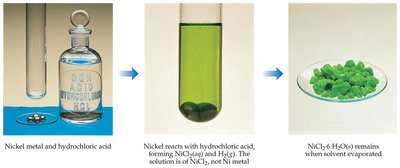
Not all substances that disappear in a solvent are simply dissolving; some may undergo a chemical reaction with the solvent.
Example: Nickel metal reacts with hydrochloric acid to form NiCl2(aq) and H2(g), not just a physical dissolution.
Solubility and Types of Solutions
Opposing Processes: Dissolution and Crystallization
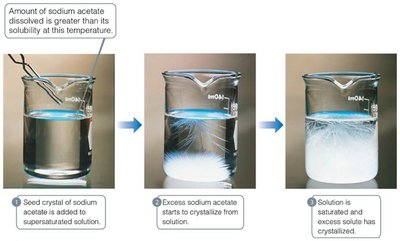
Dissolution and crystallization are opposing processes. When their rates are equal, the solution is saturated. If less solute is present than the maximum, the solution is unsaturated.
Saturated solution: Contains the maximum amount of solute at a given temperature.
Unsaturated solution: Contains less solute than the maximum possible.
Supersaturated Solutions
A supersaturated solution contains more solute than is normally possible at a given temperature. These solutions are unstable and can crystallize rapidly if disturbed.
Crystallization can be triggered by adding a seed crystal or scratching the container.
Factors Affecting Solubility
Solubility is influenced by solute–solvent interactions, pressure (for gases), and temperature.
Solute–solvent interactions: "Like dissolves like"—polar solutes dissolve in polar solvents, nonpolar in nonpolar.
Pressure: Affects solubility of gases only.
Temperature: Affects solubility of both solids and gases, but in different ways.
Solute–Solvent Interactions and Examples
The stronger the interaction between solute and solvent, the greater the solubility. For gases, larger molecules with greater dispersion forces are more soluble in water.
Gas | Molar Mass (g/mol) | Solubility (M) |
|---|---|---|
N2 | 28.0 | 0.69 × 10⁻³ |
O2 | 32.0 | 1.38 × 10⁻³ |
Ar | 39.9 | 1.50 × 10⁻³ |
Kr | 83.8 | 2.79 × 10⁻³ |
Organic Molecules in Water
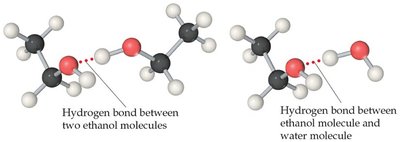
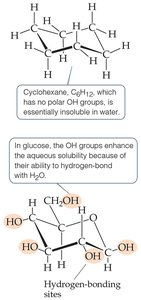
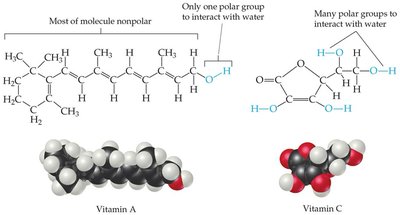
Polar organic molecules dissolve better in water than nonpolar ones. Hydrogen bonding increases solubility, as C–C and C–H bonds are not very polar.
Liquid/Liquid Solubility
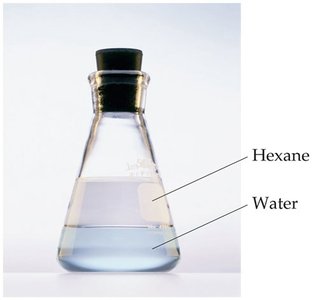
Liquids that mix in all proportions are miscible. Liquids that do not mix are immiscible. For example, hexane (nonpolar) and water (polar) are immiscible.
Solubility and Biological Importance
Fat-soluble vitamins (e.g., vitamin A) are nonpolar and stored in fatty tissue. Water-soluble vitamins (e.g., vitamin C) must be consumed regularly as they are not stored in the body.
Effects of Pressure and Temperature on Solubility
Pressure Effects
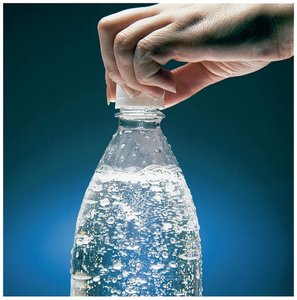
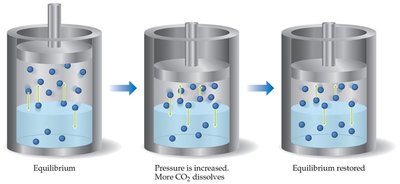
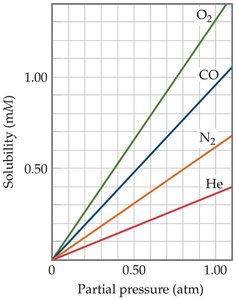
Pressure has little effect on the solubility of solids and liquids, but greatly affects gases. Increasing the pressure of a gas above a solution increases its solubility.
Henry’s Law
The solubility of a gas in a liquid is proportional to the partial pressure of the gas above the solution:
Henry's Law:
Where is the solubility, is the Henry's law constant, and is the partial pressure of the gas.
Temperature Effects
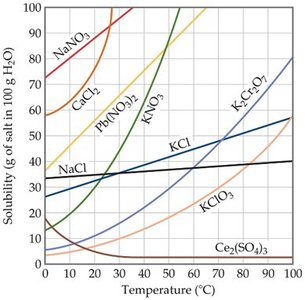
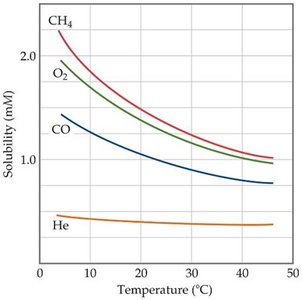
For most solids, solubility increases with temperature, but not always. For all gases, solubility decreases as temperature increases.
Cold water holds more dissolved oxygen than warm water.
Concentration Units
Common Units of Concentration
Mass percentage:
Parts per million (ppm):
Parts per billion (ppb):
Mole fraction (χ):
Molarity (M):
Molality (m):
Molarity vs. Molality
Molarity depends on volume and changes with temperature, while molality depends on mass and does not change with temperature. For dilute aqueous solutions, values are similar.
Converting Units
To convert between molarity and molality, the density of the solution is required. Use dimensional analysis for all conversions.
Colligative Properties
Definition and Types
Colligative properties depend only on the number of solute particles, not their identity. Major colligative properties include:
Vapor-pressure lowering
Boiling-point elevation
Freezing-point depression
Osmotic pressure
Vapor Pressure Lowering
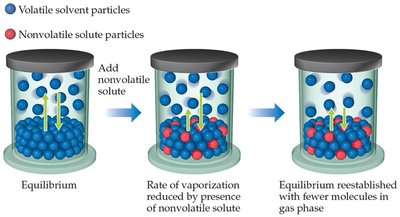
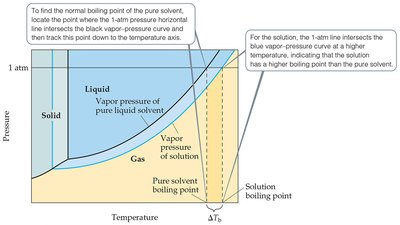
Adding a nonvolatile solute to a solvent lowers the solvent's vapor pressure due to solute–solvent interactions.
Raoult’s Law
Raoult’s Law quantifies vapor pressure lowering:
Where is the vapor pressure of the solution, is the mole fraction of the solvent, and is the vapor pressure of the pure solvent.
Boiling-Point Elevation
Since vapor pressure is lowered, a higher temperature is required to reach atmospheric pressure, raising the boiling point of the solution.
Freezing-Point Depression
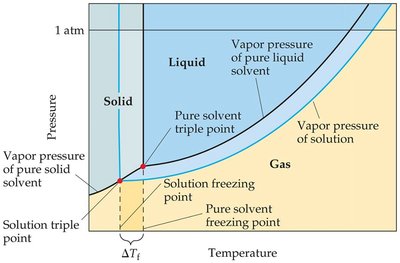
The freezing point of a solution is lower than that of the pure solvent. This is also a result of vapor pressure lowering.
Quantitative Relationships for Boiling-Point Elevation and Freezing-Point Depression
Where is the van’t Hoff factor (number of particles the solute forms in solution), and are the boiling-point elevation and freezing-point depression constants, and is the molality.
Solvent | Normal Boiling Point (°C) | Kb (°C/m) | Normal Freezing Point (°C) | Kf (°C/m) |
|---|---|---|---|---|
Water (H2O) | 100.0 | 0.51 | 0.0 | 1.86 |
Benzene (C6H6) | 80.1 | 2.53 | 5.5 | 5.12 |
Ethanol (C2H5OH) | 78.4 | 1.22 | −114.6 | 1.99 |
Carbon tetrachloride (CCl4) | 76.8 | 5.02 | −22.3 | 29.8 |
Chloroform (CHCl3) | 61.2 | 3.63 | −63.5 | 4.68 |
Osmosis and Osmotic Pressure
Osmosis
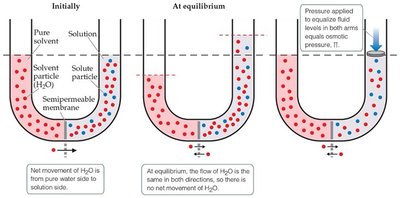
Osmosis is the movement of solvent molecules through a semipermeable membrane from a region of low solute concentration to high solute concentration. The pressure required to stop this flow is the osmotic pressure.
Osmotic Pressure Equation
Where is the osmotic pressure, is the van’t Hoff factor, is molarity, is the gas constant, and is temperature in Kelvin.
Types of Solutions and Osmosis
Isotonic: Same osmotic pressure; no net movement of solvent.
Hypotonic: Lower osmotic pressure; solvent leaves this solution.
Hypertonic: Higher osmotic pressure; solvent enters this solution.
Osmosis and Blood Cells
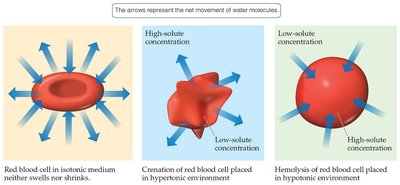
Red blood cells have semipermeable membranes. In hypertonic solutions, they shrink (crenation); in hypotonic solutions, they swell and may burst (hemolysis). IV solutions must be isotonic to blood.
Colloids
Definition and Types
Colloids are mixtures with particles larger than individual ions or molecules but too small to settle out by gravity. They form the dividing line between solutions and suspensions.
Phase of Colloid | Dispersing Substance | Dispersed Substance | Colloid Type | Example |
|---|---|---|---|---|
Gas | Gas | — | None (all are solutions) | — |
Gas | Liquid | Aerosol | Fog | |
Gas | Solid | Aerosol | Smoke | |
Liquid | Gas | Foam | Whipped cream | |
Liquid | Liquid | Emulsion | Milk | |
Liquid | Solid | Sol | Paint | |
Solid | Gas | Solid foam | Marshmallow | |
Solid | Liquid | Solid emulsion | Butter | |
Solid | Solid | Solid sol | Ruby glass |
Tyndall Effect
Colloidal suspensions scatter light, a phenomenon known as the Tyndall effect. Solutions do not scatter light in this way.
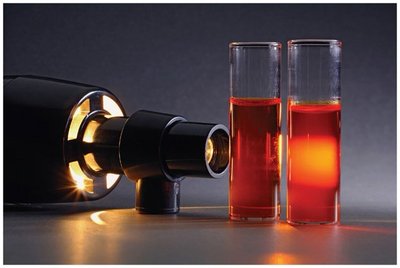
Colloids and Biomolecules
Many biomolecules have both hydrophilic (water-loving) and hydrophobic (water-fearing) regions. In water, hydrophilic portions face outward, stabilizing the colloid.
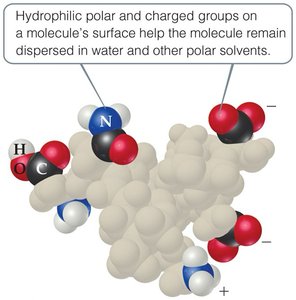
Stabilizing Colloids by Adsorption
Ions can adsorb onto the surface of hydrophobic colloids, allowing them to interact with water and remain dispersed.
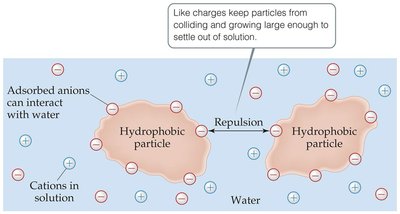
Colloids in Biological Systems
Colloids help emulsify fats and oils in aqueous solutions. An emulsifier enables substances that normally do not dissolve in a solvent to do so.
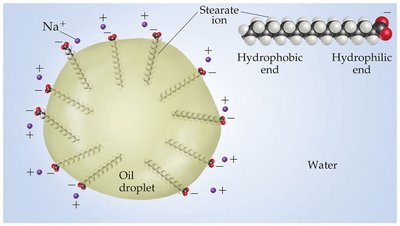
Brownian Motion
Colloidal particles exhibit Brownian motion due to collisions with much smaller solvent molecules. This motion helps keep colloidal particles suspended.
Radius of Sphere (nm) | Mean Free Path (mm) |
|---|---|
1 | 1.23 |
10 | 0.390 |
100 | 0.123 |
1000 | 0.039 |
Additional info: These notes cover all major aspects of solution properties, including types of solutions, factors affecting solubility, colligative properties, and the nature and behavior of colloids, as relevant to a General Chemistry curriculum.
