 Back
BackChapter 13: Solids and Modern Materials – Study Guide
Study Guide - Smart Notes
 Tailored notes based on your materials, expanded with key definitions, examples, and context.
Solids and Modern Materials
Graphene
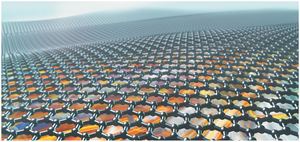
Graphene is a revolutionary material in modern chemistry, known for its unique properties and potential applications. It consists of a single layer of carbon atoms arranged in a hexagonal lattice.
Thinnest and Strongest Material: Only one atom thick, yet about 100 times stronger than steel.
Conductivity: Excellent conductor of heat and electricity; can be fully charged within seconds.
Transparency and Impermeability: Transparent and impermeable to all substances.
Applications: Used in faster computers, foldable touchscreens, ultrathin light panels, and super-strong bulletproof vests.
X-Ray Crystallography
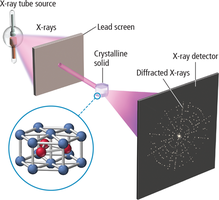
X-ray crystallography is a powerful technique used to determine the arrangement of atoms within a crystal. It relies on the diffraction of X-rays by the electrons in the crystal lattice.
Principle: X-rays are directed at a crystalline solid, and the scattered rays are detected to reveal atomic positions.
Medical X-Ray vs. Crystallography: Medical X-rays focus on absorbed rays, while crystallography focuses on scattered rays.
Applications: Used to solve crystal structures of minerals, metals, and biological molecules.
Unit Cells and Basic Structures
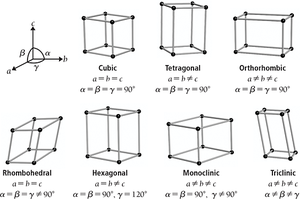
The arrangement of atoms in a crystal is described by unit cells, which are the smallest repeating units. Unit cells are classified by their symmetry and geometry.
Types of Unit Cells: Cubic, tetragonal, orthorhombic, rhombohedral, hexagonal, monoclinic, triclinic.
Coordination Number: The number of nearest neighbors each atom/ion has; varies with unit cell type.
Cubic Lattices: Simple cubic, body-centered cubic, and face-centered cubic.
Cubic Unit Cell Comparison
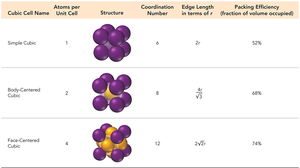
Cubic unit cells differ in the number of atoms per cell, coordination number, edge length, and packing efficiency.
Cubic Cell Name | Atoms per Unit Cell | Structure | Coordination Number | Edge Length (in terms of r) | Packing Efficiency |
|---|---|---|---|---|---|
Simple Cubic | 1 | Sphere arrangement | 6 | 2r | 52% |
Body-Centered Cubic | 2 | Sphere arrangement | 8 | 68% | |
Face-Centered Cubic | 4 | Sphere arrangement | 12 | 74% |
Face-Centered Cubic Structure
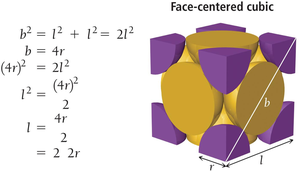
The face-centered cubic (FCC) unit cell is highly efficient in packing atoms. The relationship between edge length and atomic radius is derived using geometry.
Edge Length Formula:
Coordination Number: 12
Packing Efficiency: 74%
Classifying Crystalline Solids
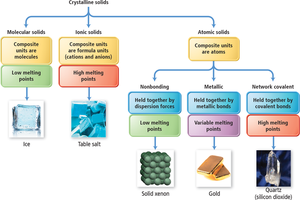
Crystalline solids are classified based on the nature of their constituent particles: molecular, ionic, and atomic solids.
Molecular Solids: Composed of molecules held by intermolecular forces (dispersion, dipole-dipole, hydrogen bonding). Low melting points.
Ionic Solids: Composed of ions held by strong electrostatic forces. High melting points.
Atomic Solids: Composed of atoms. Subtypes include network covalent, metallic, and nonbonding atomic solids.
Molecular Solids
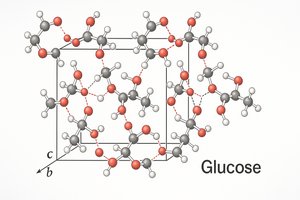
Molecular solids are formed from molecules held together by intermolecular forces. Their properties depend on the strength of these forces.
Examples: CO2, H2O, C6H12O6, C12H22O11
Polymorphism: Some molecular solids crystallize in different forms, affecting their properties (important in pharmaceuticals).
Atomic Solids
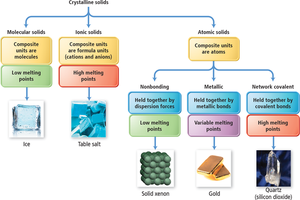
Atomic solids are further divided into network covalent, nonbonding, and metallic types.
Network Covalent: Atoms held by covalent bonds; very high melting points (e.g., graphite, diamond, quartz).
Nonbonding: Held by weak dispersion forces; very low melting points (e.g., solid noble gases).
Metallic: Held by metallic bonding; variable melting points; form closest-packed structures (e.g., gold, nickel).
Additional info:
Unit cell geometry and packing efficiency are critical for understanding material properties.
Polymorphism in molecular solids can lead to different physical properties, which is significant in drug formulation.
Network covalent solids like quartz and diamond are among the hardest and highest melting materials known.
