 Back
BackChapter 13: Solutions and Colligative Properties – Study Notes
Study Guide - Smart Notes
 Tailored notes based on your materials, expanded with key definitions, examples, and context.
Chapter 13: Solutions and Colligative Properties
Solution Terminology
Solutions are homogeneous mixtures composed of a solute dissolved in a solvent. The nature of the solution depends on the amount of solute relative to the solvent and the temperature at which the solution is prepared.
Unsaturated Solution: Contains less solute than the maximum amount that can dissolve at a given temperature.
Saturated Solution: Contains the maximum amount of solute that can dissolve at a given temperature; any additional solute will not dissolve.
Supersaturated Solution: Contains more solute than is present in a saturated solution at the same temperature; usually formed by dissolving solute at high temperature and then cooling.
Concentrated vs. Dilute: A concentrated solution has a relatively large amount of solute, while a dilute solution has a small amount. These terms are relative and depend on context.
Example: Dissolving 1 g, 2000 g, and 4000 g of sugar in 1 L of water at different temperatures demonstrates unsaturated, saturated, and supersaturated solutions, respectively.
Solubility and Miscibility
Solubility is the maximum amount of solute that can dissolve in a solvent at a specific temperature. Miscibility refers to the ability of two liquids to mix in all proportions, forming a homogeneous solution.
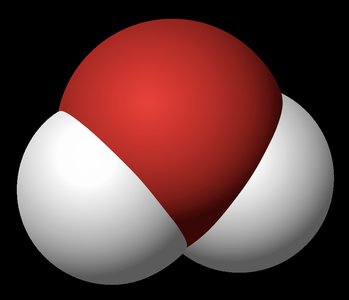
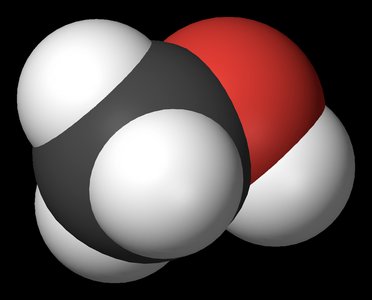
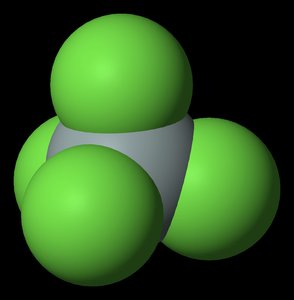
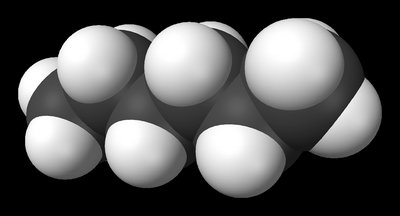
Water is miscible with polar substances (e.g., ethanol, methanol) and immiscible with nonpolar substances (e.g., carbon tetrachloride, hexane).
Concentration Units and Interconversions
Concentration describes the amount of solute present in a given quantity of solvent or solution. Common units include:
Molarity (M):
Molality (m):
Mole Fraction (\(\chi\)):
Density is often used to convert between mass and volume when interconverting concentration units.


Example Calculations
Calculating the molarity of sodium ions in blood, or the molality of sulfuric acid in industrial processes, requires careful use of mass, volume, and density data.


Energetics of Solution Formation
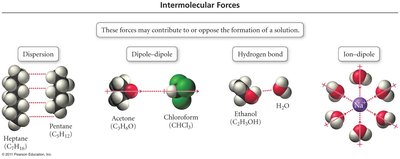
The formation of a solution involves breaking intermolecular forces in both solute and solvent and forming new interactions between solute and solvent particles. The overall energy change (enthalpy of solution) determines whether the process is endothermic or exothermic.
Solvent-solvent interactions (e.g., hydrogen bonding in water)
Solute-solute interactions (e.g., ionic bonds in salts)
Solvent-solute interactions (e.g., ion-dipole interactions)
Temperature and Solubility
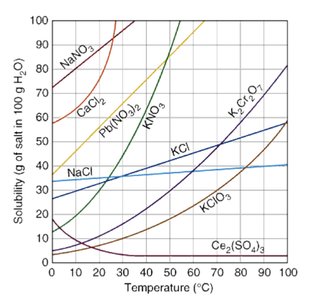
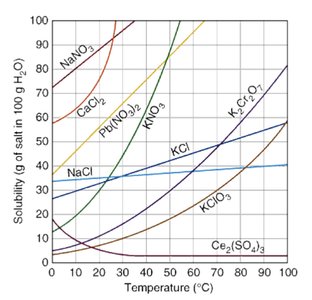
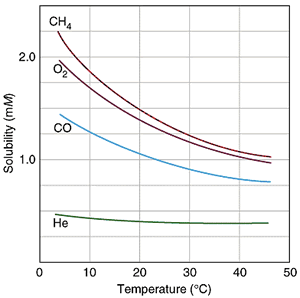
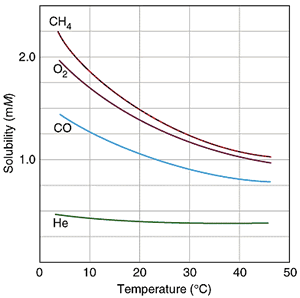
For most solid and liquid solutes, solubility increases with temperature. For gases, solubility decreases as temperature increases.
Henry’s Law
Henry’s Law describes the relationship between the solubility of a gas in a liquid and the partial pressure of that gas above the liquid:
C: Concentration of dissolved gas (mol/L)
k_H: Henry’s Law constant (mol/L·atm)
P: Partial pressure of the gas (atm)
Colligative Properties
Colligative properties depend on the number of solute particles in solution, not their identity. These include vapor pressure lowering, boiling point elevation, freezing point depression, and osmotic pressure.
Vapor Pressure Lowering (Raoult’s Law)
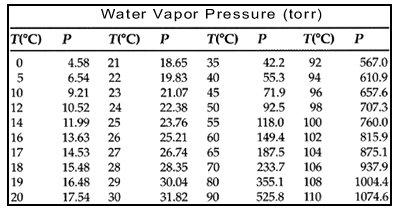
The vapor pressure of a solvent above a solution is lower than that of the pure solvent:
\(\chi_{\text{solvent}}\): Mole fraction of solvent
: Vapor pressure of pure solvent
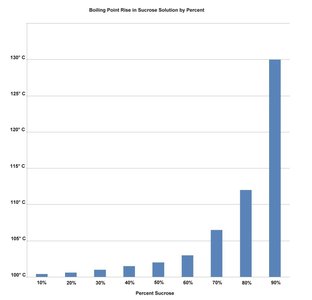
Freezing Point Depression and Boiling Point Elevation
Adding a solute to a solvent lowers the freezing point and raises the boiling point of the solution:
Freezing Point Depression:
Boiling Point Elevation:
For electrolytes: where is the van’t Hoff factor (number of particles the solute dissociates into).



Osmosis and Osmotic Pressure
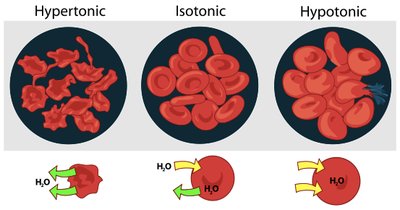
Osmosis is the movement of solvent molecules through a semi-permeable membrane from a region of lower solute concentration to higher solute concentration. Osmotic pressure is the pressure required to stop this flow:
\(\Pi\): Osmotic pressure (atm)
M: Molarity of solute (mol/L)
R: Gas constant (0.0821 L·atm·mol-1·K-1)
T: Temperature (K)
van’t Hoff Factor (i)
The van’t Hoff factor, , accounts for the number of particles a solute produces in solution. For non-electrolytes, . For electrolytes, $i$ equals the number of ions formed per formula unit.
Example: NaCl dissociates into Na+ and Cl-, so .
Summary Table: Colligative Properties and Equations
Property | Equation | Key Variables |
|---|---|---|
Vapor Pressure Lowering | Mole fraction, vapor pressure | |
Boiling Point Elevation | van’t Hoff factor, molality | |
Freezing Point Depression | van’t Hoff factor, molality | |
Osmotic Pressure | van’t Hoff factor, molarity, temperature |
Key Takeaways
Solutions are characterized by their composition, concentration, and the interactions between solute and solvent.
Colligative properties depend on the number of solute particles, not their identity.
Electrolytes affect colligative properties more than non-electrolytes due to dissociation.
Osmosis and osmotic pressure are critical in biological and chemical systems.
