 Back
BackChapter 13: Solutions and Their Properties – General Chemistry Study Notes
Study Guide - Smart Notes
 Tailored notes based on your materials, expanded with key definitions, examples, and context.
Solutions and Their Properties
Antifreeze in Frogs: Biological Application of Solution Chemistry
Wood frogs survive freezing temperatures by entering a suspended, frozen state. Their physiological adaptation involves flooding their blood with glucose, which acts as an antifreeze by lowering the freezing point of their bodily fluids. This is an example of how concentrated solutions can depress the freezing point, a principle central to solution chemistry.
Key Point: High glucose concentration prevents blood from freezing by lowering its freezing point.
Key Point: Most cold-blooded animals cannot survive freezing because ice formation damages cells.
Example: Wood frogs revive vital functions within 1–2 hours of thawing due to this adaptation.
Definition and Types of Solutions
Solutions are homogeneous mixtures composed of a solute (the substance being dissolved) and a solvent (the substance doing the dissolving). The formation of solutions depends on the interaction of intermolecular forces between solute and solvent particles.
Key Point: "Likes dissolve in likes" – polar substances dissolve in polar solvents, nonpolar in nonpolar.
Key Point: Uniform mixing is energetically favorable due to spontaneous mixing.
Common Types of Solutions
Solution Phase | Solute Phase | Solvent Phase | Example |
|---|---|---|---|
Gaseous | Gas | Gas | Air (O2 and N2) |
Liquid | Gas | Liquid | Club soda (CO2 in water) |
Liquid | Liquid | Liquid | Vodka (ethanol and water) |
Liquid | Solid | Liquid | Seawater (salt in water) |
Solid | Solid | Solid | Brass (copper and zinc) |
Solubility and Miscibility
Solubility is the maximum amount of solute that can dissolve in a given amount of solvent. Two liquids that are mutually soluble are called miscible; if not, they are immiscible.
Key Point: Solubility depends on intermolecular forces and varies with temperature and pressure.
Example: Alcohol and water are miscible; oil and water are immiscible.
Effect of Intermolecular Forces on Solution Formation
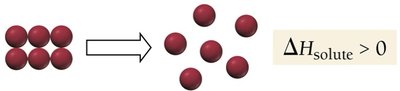
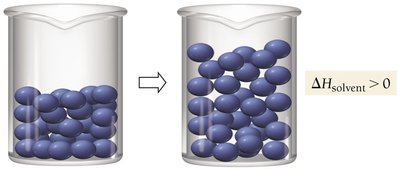
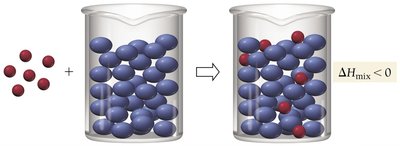
Intermolecular forces such as dispersion, dipole-dipole, hydrogen bonding, and ion-dipole interactions determine whether a solute will dissolve in a solvent. Overcoming solute-solute and solvent-solvent attractions is endothermic, while forming new solute-solvent attractions is exothermic.
Key Point: Both solute-solute and solvent-solvent attractions must be overcome for mixing.
Key Point: New solute-solvent attractions release energy (exothermic).
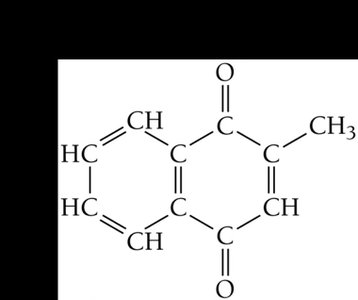
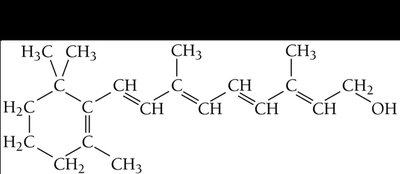
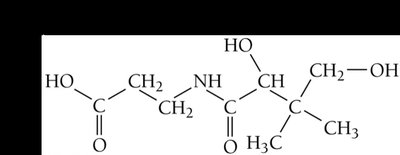
Solubility Classification: Fat-Soluble vs. Water-Soluble Vitamins
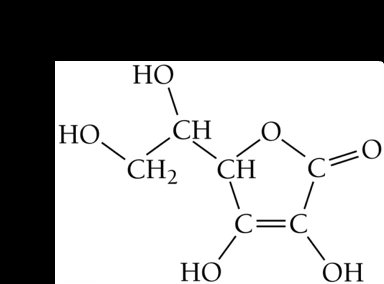
Vitamins are classified based on their solubility in water or fat, which depends on their molecular structure and polarity.
Key Point: Water-soluble vitamins have polar groups (e.g., OH, NH) and can hydrogen bond with water.
Key Point: Fat-soluble vitamins are dominated by nonpolar bonds and accumulate in fatty tissues.
Concentration Units
Molarity (M)
Molarity is a common unit for expressing solution concentration, defined as moles of solute per liter of solution.
Formula:
Example: A 0.500 M NaCl solution contains 0.500 mol NaCl per liter.

Molality (m)
Molality is defined as moles of solute per kilogram of solvent. Unlike molarity, it does not vary with temperature.
Formula:

Mole Fraction (Xa)
Mole fraction is the ratio of moles of one component to the total moles in the solution. It is unitless and the sum of all mole fractions equals 1.
Formula:

Other Concentration Units
Mole Percent: Mole fraction × 100%
Percent by Mass: Parts of solute per 100 parts solution
Parts per Million (ppm): mg solute per kg solution
Parts per Billion (ppb): µg solute per kg solution
Energetics of Solution Formation
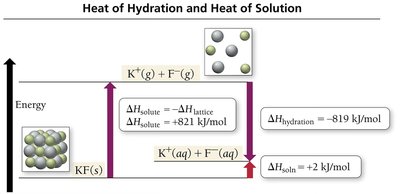
Enthalpy of Solution
The enthalpy change for making a solution () is the sum of the enthalpy changes for separating solute particles, separating solvent particles, and mixing them.
Formula:
Heats of Hydration
For ionic compounds in water, the heat of hydration () combines the energy to overcome water-water attractions and the energy released from ion-water attractions.
Formula:
Solubility Limits and Saturation
Saturated, Unsaturated, and Supersaturated Solutions
A saturated solution contains the maximum solute at equilibrium. Unsaturated solutions can dissolve more solute, while supersaturated solutions contain more solute than equilibrium allows and are unstable.
Key Point: Saturation concentration depends on temperature and pressure.
Temperature Dependence of Solubility
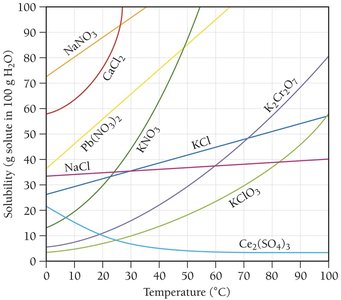
Solubility of solids generally increases with temperature, while solubility of gases decreases with temperature.
Pressure Dependence of Gas Solubility: Henry's Law
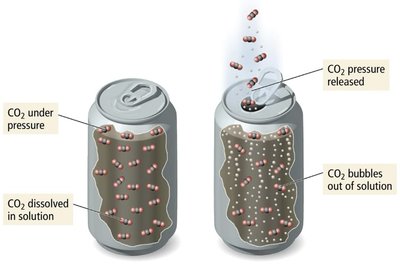
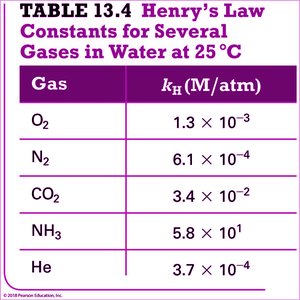
The solubility of a gas in a liquid is directly proportional to its partial pressure above the liquid, described by Henry's Law.
Formula:
Key Point: Each gas has its own Henry's Law constant ().
Colligative Properties of Solutions
Definition and Types
Colligative properties depend only on the number of solute particles, not their identity. These include vapor pressure lowering, freezing point depression, boiling point elevation, and osmotic pressure.
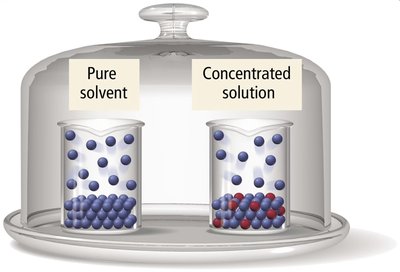
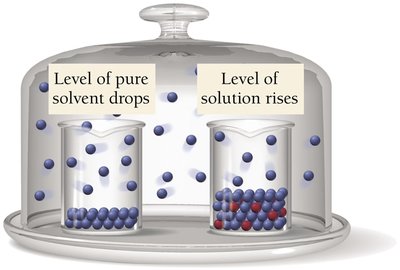
Key Point: Colligative properties arise from solute particles occupying positions of solvent molecules.
Vapor Pressure Lowering: Raoult's Law
The vapor pressure of a solvent above a solution is lower than that of the pure solvent. Raoult's Law relates the vapor pressure of the solvent in solution to its mole fraction.
Formula:
Vapor Pressure Lowering:
Freezing Point Depression and Boiling Point Elevation
Adding solute lowers the freezing point and raises the boiling point of a solvent. The magnitude of these changes depends on the molality of the solution and specific constants for each solvent.
Freezing Point Depression:
Boiling Point Elevation:
Solvent | Normal Freezing Point (℃) | Kf (℃/m) | Normal Boiling Point (℃) | Kb (℃/m) |
|---|---|---|---|---|
Benzene (C6H6) | 5.5 | 5.12 | 80.1 | 2.53 |
Carbon tetrachloride (CCl4) | -22.9 | 29.9 | 76.7 | 5.03 |
Chloroform (CHCl3) | -63.5 | 4.70 | 61.2 | 3.63 |
Ethanol (C2H5OH) | -114.1 | 1.99 | 78.3 | 1.22 |
Diethyl ether (C4H10O) | -116.3 | 1.79 | 34.6 | 2.02 |
Water (H2O) | 0.00 | 1.86 | 100.0 | 0.512 |
Osmosis and Osmotic Pressure
Osmosis is the flow of solvent from a low concentration solution to a high concentration solution through a semipermeable membrane. Osmotic pressure is the pressure required to stop this flow and is proportional to the molarity of solute particles.
Formula:
R: Gas constant,
Van't Hoff Factor (i)
The van't Hoff factor accounts for the number of particles produced by ionic compounds in solution, affecting colligative properties.
Solute | i Expected | i Measured |
|---|---|---|
Nonelectrolyte | 1 | 1 |
NaCl | 2 | 1.9 |
MgSO4 | 2 | 1.3 |
MgCl2 | 3 | 2.7 |
K2SO4 | 3 | 2.6 |
FeCl3 | 4 | 3.4 |
Colligative Properties and Medical Solutions
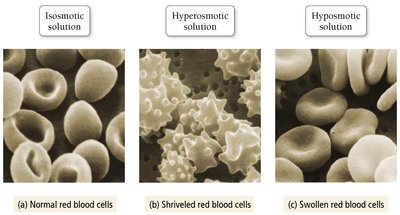
Medical solutions are classified based on their osmotic pressure relative to cells: isosmotic (no net water flow), hyperosmotic (water leaves cell, cell shrivels), and hyposmotic (water enters cell, cell swells).
Reverse Osmosis
Reverse osmosis is a pressure-driven process used to purify water by forcing it through a semipermeable membrane, which blocks most solutes and contaminants.
Key Point: Used in water purification and desalination.
