 Back
BackChapter 13: Solutions – Structure, Properties, and Calculations
Study Guide - Smart Notes
 Tailored notes based on your materials, expanded with key definitions, examples, and context.
Solutions: Homogeneous Mixtures
Definition and Examples
A solution is a homogeneous mixture of two or more substances. The component present in the largest amount is called the solvent, while the other component(s) are called solute(s). Solutions are found in all states of matter and are common in everyday life and laboratory practice.
Solvent: The dissolving medium (majority component).
Solute: The substance dissolved (minority component).
Examples: Salt water (NaCl in H2O), air (O2 and N2), soda (CO2 in H2O).
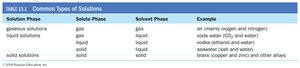
Types of Solutions
Solutions can be classified based on the physical states of their components:
Solution Phase | Solute Phase | Solvent Phase | Example |
|---|---|---|---|
Gaseous | Gas | Gas | Air (O2 in N2) |
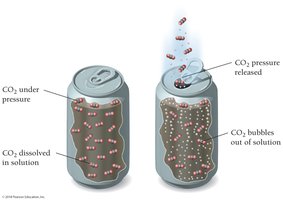
Liquid | Gas | Liquid | Soda (CO2 in H2O) |
Liquid | Solid | Liquid | Seawater (salts in H2O) |
Solid | Solid | Solid | Brass (Zn in Cu) |
Properties of Solutions, Colloids, and Suspensions
Classification and Comparison
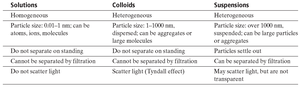
Mixtures can be classified as solutions, colloids, or suspensions based on particle size and behavior:
Solutions | Colloids | Suspensions | |
|---|---|---|---|
Homogeneity | Homogeneous | Heterogeneous | Heterogeneous |
Particle Size | 0.01–1 nm | 1–1000 nm | >1000 nm |
Separation | Do not separate | Do not separate | Settle out |
Filtration | Cannot be filtered | Cannot be filtered | Can be filtered |
Light Scattering | No | Tyndall effect | May scatter |
Solubility: Soluble vs. Insoluble, Miscible vs. Immiscible
Definitions
Soluble: A solute that dissolves in a solvent.
Insoluble: A solute that does not dissolve in a solvent.
Miscible: Two liquids that are infinitely soluble in each other (e.g., water and vinegar).
Immiscible: Two liquids that do not mix (e.g., oil and vinegar).
Polarity and Solubility
Polarity and "Like Dissolves Like"
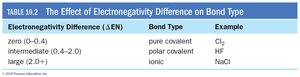
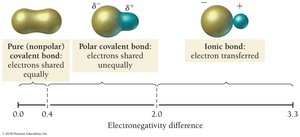
The solubility of substances depends on their polarity. Polar solvents dissolve polar and ionic solutes, while nonpolar solvents dissolve nonpolar solutes. This is summarized by the rule: like dissolves like.
Polar molecules: Unequal sharing of electrons, resulting in dipoles (e.g., water, vinegar).
Nonpolar molecules: Equal sharing of electrons, no dipoles (e.g., oil).
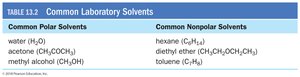
Common Laboratory Solvents
Common Polar Solvents | Common Nonpolar Solvents |
|---|---|
Water (H2O) | Hexane (C6H14) |
Acetone (CH3COCH3) | Diethyl ether (CH3CH2OCH2CH3) |
Methyl alcohol (CH3OH) | Toluene (C7H8) |
Electrolytes vs. Nonelectrolytes
Definitions and Examples
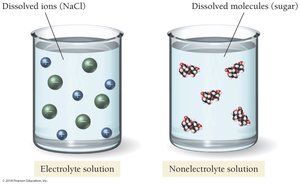
Electrolyte: A substance that dissolves in water to give a solution that conducts electricity (e.g., NaCl, KCl, HCl).
Nonelectrolyte: A substance that dissolves in water but does not conduct electricity (e.g., sugar, air).
Water: The Universal Solvent
Unique Properties of Water
Polar covalent bonds and hydrogen bonding.
Ice is less dense than liquid water.
High boiling point and surface tension.
Low vapor pressure.
Formation of Solutions: Dissolving Solids in Water
Solvation Process
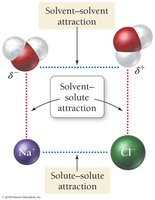
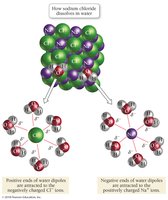
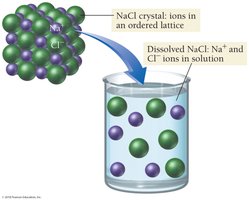
When an ionic solid dissolves in water, the solvent–solute attractions must overcome the solute–solute and solvent–solvent attractions. Water molecules surround and separate the ions, dispersing them throughout the solution.
Factors Affecting the Rate of Dissolving
How Quickly Does a Solute Dissolve?
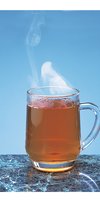
Agitation: Stirring brings fresh solvent into contact with solute, increasing the rate of dissolving.
Temperature: Higher temperatures increase kinetic energy, leading to faster dissolving.
Particle Size: Smaller particles have greater surface area, dissolving faster.


Solubility: How Much Solute Can Dissolve?
Definitions and Categories
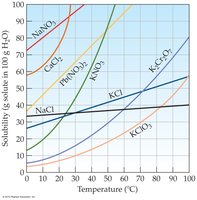
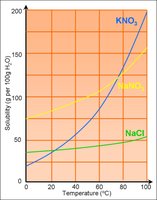
Solubility: The amount of solute that dissolves in a given quantity of solvent at a specified temperature and pressure (g/100 g H2O).
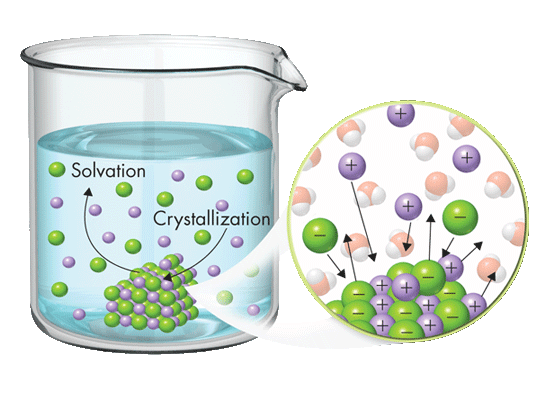
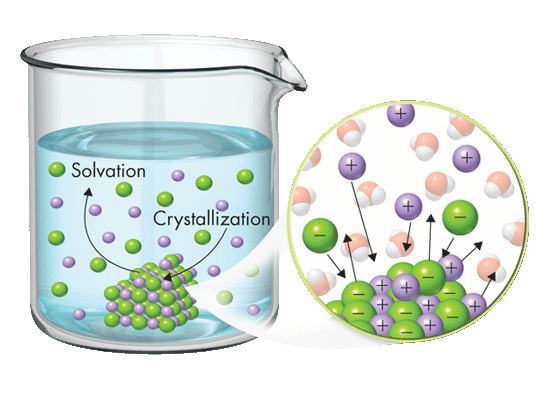
Saturated Solution: Contains the maximum amount of solute at given conditions.
Unsaturated Solution: Contains less than the maximum amount of solute.
Supersaturated Solution: Contains more than the normal maximum amount of solute; unstable and excess solute may precipitate.
Solubility and Temperature
Solids and Gases
Solubility of most solids increases with temperature.
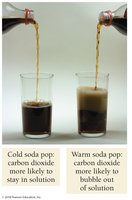
Solubility of gases decreases with increasing temperature.
Solubility and Pressure: Henry's Law
Gas Solubility and Pressure
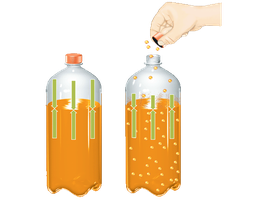
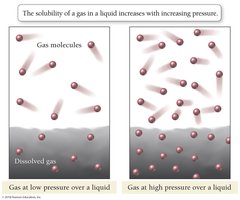
The solubility of a gas in a liquid increases as the partial pressure of the gas above the solution increases. This relationship is described by Henry's Law:
Henry's Law: where S is the solubility of the gas, k is a constant, and P is the partial pressure of the gas.
Concentration Units
Molarity (M)
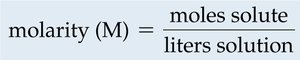
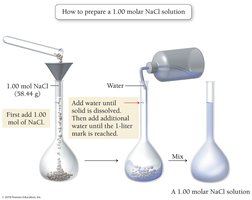
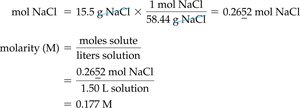
Molarity is the most common unit of concentration in chemistry, defined as the number of moles of solute per liter of solution:
Calculating Molarity: Example
To calculate the molarity of a solution, convert the mass of solute to moles and divide by the volume of solution in liters.
Using Molarity in Calculations
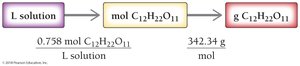
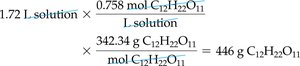
To find the mass of solute in a given volume and molarity, use dimensional analysis:

Solution Dilution
Dilution Equation
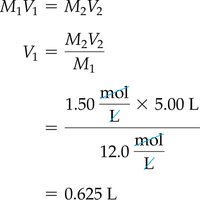
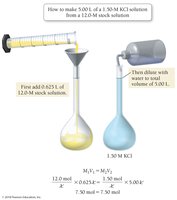
To dilute a solution, use the equation:
M1 and V1: Initial molarity and volume
M2 and V2: Final molarity and volume
Other Concentration Measures
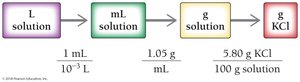
Percent by Volume and Mass
Percent by volume (% v/v):
Percent by mass (% m/m):




Colligative Properties of Solutions
Definition and Types
Colligative properties depend only on the number of solute particles, not their identity. Important colligative properties include:
Vapor-pressure lowering
Freezing-point depression
Boiling-point elevation
Osmotic pressure
Osmosis and Osmotic Pressure
Osmosis
Osmosis is the flow of solvent from a less concentrated solution to a more concentrated solution through a semipermeable membrane. Osmotic pressure is the pressure required to stop this flow and is a colligative property.
Red Blood Cells in Solutions
Isoosmotic: No net flow of water; cell retains shape.
Hypoosmotic: Water enters cell; cell may burst.
Hyperosmotic: Water leaves cell; cell shrinks.
Solution Stoichiometry
Using Molarity in Chemical Reactions
In reactions involving solutions, use the volume and molarity to calculate moles of reactants or products, then apply stoichiometric coefficients from the balanced equation.
Summary of Key Formulas
Molarity:
Mass percent:
Dilution:
Henry's Law:
