 Back
BackChapter 14 & 17: Solutions and Colligative Properties
Study Guide - Smart Notes
 Tailored notes based on your materials, expanded with key definitions, examples, and context.
Solutions and Their Properties
Concentration Units
Understanding solution concentration is fundamental in chemistry. Several units are used to express concentration, each with specific applications:
Molality (m): Defined as moles of solute per kilogram of solvent. It is temperature-independent because mass does not change with temperature.
Mole Fraction (χ): The ratio of moles of a component to the total moles in the solution. Useful in vapor pressure calculations.
Molarity (M): Moles of solute per liter of solution. It is temperature-dependent because volume changes with temperature.
Key Point: When temperature changes, molarity changes, but molality and mole fraction remain constant.
Colligative Properties
Vapor Pressure Lowering
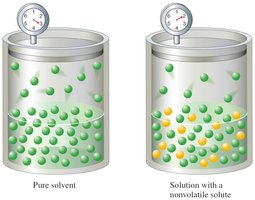
Adding a nonvolatile solute to a solvent decreases the solvent's vapor pressure. This is a colligative property, meaning it depends on the number of solute particles, not their identity.
Nonvolatile solute: Has low vapor pressure at room temperature (e.g., NaCl, KNO3, C6H12O6).
Raoult’s Law: For a solution with a nonvolatile solute:
= vapor pressure of the solution
= mole fraction of the solvent
= vapor pressure of pure solvent
Example: Mixing 50 g KNO3 with 150 g water at 25°C, where pure water's vapor pressure is 23.8 torr, yields a lower vapor pressure for the solution.
Boiling Point Elevation
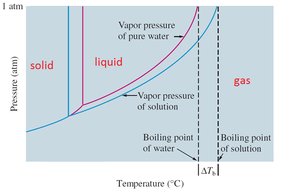
Lowering the vapor pressure of a solution increases its boiling point. The boiling point elevation is another colligative property.
Equation:
= van't Hoff factor (number of particles formed when solute dissolves)
= boiling point elevation constant (depends on solvent)
= molality of solute
Freezing Point Depression
Adding a solute lowers the freezing point of a solvent. This occurs because the vapor pressure is reduced, shifting the equilibrium.
Equation:
= freezing point depression constant (depends on solvent)
Example: Dissolving 0.2 g of a nonvolatile, nonelectrolyte solute in 4 g benzene decreases the freezing point from 5.5°C to 5.1°C. The molar mass of the solute can be calculated using the above equation.
Osmosis and Osmotic Pressure
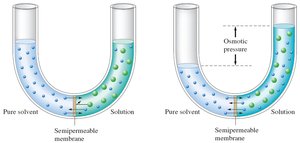
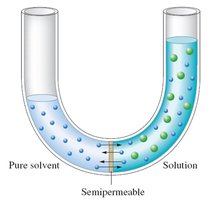
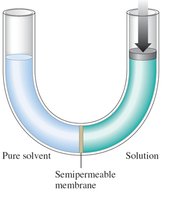
Osmosis is the movement of solvent across a semipermeable membrane from a region of lower solute concentration to higher solute concentration. Osmotic pressure is the pressure required to stop this flow.
Equation:
= osmotic pressure (atm)
= molarity
= gas constant
= temperature (K)
Solubility and Factors Affecting Solubility
Types of Solutions
Solubility is the maximum amount of solute that can dissolve in a solvent at a given temperature.
Saturated solution: Contains the maximum amount of solute.
Unsaturated solution: Contains less than the maximum amount.
Supersaturated solution: Contains more than the maximum amount.
Like Dissolves Like
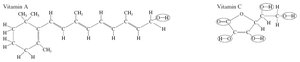
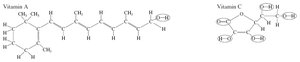
The solubility of a substance depends on the nature of both solute and solvent. Polar solutes dissolve in polar solvents, and nonpolar solutes dissolve in nonpolar solvents.
Example: Water (polar) and methanol (polar) mix; oil (nonpolar) and water (polar) do not mix.
Thermodynamics of Solution Formation
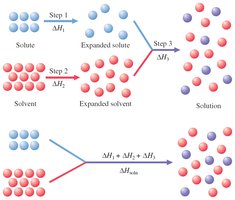
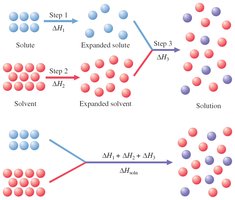
Solution formation involves changes in enthalpy () and entropy (). The process can be exothermic or endothermic depending on the interactions between solute and solvent.
Exothermic: Strong solute-solvent interactions ( large), .
Endothermic: Weak solute-solvent interactions ( small), .
Spontaneity: Determined by . If , dissolution is spontaneous.
Temperature Effects on Solubility
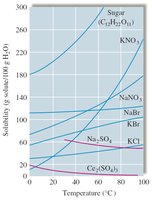
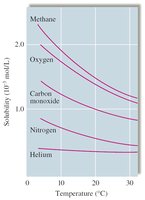
Solubility of solids generally increases with temperature, though there are exceptions. For gases, solubility decreases as temperature increases.
Pressure Effects on Solubility
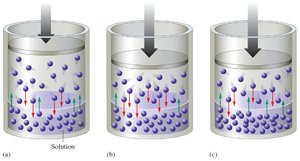
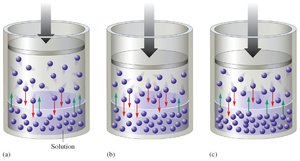
Increasing external pressure increases the solubility of gases in liquids (Henry’s Law).
Mixtures of Volatile Substances and Raoult’s Law
Raoult’s Law for Volatile Solute and Solvent
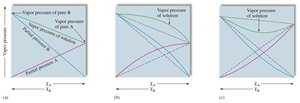
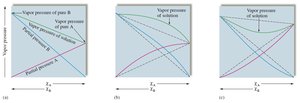
For a mixture of two volatile substances, the total vapor pressure is the sum of the partial pressures:
Raoult’s Law assumes ideal solutions, where interactions between solute and solvent are similar to those in pure substances.
Deviations from Raoult’s Law
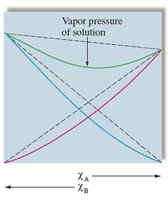
Real solutions often deviate from ideal behavior:
Negative deviation: Vapor pressure lower than expected due to strong solute-solvent interactions (exothermic).
Positive deviation: Vapor pressure higher than expected due to weak solute-solvent interactions (endothermic).
Summary Table: Colligative Properties Equations
Property | Equation | Key Variables |
|---|---|---|
Vapor Pressure Lowering | Mole fraction, vapor pressure | |
Boiling Point Elevation | van't Hoff factor, molality, | |
Freezing Point Depression | van't Hoff factor, molality, | |
Osmotic Pressure | van't Hoff factor, molarity, , |
Key Concepts for Exam Preparation
Interconversion between mass percent, molarity, molality, and mole fraction
Determinants of solubility: polarity, temperature, pressure
Thermodynamics of solution formation: enthalpy and entropy
Colligative properties: vapor pressure lowering, boiling point elevation, freezing point depression, osmotic pressure
Raoult’s Law and deviations for ideal and non-ideal solutions
