 Back
BackChapter 14: Solutions – Properties, Types, and Colligative Effects
Study Guide - Smart Notes
 Tailored notes based on your materials, expanded with key definitions, examples, and context.
Solutions: Definitions and Types
What is a Solution?
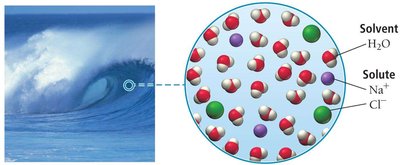
A solution is a homogeneous mixture of two or more substances, where the composition is uniform throughout. Solutions can exist in any phase: solid, liquid, or gas. The solvent is the component present in the greatest amount and is responsible for dissolving the other substances, called solutes.
Solvent: The main dissolving medium (e.g., water, acetone).
Solute: The substance dissolved in the solvent (e.g., salt in water).
Solutions can be solid, liquid, or gas.
Types of Solutions
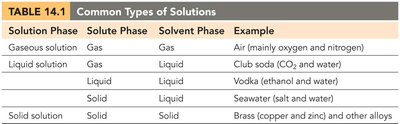
Solutions are classified based on the physical states of their components. The following table summarizes common types:
Solution Phase | Solute Phase | Solvent Phase | Example |
|---|---|---|---|
Gas | Gas | Gas | Air (mainly O2 and N2) |
Liquid | Gas | Liquid | Club soda (CO2 and water) |
Liquid | Liquid | Liquid | Vodka (ethanol and water) |
Liquid | Solid | Liquid | Seawater (salt and water) |
Solid | Solid | Solid | Brass (copper and zinc) and other alloys |
Nature’s Tendency Toward Mixing: Entropy
Spontaneous Mixing and Entropy
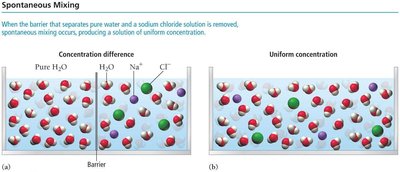
Entropy is a measure of energy dispersal or randomness in a system. There is a natural tendency for substances to mix and increase entropy, even if the process is slightly endothermic (absorbs heat). This tendency is a driving force for solution formation.
Mixing increases entropy (randomness).
Spontaneous mixing occurs when barriers are removed, leading to uniform concentration.
Intermolecular Forces and Solution Formation
Types of Intermolecular Forces
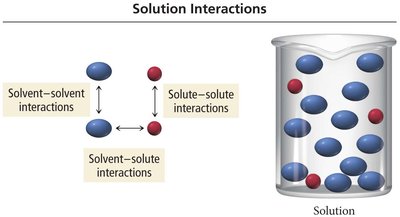
The interactions between particles in a solution determine solubility and solution properties. The main types of intermolecular forces are:
Ion-Ion interactions (strongest)
Ion-Dipole interactions
Hydrogen Bonds
Dipole-Dipole interactions
Dipole-Induced Dipole interactions
Dispersion forces (London forces, weakest)
Solubility is favored when solute-solvent interactions are stronger than solute-solute and solvent-solvent interactions.
Enthalpy of Solution Formation
The enthalpy change for solution formation is the sum of three steps:
Separating solute particles (endothermic, positive ΔH)
Separating solvent particles (endothermic, positive ΔH)
Mixing solute and solvent (exothermic, negative ΔH)
The overall enthalpy change is:

Solubility: Like Dissolves Like
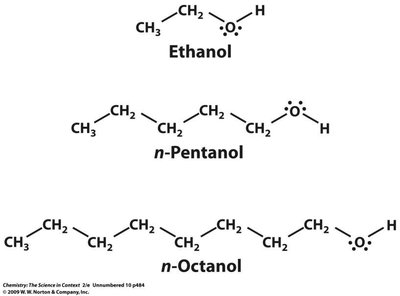
The "like dissolves like" rule states that polar solvents dissolve polar or ionic solutes, while nonpolar solvents dissolve nonpolar solutes. For example, NaCl dissolves in water (polar), but not in hexane (nonpolar).
Hydrophilic (water-loving): Polar or ionic substances, increased water solubility.
Hydrophobic (water-fearing): Nonpolar substances, decreased water solubility.
Example: Soap micelles have hydrophilic heads and hydrophobic tails, allowing them to interact with both water and oils.
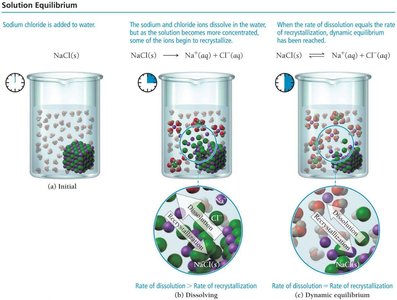
Solution Equilibrium and Solubility
Dynamic Equilibrium in Solutions
When a solute dissolves in a solvent, it eventually reaches a point where the rate of dissolution equals the rate of recrystallization. This is called dynamic equilibrium.
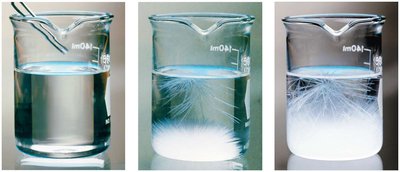
Saturated solution: Contains the maximum amount of solute that can dissolve at a given temperature.
Unsaturated solution: Contains less than the maximum amount of solute.
Supersaturated solution: Contains more solute than predicted; often unstable.
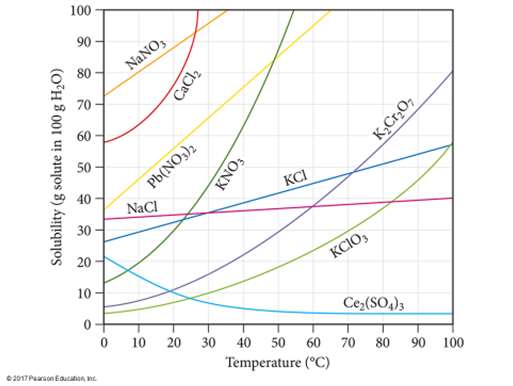
Temperature Dependence of Solubility
For most solids, solubility increases with temperature. However, some substances show exceptions to this trend.
Visualizing Saturated, Unsaturated, and Supersaturated Solutions
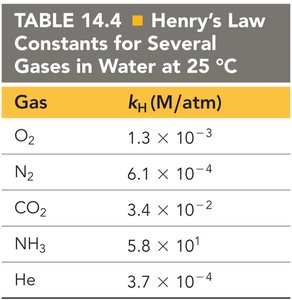
Solubility of Gases: Henry’s Law
Henry’s Law
The solubility of a gas in a liquid is proportional to the partial pressure of the gas above the solution:
= solubility of the gas
= Henry’s Law constant (depends on gas, solvent, and temperature)
= partial pressure of the gas
As temperature increases, gas solubility decreases.
Concentration Units
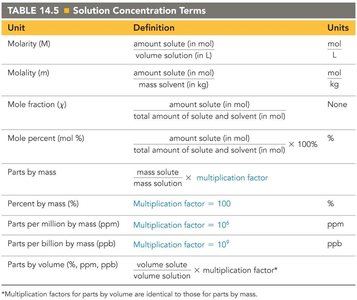
Common Concentration Units
Concentration expresses the amount of solute in a given amount of solution or solvent. Common units include:
Unit | Definition | Units |
|---|---|---|
Molarity (M) | amount solute (mol) / volume solution (L) | mol/L |
Molality (m) | amount solute (mol) / mass solvent (kg) | mol/kg |
Mole fraction (χ) | amount solute (mol) / total moles (solution) | None |
Mole percent (mol %) | mole fraction × 100% | % |
Parts by mass | mass solute / mass solution × factor | ppm, ppb, % |
Parts by volume | volume solute / volume solution × factor | ppm, ppb, % |
Using Concentration as a Conversion Factor
Concentration values can be used as conversion factors in dimensional analysis for problem solving. For example, 1.48 M K+ means 1.48 mol K+ per 1 L solution.
Vapor Pressure and Raoult’s Law
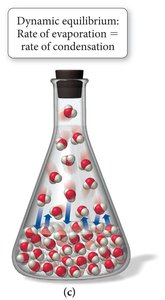
Vapor Pressure and Dynamic Equilibrium
Vaporization is the process where molecules transition from the liquid to the gas phase. Vapor pressure is the pressure exerted by a vapor in equilibrium with its liquid at a given temperature.
Raoult’s Law
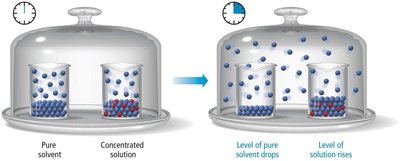
Raoult’s Law describes the vapor pressure of a solution containing a nonvolatile solute:
= vapor pressure of the solution
= mole fraction of the solvent
= vapor pressure of the pure solvent
Raoult’s Law for Volatile Mixtures
For solutions with two volatile components:
Raoult’s Law applies to ideal solutions, where intermolecular interactions are similar among all components.
Colligative Properties of Solutions
Definition and Types
Colligative properties depend only on the number of solute particles, not their identity. The main colligative properties are:
Vapor Pressure Lowering
Boiling Point Elevation
Freezing Point Depression
Osmotic Pressure
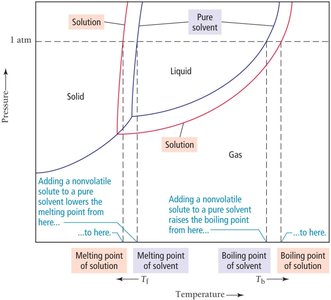
Boiling Point Elevation
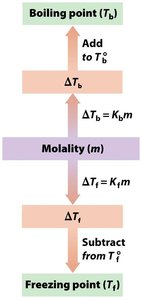
Adding a nonvolatile solute raises the boiling point of a solvent. The increase is given by:
= increase in boiling point
= molality of the solution
= boiling point elevation constant (specific to solvent)
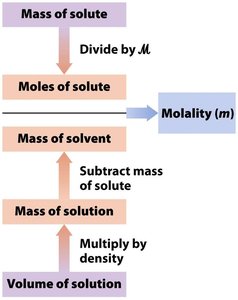
Freezing Point Depression
Adding a solute lowers the freezing point of a solvent:
= decrease in freezing point
= molality
= freezing point depression constant
Phase Diagram Effects
Osmosis and Osmotic Pressure
Osmosis
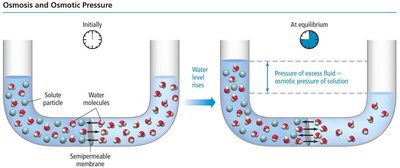
Osmosis is the flow of solvent from a region of lower solute concentration to higher concentration through a semipermeable membrane. Water moves to balance concentrations on both sides.
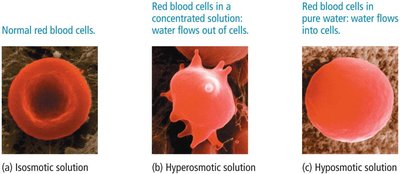
Osmotic Pressure Equation
The pressure required to stop osmosis is called osmotic pressure ():
= molarity of solute
= ideal gas constant (0.08206 L·atm/mol·K)
= temperature in Kelvin
The van’t Hoff Factor and Electrolytes
van’t Hoff Factor (i)
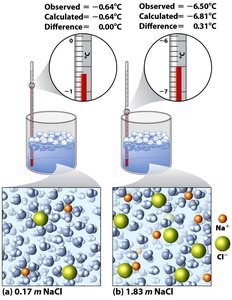
The van’t Hoff factor () accounts for the number of particles a solute produces in solution. For nonelectrolytes, . For ionic compounds, $i$ is the number of ions formed per formula unit, but is often less than predicted due to ion pairing.
Colligative property equations for electrolytes:
Values of van’t Hoff Factors
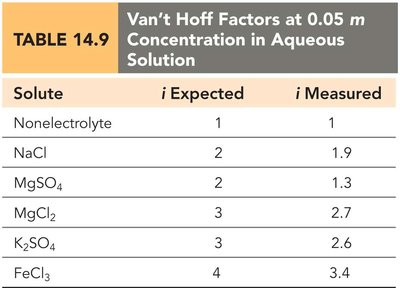
Solute | i Expected | i Measured |
|---|---|---|
Nonelectrolyte | 1 | 1 |
NaCl | 2 | 1.9 |
MgSO4 | 2 | 1.3 |
MgCl2 | 3 | 2.7 |
K2SO4 | 3 | 2.6 |
FeCl3 | 4 | 3.4 |
Summary Table: Solution Concentration Terms
Additional info: This guide covers the essential concepts of solution chemistry, including types of solutions, intermolecular forces, solubility, colligative properties, and the van’t Hoff factor, with relevant equations and visual aids for clarity.
