 Back
BackChapter 14: Solutions – Structure, Energetics, and Concentration
Study Guide - Smart Notes
 Tailored notes based on your materials, expanded with key definitions, examples, and context.
Solutions
Introduction to Solutions
Solutions are homogeneous mixtures composed of two or more substances. The process of solution formation involves interactions between solute and solvent particles, which determine whether a solution will form and its properties.
Solution Interactions
Types of Intermolecular Interactions
The formation of a solution depends on the relative strengths of three types of interactions:
Solvent–solvent interactions: Attractions between solvent molecules.
Solute–solute interactions: Attractions between solute molecules.
Solvent–solute interactions: Attractions between solvent and solute molecules.
The solution forms if the solvent–solute interactions are comparable to or stronger than the sum of solvent–solvent and solute–solute interactions.
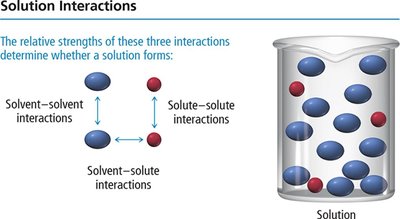
Relative Interactions and Solution Formation
The likelihood of solution formation can be summarized as follows:
Solvent–solute interactions | Solvent–solvent & solute–solute interactions | Result |
|---|---|---|
> | Solution forms | |
= | Solution forms | |
< | Solution may or may not form, depending on entropy |
When solute-to-solvent attractions are weaker, the solution forms only if the energy difference is small enough to be overcome by the increase in entropy from mixing.
Effect of Intermolecular Forces
To mix solvent and solute, you must overcome:
All solute–solute attractive forces (endothermic)
Some solvent–solvent attractive forces (endothermic)
Energy is released when new solute–solvent attractions are formed (exothermic).
Will It Dissolve? – "Like Dissolves Like"
A chemical will dissolve in a solvent if it has a similar structure to the solvent:
Polar molecules and ionic compounds are more soluble in polar solvents.
Nonpolar molecules are more soluble in nonpolar solvents.
Energetics of Solution Formation
Steps in Solution Formation
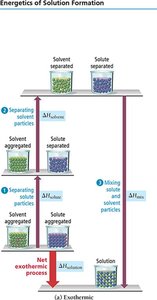
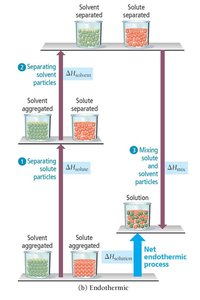
The process of making a solution involves three steps:
Separating the solute into its constituent particles (endothermic, )
Separating solvent particles from each other (endothermic, )
Mixing solute and solvent particles (exothermic, )
The overall enthalpy change for solution formation is:
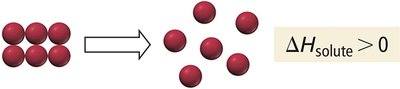
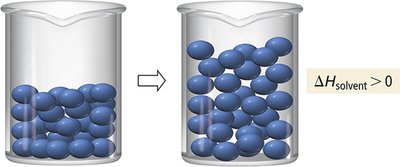
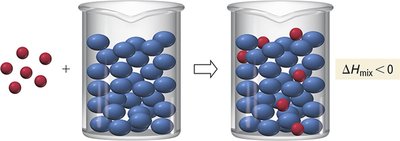
Exothermic vs. Endothermic Solution Formation
If the energy cost for breaking attractions in pure solute and solvent is less than the energy released in making new solute–solvent attractions, the process is exothermic. If the energy cost is greater, the process is endothermic.
Heat of Solution and Heat of Hydration
Heat of Solution for Ionic Compounds
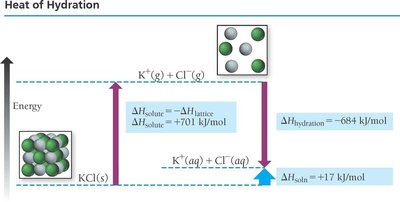
For ionic compounds in water, the enthalpy of solution is the difference between the heat of hydration and the lattice energy:
Ion–Dipole Interactions
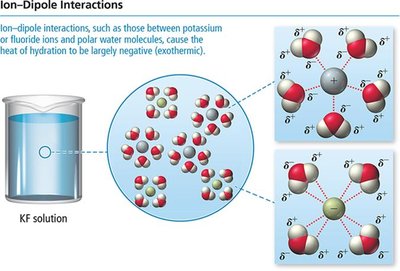
When ions dissolve in water, they become hydrated, surrounded by water molecules. The formation of ion–dipole attractions makes the heat of hydration very exothermic.
Solubility and Saturation
Solubility Limit
A solution is saturated when the solute and solvent are in dynamic equilibrium. Adding more solute will not dissolve. The saturation concentration depends on temperature and pressure (for gases).
Unsaturated: Less solute than saturation; more solute can dissolve.
Supersaturated: More solute than saturation; unstable and loses excess solute when disturbed.
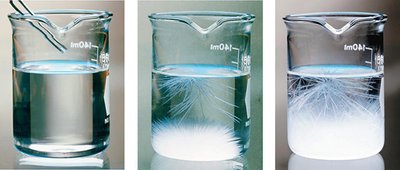
Supersaturated Solutions
Supersaturated solutions can be made by saturating at non-room conditions and then slowly returning to room conditions. Disturbing the solution (e.g., shaking) causes excess solute to precipitate.
Temperature Dependence of Solubility
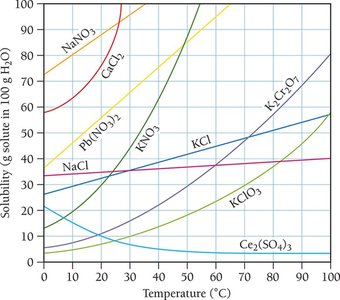
Solubility of Solids in Water
For most solids, solubility increases as temperature increases, especially when solution formation is endothermic. Solubility curves help predict whether a solution is saturated, unsaturated, or supersaturated.
Solubility of Gases in Water
Gases generally have lower solubility in water than ionic or polar covalent solids. For all gases, solubility decreases as temperature increases because solution formation is exothermic.
Henry’s Law
The solubility of a gas () is directly proportional to its partial pressure ():
Where is the Henry’s law constant, which varies for different gases.
Concentration Units
Describing Solution Concentration
Concentration is the amount of solute in a given amount of solution or solvent. Common units include:
Unit | Definition | Units |
|---|---|---|
Molarity (M) | Amount of solute (mol) / Volume of solution (L) | mol/L |
Molality (m) | Amount of solute (mol) / Mass of solvent (kg) | mol/kg |
Mole fraction () | Amount of solute (mol) / Total moles (solute + solvent) | Unitless |
Mole percent | Mole fraction × 100% | % |
Percent by mass | Mass solute / Mass solution × 100% | % |
Parts per million (ppm) | Mass solute / Mass solution × | ppm |
Parts per billion (ppb) | Mass solute / Mass solution × | ppb |
Parts by volume | Volume solute / Volume solution × multiplication factor | — |
Preparing a Solution
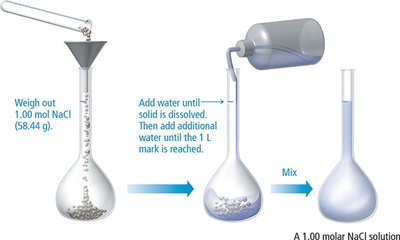
To prepare a solution of known concentration:
Calculate the mass of solute needed using the desired concentration and volume.
Dissolve the solute in enough solvent to reach the total volume of solution.
Molarity (M)
Molarity is defined as moles of solute per liter of solution:
Molality (m)
Molality is defined as moles of solute per kilogram of solvent:
Molality does not vary with temperature because it is based on mass, not volume.
Mole Fraction and Mole Percent
The mole fraction () is the fraction of moles of one component in the total moles of all components:
Mole percent is mole fraction × 100%.
Example Calculations
Example 14.4: Calculating concentrations for a solution prepared by dissolving 17.2 g ethylene glycol () in 0.500 kg water, final volume 515 mL:
(a) Molarity
(b) Molality
(c) Percent by mass
(d) Mole fraction
(e) Mole percent
Example 14.5: Converting between concentration units for a 6.56% by mass glucose () solution with density 1.03 g/mL.
Additional info: The notes cover all major aspects of solution chemistry, including energetics, solubility, concentration units, and practical preparation, suitable for general chemistry students.
