 Back
BackChapter 15: Chemical Equilibrium – Study Guide
Study Guide - Smart Notes
 Tailored notes based on your materials, expanded with key definitions, examples, and context.
Chemical Equilibrium
Dynamic Equilibrium
Dynamic equilibrium occurs when two opposing processes happen at the same rate, resulting in no net change in the system. In chemical reactions, this means the forward and reverse reactions proceed at equal rates, so concentrations of reactants and products remain constant.
Dynamic equilibrium is not static; reactions continue but at equal rates.
Analogy: Like traffic moving in opposite directions at the same rate, resulting in constant traffic flow.
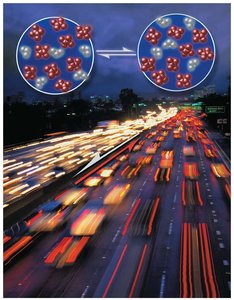
Equilibrium: Sameness and Constancy
Equilibrium is characterized by sameness (equal property with surroundings) and constancy (no further change). For example, a cup of hot water cools until its temperature matches the surroundings, then remains constant.
At equilibrium, properties such as temperature or concentration do not change.
Living things maintain controlled disequilibrium, keeping internal conditions different from their environment.
Reaction Rates and Collision Theory
The Rate of a Chemical Reaction
The rate of a chemical reaction measures how quickly reactants are converted to products. It is influenced by several factors, including concentration and temperature.
Fast reactions: Products form quickly.
Slow reactions: Products form slowly.
Understanding factors affecting rate allows control over reaction speed.
Collision Theory
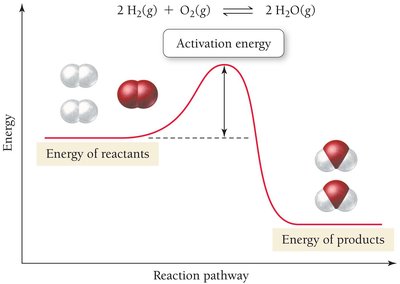
According to collision theory, chemical reactions occur when molecules or atoms collide with sufficient energy to overcome the activation energy barrier.
Activation energy: Minimum energy required for a reaction to occur.
High-energy collisions lead to product formation; low-energy collisions do not.
Effect of Concentration on Reaction Rate
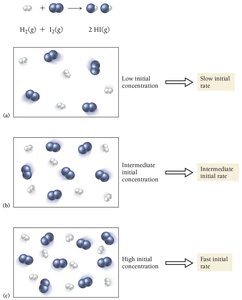
Increasing the concentration of reactants generally increases the rate of reaction, as more collisions occur per unit time.
Higher concentration → more frequent collisions → faster reaction rate.
The relationship between concentration and rate is studied in chemical kinetics.
Effect of Temperature on Reaction Rate
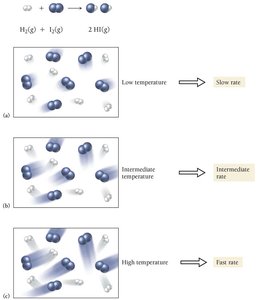
Raising the temperature increases the speed of molecules, resulting in more frequent and higher-energy collisions, which increases the reaction rate.
Higher temperature → faster movement → more collisions → faster rate.
High-energy collisions are more likely to overcome activation energy.
Reversible Reactions and Dynamic Chemical Equilibrium
Reversible Reactions
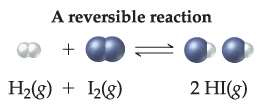
A reversible reaction can proceed in both forward and reverse directions. Dynamic equilibrium is reached when the rates of the forward and reverse reactions are equal.
At equilibrium, concentrations of reactants and products remain constant.
Both reactions continue to occur, but at equal rates.
Population Analogy for Equilibrium
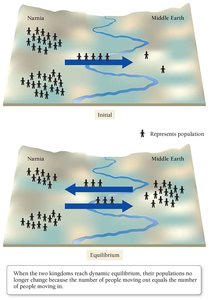
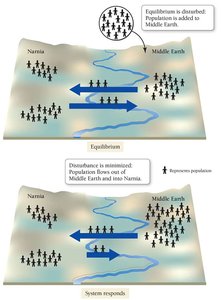
Dynamic equilibrium can be illustrated by populations moving between two kingdoms. When the rate of people moving in each direction is equal, populations remain constant.
Analogy helps visualize the concept of equilibrium in chemical systems.
The Equilibrium Constant (Keq)
Definition and Expression
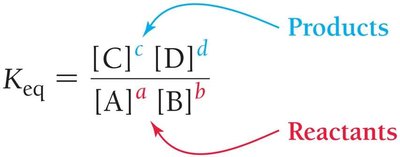
The equilibrium constant (Keq) quantifies the relative concentrations of reactants and products at equilibrium. It is calculated using the concentrations of products and reactants, each raised to their stoichiometric coefficients.
For a general reaction:
Equilibrium expression:
Writing Equilibrium Expressions
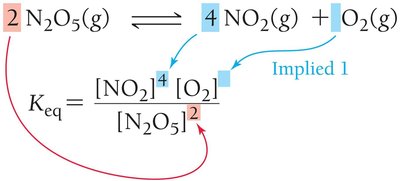
Coefficients in the balanced chemical equation become exponents in the equilibrium expression.
Example:
Significance of Keq
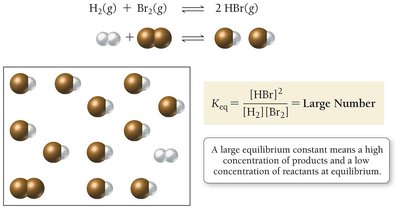
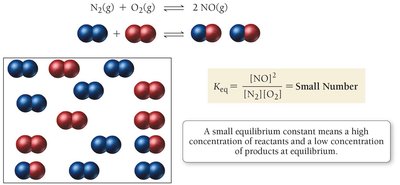
The magnitude of Keq indicates the extent to which a reaction proceeds.
Keq >> 1: Forward reaction favored; high product concentration.
Keq << 1: Reverse reaction favored; high reactant concentration.
Keq ≈ 1: Significant amounts of both reactants and products.
Calculating Keq
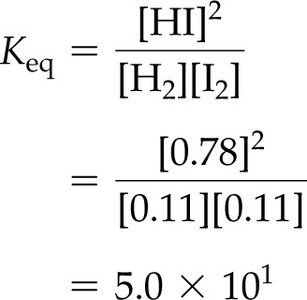
Keq can be calculated from measured equilibrium concentrations.
Example:
Substitute values to solve for Keq.
Using Keq in Calculations
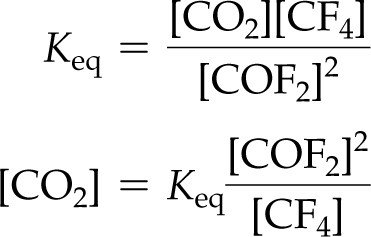
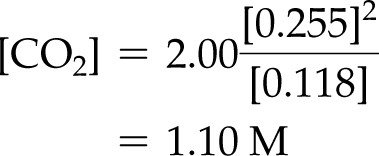
Keq can be used to solve for unknown concentrations in equilibrium mixtures.
Rearrange the equilibrium expression to solve for the desired concentration.
Le Châtelier’s Principle
Principle Overview
Le Châtelier’s Principle states that when a system at equilibrium is disturbed, it shifts in a direction that minimizes the disturbance.
Disturbances include changes in concentration, volume, or temperature.
Effect of Adding Products or Reactants
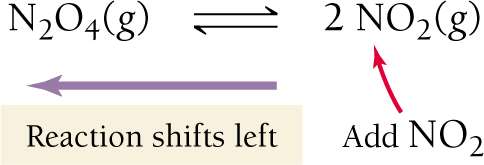
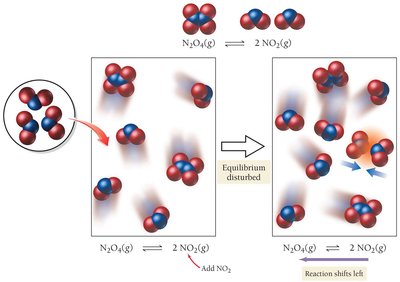
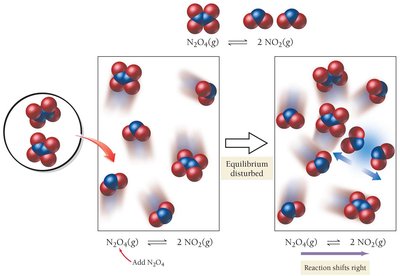
Adding products causes the reaction to shift toward reactants; adding reactants causes the reaction to shift toward products.
Example: Adding NO2 shifts the reaction left, forming more N2O4.
Example: Adding N2O4 shifts the reaction right, forming more NO2.
Effect of Volume Change on Equilibrium
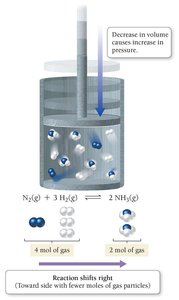
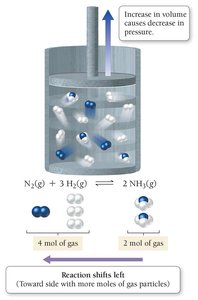
Changing the volume of a gas mixture affects equilibrium by altering pressure. The system shifts to relieve the pressure change.
Decrease in volume (increase in pressure): Reaction shifts to side with fewer moles of gas.
Increase in volume (decrease in pressure): Reaction shifts to side with more moles of gas.
If both sides have equal moles of gas, volume change has no effect.
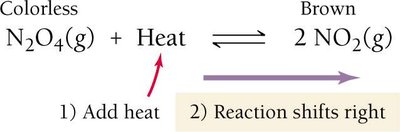
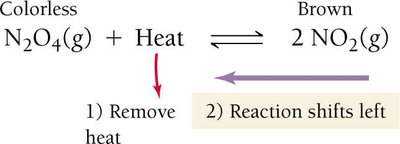
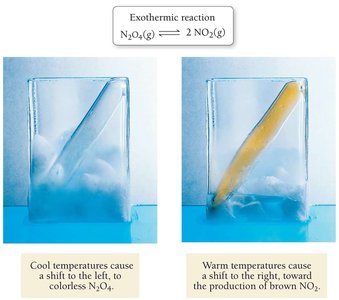
Effect of Temperature Change on Equilibrium
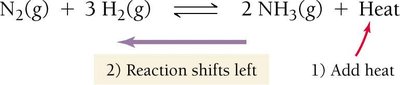
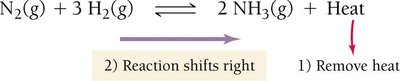
Temperature changes affect equilibrium differently for exothermic and endothermic reactions.
Exothermic: Heat is a product. Increasing temperature shifts equilibrium toward reactants.
Endothermic: Heat is a reactant. Increasing temperature shifts equilibrium toward products.
Solubility-Product Constant (Ksp)
Definition and Expression
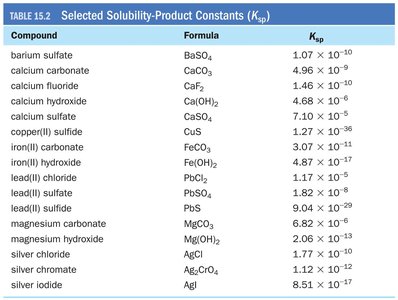
The solubility-product constant (Ksp) describes the equilibrium between a solid ionic compound and its dissolved ions. Solids are omitted from the equilibrium expression.
Large Ksp: Compound is very soluble.
Small Ksp: Compound is not very soluble.
Compound | Formula | Ksp |
|---|---|---|
Barium sulfate | BaSO4 | 1.07 × 10⁻¹⁰ |
Calcium carbonate | CaCO3 | 4.96 × 10⁻⁹ |
Silver chloride | AgCl | 1.77 × 10⁻¹⁰ |
Silver iodide | AgI | 8.51 × 10⁻¹⁷ |
... (see full table for more compounds) |
Calculating Molar Solubility from Ksp
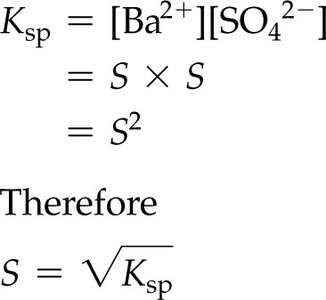
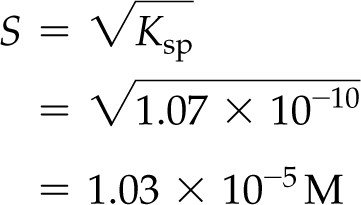
Molar solubility is the concentration of dissolved ions at equilibrium. For simple salts, it can be calculated directly from Ksp.
Example: For BaSO4,
Substitute Ksp value to solve for S.
Reaction Pathways and Catalysts
Activation Energy and Reaction Rate
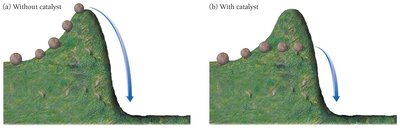
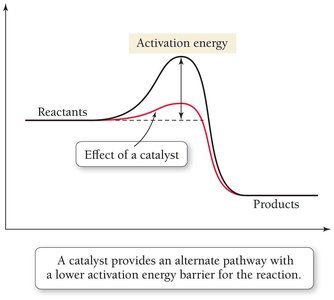
Activation energy is the energy barrier that must be overcome for a reaction to proceed. Higher activation energy means slower reaction rate.
Increasing reactant concentration or temperature increases reaction rate.
A catalyst lowers the activation energy, speeding up the reaction.
Enzymes: Biological Catalysts
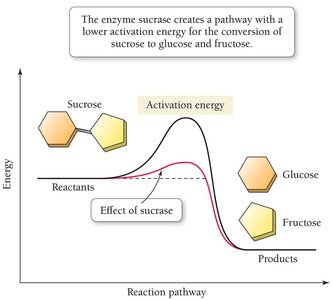
Enzymes are biological catalysts that increase the rates of biochemical reactions by lowering activation energy. They are essential for life, as many reactions would be too slow otherwise.
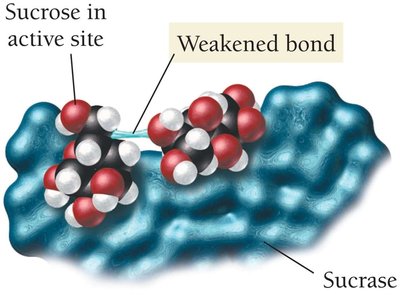
Enzyme sucrase lowers activation energy for conversion of sucrose to glucose and fructose.
Enzymes work by binding reactants in their active site and weakening bonds.
Summary Table: Effects on Equilibrium
Disturbance | System Response |
|---|---|
Add reactant | Shifts toward products |
Add product | Shifts toward reactants |
Decrease volume | Shifts to side with fewer moles of gas |
Increase volume | Shifts to side with more moles of gas |
Increase temperature (exothermic) | Shifts toward reactants |
Increase temperature (endothermic) | Shifts toward products |
