 Back
BackChapter 15: Chemical Kinetics – Mini-Textbook Study Notes
Study Guide - Smart Notes
 Tailored notes based on your materials, expanded with key definitions, examples, and context.
Chemical Kinetics
Introduction to Chemical Kinetics
Chemical kinetics is the study of the rates at which chemical reactions occur and the factors that affect these rates. Understanding kinetics allows chemists to control reactions, optimize conditions, and explain mechanisms.
Reaction Rate: The change in concentration of reactants or products per unit time.
Rate Law: An equation that relates the reaction rate to the concentrations of reactants.
Rate Laws and Reaction Order
Rate laws describe how the rate depends on reactant concentrations. The order of a reaction is determined by the exponents in the rate law.
Zero Order: Rate = k; rate is independent of reactant concentration.
First Order: Rate = k[A]; rate is directly proportional to [A].
Second Order: Rate = k[A]^2; rate is proportional to the square of [A].
Integrated Rate Laws
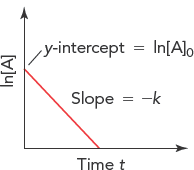
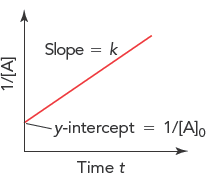
Integrated rate laws relate reactant concentration to time, allowing calculation of concentrations at any time.
Zero Order:
First Order:
Second Order:
Example: A plot of vs. time yields a straight line for a first-order reaction. 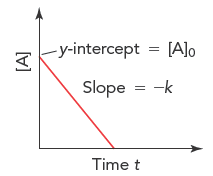
Half-Life Expressions
The half-life () is the time required for the concentration of a reactant to decrease by half.
First Order:
Second Order:
Zero Order:
The Effect of Temperature on Reaction Rate
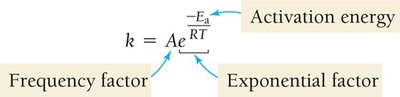
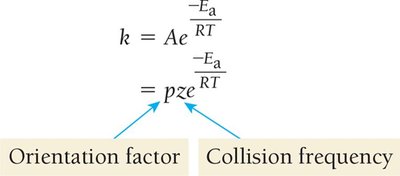
The rate constant, k, is temperature dependent. The Arrhenius equation describes this relationship:
Arrhenius Equation:
Activation Energy (): Minimum energy required for a reaction to occur.
Frequency Factor (A): Number of times reactants approach the activation energy per unit time.
Reaction Energy Profile
The energy profile of a reaction shows the energy changes as reactants convert to products, highlighting the activation energy barrier. 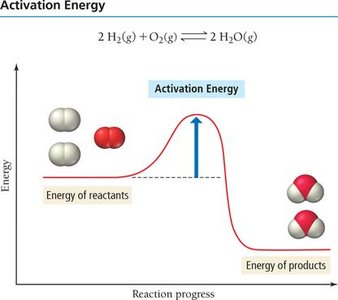
Thermal Energy Distribution
As temperature increases, more molecules have enough energy to overcome the activation energy barrier, increasing the reaction rate. 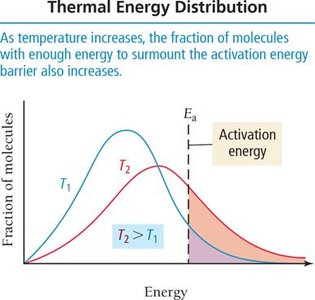
Arrhenius Plots and Kinetic Parameters
The Arrhenius equation can be linearized for experimental determination of and A:
A plot of vs. yields a straight line with slope .
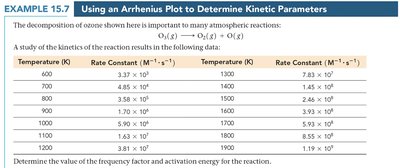
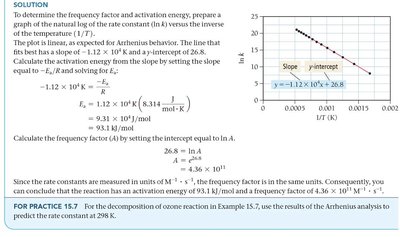
Two-Point Form of the Arrhenius Equation
If only two (T, k) data points are available, use: 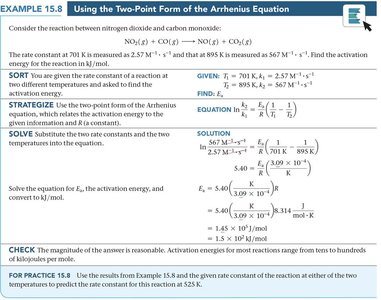
Collision Theory
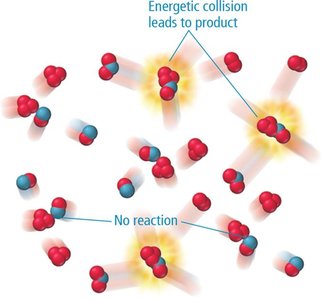
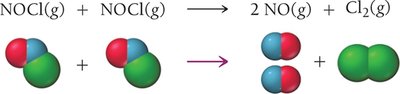
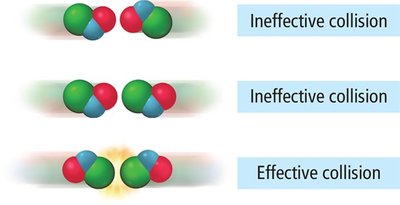
For a reaction to occur, molecules must collide with sufficient energy and proper orientation.
Effective Collisions: Collisions that result in product formation.
Kinetic Energy Factor: Only collisions with enough energy can overcome the activation barrier.
Orientation Factor (p): Probability that molecules are aligned correctly during collision.
Reaction Mechanisms
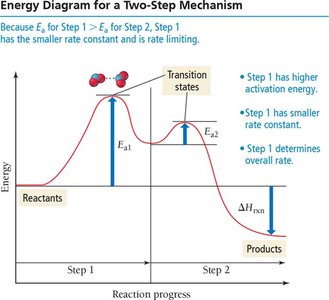
Reaction Mechanism: Sequence of elementary steps that make up the overall reaction.
Elementary Step: A single step in a mechanism, cannot be broken down further.
Reaction Intermediate: Species produced in one step and consumed in another; does not appear in the overall equation.
Molecularity: Number of reactant particles in an elementary step (unimolecular, bimolecular, termolecular).
Rate Laws for Elementary Steps
The rate law for an elementary step can be deduced directly from its equation.
Elementary Step | Molecularity | Rate Law |
|---|---|---|
A → products | 1 | Rate = k[A] |
A + A → products | 2 | Rate = k[A]^2 |
A + B → products | 2 | Rate = k[A][B] |
A + A + A → products | 3 (rare) | Rate = k[A]^3 |
A + A + B → products | 3 (rare) | Rate = k[A]^2[B] |
A + B + C → products | 3 (rare) | Rate = k[A][B][C] |
Rate-Determining Step
The slowest step in a mechanism is the rate-determining step (RDS).
The rate law for the RDS determines the rate law for the overall reaction.
Catalysts and Enzymes
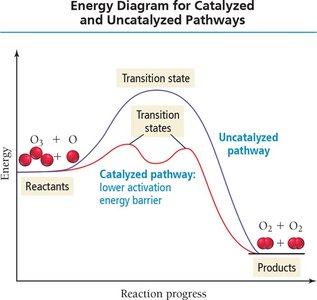
Catalyst: Substance that increases reaction rate by providing an alternative pathway with lower activation energy, without being consumed.
Homogeneous Catalyst: Same phase as reactants.
Heterogeneous Catalyst: Different phase than reactants.
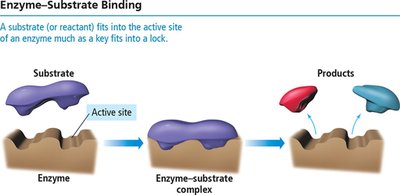
Enzyme: Biological catalyst, usually a protein, that accelerates reactions by binding substrates at an active site.
Summary Table: Rate Laws and Integrated Rate Laws
Order | Rate Law | Units of k | Integrated Rate Law | Straight-Line Plot | Half-Life Expression |
|---|---|---|---|---|---|
Zero | Rate = k | M/s | vs. t | ||
First | Rate = k[A] | 1/s | vs. t | ||
Second | Rate = k[A]^2 | 1/(M·s) | vs. t |
Additional info: Academic context and explanations have been expanded for clarity and completeness.
