 Back
BackChapter 15: Chemical Kinetics – Study Notes
Study Guide - Smart Notes
 Tailored notes based on your materials, expanded with key definitions, examples, and context.
Chemical Kinetics
Introduction to Chemical Kinetics
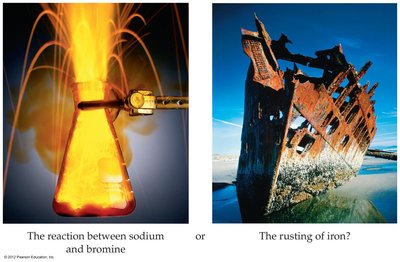
Chemical kinetics is the study of the rates at which chemical reactions occur and the factors that affect these rates. Reactions can be fast, such as the reaction between sodium and bromine, or slow, like the rusting of iron.
Reaction Rate: The change in concentration of a reactant or product per unit time.
Factors Affecting Rate: Concentration, temperature, catalysts, and the nature of reactants.
Molecular Level: Understanding how reactions proceed at the molecular level helps explain observed rates.
Measuring Reaction Rates
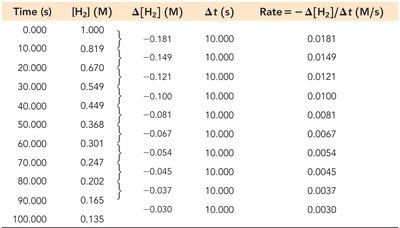
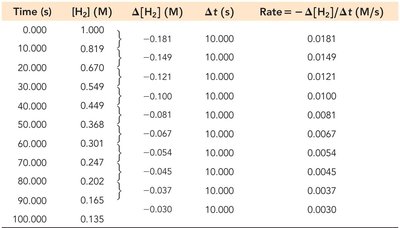
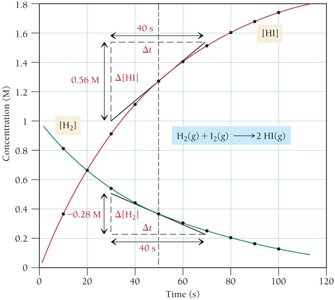
Reaction rates are determined by measuring the concentration of reactants or products over time. For example, in the reaction:
H2(g) + I2(g) → 2 HI(g)
Rate = Change in concentration / Change in time
Increase in product concentration or decrease in reactant concentration is monitored.
Types of Reaction Rates
Average Rate: Calculated over a time interval.
Instantaneous Rate: Rate at a specific moment, determined by the slope of the tangent to the concentration vs. time curve.
Initial Rate: Rate at the very start of the reaction.
The Rate Law: Effect of Concentration on Rate
Rate Law and Reaction Order
The rate law expresses the relationship between the rate of a reaction and the concentrations of reactants:
General Form:
k: Rate constant
m, n: Reaction orders (must be determined experimentally)
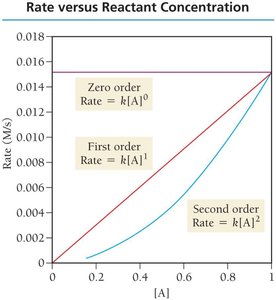
Determining Reaction Order
Zero Order: Rate does not depend on concentration ()
First Order: Rate is directly proportional to concentration ()
Second Order: Rate increases as the square of concentration ()
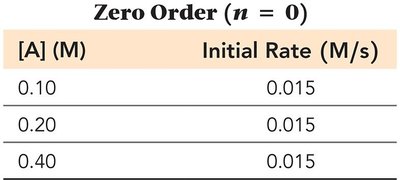
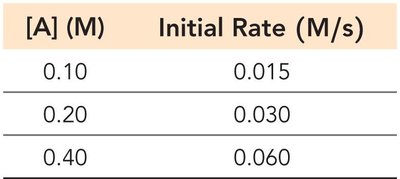
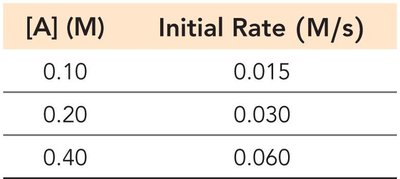
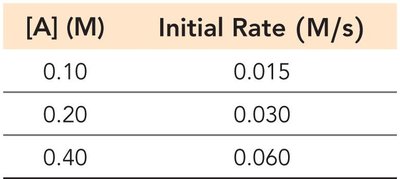
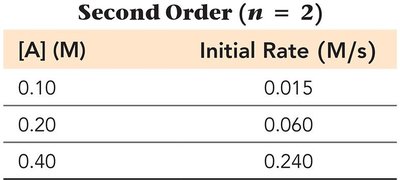
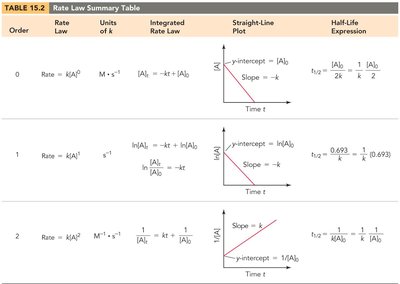
Rate Law Summary Table
The following table summarizes the rate laws, units of k, integrated rate laws, straight-line plots, and half-life expressions for zero, first, and second order reactions:
Order | Rate Law | Units of k | Integrated Rate Law | Straight-Line Plot | Half-Life Expression |
|---|---|---|---|---|---|
0 | Rate = k[A]0 | M·s–1 | [A]t = [A]0 – kt | [A] vs. t (slope = –k) | t1/2 = [A]0/2k |
1 | Rate = k[A]1 | s–1 | ln[A]t = –kt + ln[A]0 | ln[A] vs. t (slope = –k) | t1/2 = 0.693/k |
2 | Rate = k[A]2 | M–1·s–1 | 1/[A]t = kt + 1/[A]0 | 1/[A] vs. t (slope = k) | t1/2 = 1/k[A]0 |
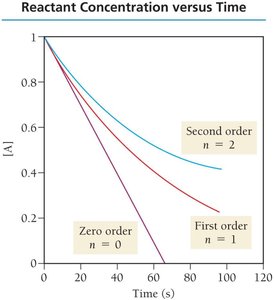
Integrated Rate Laws: Dependence of Concentration on Time
First-Order Reactions
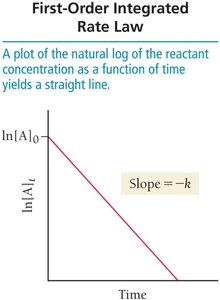
For a first-order reaction, the integrated rate law is:
A plot of vs. time yields a straight line with slope –k.
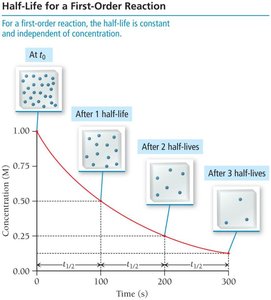
Half-life () is constant and independent of concentration:
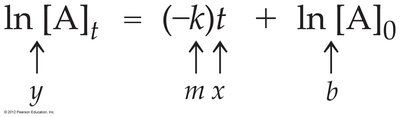
Second-Order Reactions
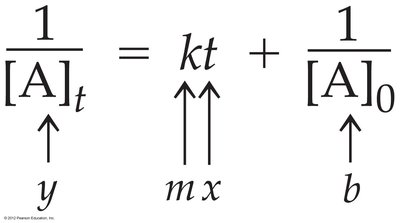
For a second-order reaction, the integrated rate law is:
A plot of vs. time yields a straight line with slope k.
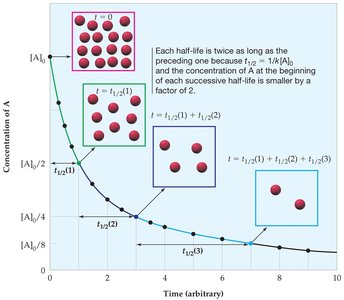
Half-life depends on initial concentration:
Zero-Order Reactions
For a zero-order reaction, the rate is constant and independent of concentration:
A plot of vs. time yields a straight line.
Half-life:
Effect of Temperature on Reaction Rate
Activation Energy and Collision Theory
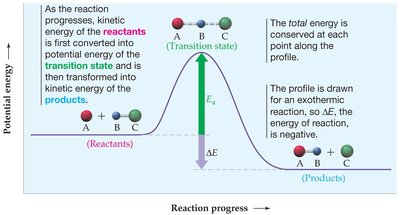
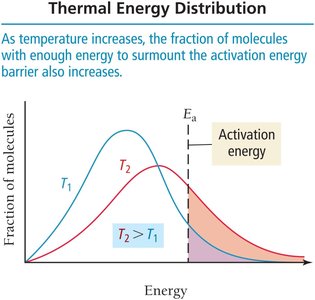
Reaction rates increase with temperature because molecules move faster and collide more frequently and with greater energy. The minimum energy required for a reaction is called the activation energy (Ea).
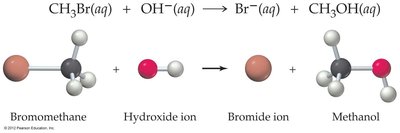
Only collisions with sufficient energy and correct orientation lead to reaction.
Transition state or activated complex is formed at the top of the energy barrier.

Arrhenius Equation
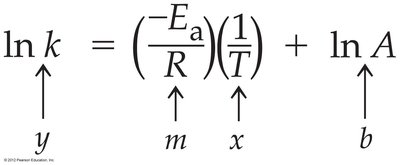
The Arrhenius equation relates the rate constant k to temperature and activation energy:
As Ea increases, k decreases; as T increases, k increases.
Linear form:
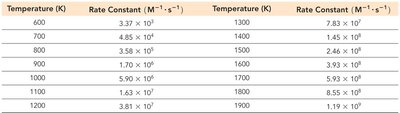
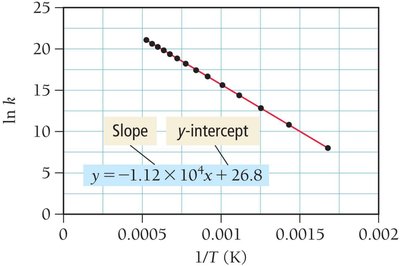
A plot of vs. yields a straight line with slope .
Reaction Mechanisms
Elementary Steps and Molecularity
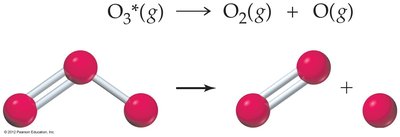
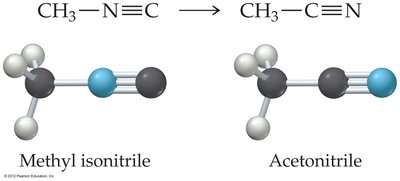
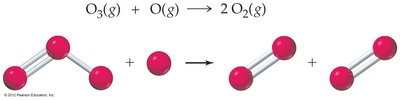
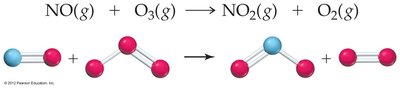
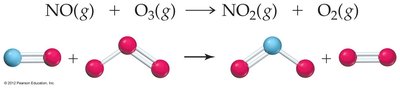
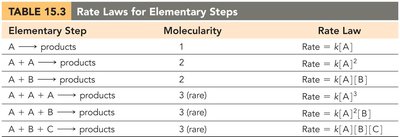
Reaction mechanisms describe the sequence of elementary steps by which a reaction occurs. Each step can be unimolecular, bimolecular, or (rarely) termolecular.
Unimolecular: One particle reacts by itself ()
Bimolecular: Two particles collide ( or )
Termolecular: Three particles collide (rare)
Rate Laws for Elementary Steps
Elementary Step | Molecularity | Rate Law |
|---|---|---|
A → products | 1 | Rate = k[A] |
A + A → products | 2 | Rate = k[A]^2 |
A + B → products | 2 | Rate = k[A][B] |
A + A + A → products | 3 (rare) | Rate = k[A]^3 |
A + A + B → products | 3 (rare) | Rate = k[A]^2[B] |
A + B + C → products | 3 (rare) | Rate = k[A][B][C] |
Multi-Step Mechanisms and Intermediates
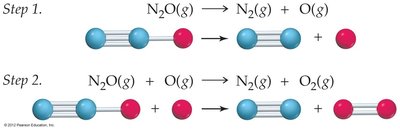
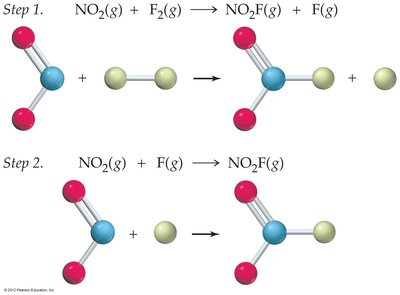
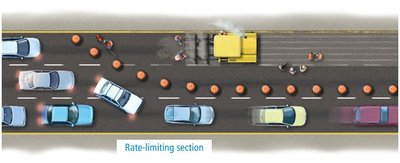
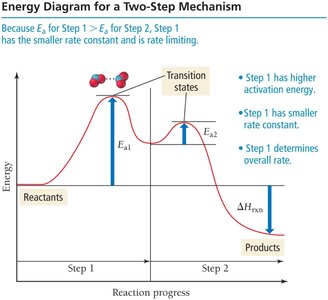
Many reactions occur in multiple steps, each with its own rate law. The slowest step determines the overall rate (rate-limiting step). Intermediates are species produced in one step and consumed in another.
Catalysis
Role of Catalysts
Catalysts increase the rate of a reaction by providing an alternative pathway with a lower activation energy. They are not consumed in the reaction.
Homogeneous Catalysts: Same phase as reactants (e.g., I– in aqueous H2O2 decomposition)
Heterogeneous Catalysts: Different phase (e.g., solid catalyst for gas or liquid reactants)
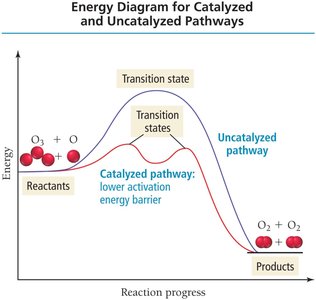
Energy Diagram for Catalyzed vs. Uncatalyzed Pathways
Catalysts lower the activation energy, increasing the fraction of successful collisions and thus the reaction rate.
Summary
Chemical kinetics explores how and why reaction rates vary.
Rate laws and integrated rate laws allow prediction of concentration changes over time.
Temperature, concentration, and catalysts are key factors in controlling reaction rates.
Reaction mechanisms provide insight into the molecular steps of reactions.
Catalysts are essential in both industrial and biological processes.
