 Back
BackChapter 17: Acids and Bases – General Chemistry II Study Notes
Study Guide - Smart Notes
 Tailored notes based on your materials, expanded with key definitions, examples, and context.
Acids and Bases
Definitions of Acids and Bases
Understanding acids and bases is fundamental in chemistry. There are three main definitions: Arrhenius, Brønsted-Lowry, and Lewis. Each definition broadens the scope of what can be considered an acid or a base.
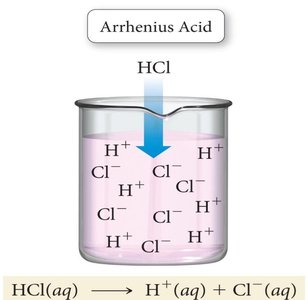
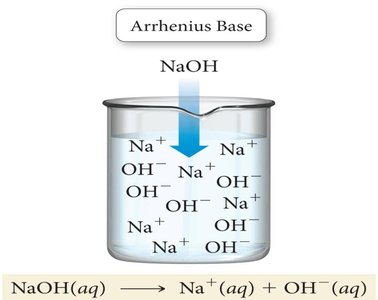
Arrhenius Acids and Bases: An Arrhenius acid produces H+ ions in water, while an Arrhenius base produces OH− ions in water.
Brønsted-Lowry Acids and Bases: A Brønsted-Lowry acid is a proton (H+) donor, and a Brønsted-Lowry base is a proton acceptor. Acid-base reactions involve the transfer of a proton from the acid to the base.
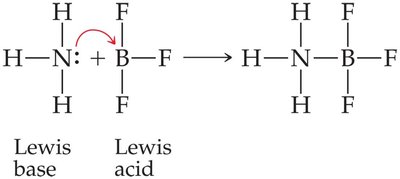
Lewis Acids and Bases: A Lewis acid is an electron pair acceptor, and a Lewis base is an electron pair donor. This definition includes more substances, such as metal ions, as acids.
Conjugate Acid-Base Pairs
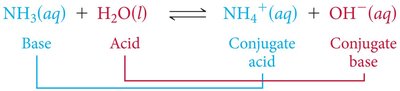
In Brønsted-Lowry theory, acids and bases always occur in pairs. When an acid donates a proton, it forms its conjugate base; when a base accepts a proton, it forms its conjugate acid.
Every acid has a conjugate base, and every base has a conjugate acid.
Example: NH3 + H2O ⇌ NH4+ + OH−

Water as a Solvent
Auto-Ionization of Water
Water is an amphoteric substance, meaning it can act as both an acid and a base. In pure water, two water molecules react to form hydronium and hydroxide ions:
H2O(l) + H2O(l) ⇌ H3O+(aq) + OH−(aq)
Or simply: H2O(l) ⇌ H+(aq) + OH−(aq)
Ion-Product Constant of Water, Kw
The equilibrium constant for the auto-ionization of water is called the ion-product constant, Kw:
At 25°C,
In neutral water, M$
pKw, pH, and pOH
The pH and pOH scales are logarithmic measures of hydronium and hydroxide ion concentrations, respectively:
at 25°C
at 25°C
pH Scale and Measurements
The pH Scale
The pH scale typically ranges from 0 (very acidic) to 14 (very basic), but values outside this range are possible. Each unit change in pH represents a tenfold change in [H+].
pH < 7: Acidic solution ()
pH = 7: Neutral solution ()
pH > 7: Basic solution ()


Calculating pH and pOH
To find [H3O+] from pH:
To find [OH−] from pOH:
To find pH from [OH−]: Calculate pOH, then use
pH Measurement
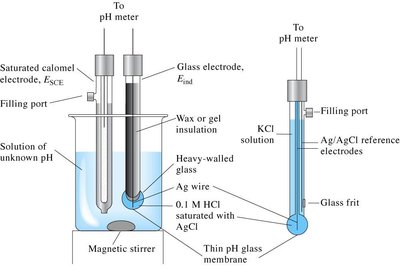
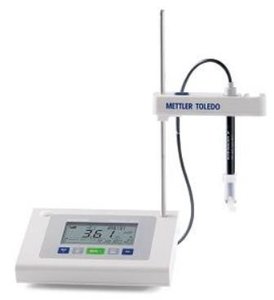
The pH of a solution is most accurately measured using a pH meter, which uses a glass electrode sensitive to [H3O+]. Less accurate methods include pH paper and indicators.

Weak Acids: Acid Dissociation Constant (Ka), % Ionization, and pH Calculations
Strong vs. Weak Acids
Strong acids ionize completely in water, while weak acids only partially ionize. The concentration of H+ in a strong acid solution equals the acid's molarity. For weak acids, equilibrium calculations are required.
Strong acids to memorize: HCl, HBr, HI, HNO3, HClO4, HClO3, H2SO4 (first proton only)
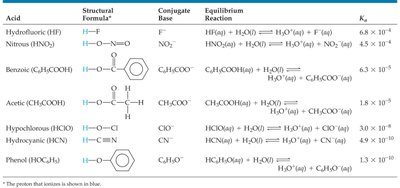
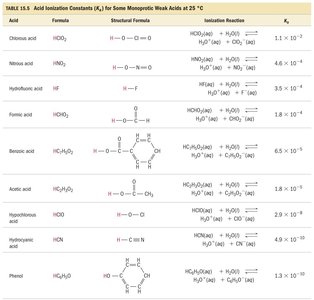
Acid Dissociation Constant (Ka)
The strength of a weak acid is quantified by its acid dissociation constant, Ka:
For HA(aq) + H2O(l) ⇌ H3O+(aq) + A−(aq):
The larger the Ka, the stronger the acid.
pKa is defined as ; smaller pKa means a stronger acid.

% Ionization of a Weak Acid
The percent ionization of a weak acid is the fraction of acid molecules that ionize in solution, expressed as a percentage:
As the acid is diluted, % ionization increases.

Calculating pH of a Weak Acid Solution
To calculate the pH of a weak acid solution, set up an ICE (Initial, Change, Equilibrium) table and solve for [H3O+] using Ka. If % ionization is less than 5%, the change in concentration (x) can be neglected in the denominator for simplification.
Example: For 0.15 M acetic acid (Ka = 1.8 × 10⁻⁵):
Set up: , solve for x, then
If % ionization ≤ 5%, the approximation is valid.
Concentration | [HC2H3O2], M | [H3O+], M | [C2H3O2−], M |
|---|---|---|---|
Initial | 0.15 | 0 | 0 |
Change | −x | +x | +x |
Equilibrium | 0.15−x | x | x |
Additional info: The ICE table method is a standard approach for equilibrium calculations in weak acid and base chemistry.
