 Back
BackChapter 17: Acids and Bases – General Chemistry Study Notes
Study Guide - Smart Notes
 Tailored notes based on your materials, expanded with key definitions, examples, and context.
Acids and Bases: Definitions and Concepts
Definitions of Acids and Bases
Acids and bases are fundamental chemical species with several definitions, each broadening the scope of what can be considered an acid or a base.
Arrhenius Definition:
Acid: Increases the concentration of H+ ions in aqueous solution.
Base: Increases the concentration of OH- ions in aqueous solution.
Brønsted-Lowry Definition:
Acid: Proton (H+) donor.
Base: Proton (H+) acceptor.
Lewis Definition:
Acid: Electron pair acceptor.
Base: Electron pair donor.
Example: HCl in water acts as an Arrhenius acid, a Brønsted-Lowry acid, and a Lewis acid.
Brønsted-Lowry Acids and Bases
The Brønsted-Lowry model is widely used to describe acid-base reactions in aqueous solutions.
General acid formula: HA
Reaction:
HA (acid) donates H+ to water, forming H3O+.
H2O (base) accepts H+ from HA.
A- is the conjugate base of acid HA.
H3O+ is the conjugate acid of base H2O.
Acid and Base Strength
Acid Dissociation Constant (Ka)
The strength of an acid is measured by its acid dissociation constant, Ka.
General reaction:
Simplified:
Equilibrium expression:
Interpretation:
Ka >> 1: Strong acid (almost complete dissociation)
Ka << 1: Weak acid (partial dissociation)
Acid/Base Strength Table
The following table summarizes the relative strengths of common acids and their conjugate bases:
Acid | Formula | Conjugate Base | Ka |
|---|---|---|---|
Hydrochloric | HCl | Cl- | Very large |
Sulfuric | H2SO4 | HSO4- | Very large |
Hydronium Ion | H3O+ | H2O | 1.0 |
Hydrofluoric | HF | F- | 7.2 × 10⁻⁴ |
Acetic | CH3COOH | CH3COO- | 1.8 × 10⁻⁵ |
Carbonic (1) | H2CO3 | HCO3- | 4.3 × 10⁻⁷ |
Ammonium ion | NH4+ | NH3 | 5.6 × 10⁻¹⁰ |
Carbonic (2) | HCO3- | CO32- | 4.8 × 10⁻¹¹ |
Water | H2O | OH- | 1.0 × 10⁻¹⁴ |
Additional info: The smaller the Ka value, the weaker the acid and the stronger its conjugate base.
The pH Scale and Calculations
The pH Scale
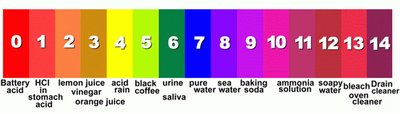
The pH scale is a logarithmic scale used to express the concentration of hydrogen ions in solution.
pH = –log[H+]
pOH = –log[OH-]
pKa = –log(Ka)
At 25°C, pH + pOH = 14
pH < 7: Acidic solution
pH = 7: Neutral solution
pH > 7: Basic solution
Calculating pH
For strong acids (e.g., HCl): Dissociate completely, so [H+] = initial acid concentration.
For weak acids (e.g., CH3COOH): Use an ICE table and Ka expression to solve for [H+].
Example:
0.10 M HCl (strong acid): [H+] = 0.10 M, pH = 1.0
0.10 M CH3COOH (weak acid): [H+] = 1.34 × 10⁻³ M, pH = 2.9
Percent Dissociation
Percent dissociation measures the fraction of acid molecules that ionize in solution.
Formula:
Base Strength and Calculations
Base Dissociation Constant (Kb)
The strength of a base is measured by its base dissociation constant, Kb.
General reaction:
Equilibrium expression:
Relationship Between Ka and Kb
For a conjugate acid-base pair in water:
at 25°C
If you know Ka for an acid, you can calculate Kb for its conjugate base and vice versa.
Calculating pH of Base Solutions
Strong bases (e.g., NaOH): [OH-] = initial base concentration, then calculate pOH and pH.
Weak bases (e.g., NH3): Use ICE table and Kb to solve for [OH-], then find pOH and pH.
Example: 0.2 M NH3 (Kb = 1.8 × 10⁻⁵): [OH-] = 1.9 × 10⁻³ M, pH = 11.27
Polyprotic Acids
Definition and Properties
Polyprotic acids can donate more than one proton per molecule (e.g., H2SO4, H2CO3).
Each dissociation step has its own Ka value (Ka1, Ka2, etc.).
The first dissociation usually contributes most to the pH.
Example: H2CO3:
First dissociation: , Ka1 = 4.3 × 10⁻⁷
Second dissociation: , Ka2 = 5.6 × 10⁻¹¹
Auto-Ionization of Water and the pH Scale
Auto-Ionization of Water
Water can act as both an acid and a base, undergoing auto-ionization:
Equilibrium constant: at 25°C
Acid/Base Properties of Salts
Salts in Solution
Salts are ionic compounds that can affect the pH of their aqueous solutions depending on the acid-base properties of their constituent ions.
Salts from strong acids and strong bases (e.g., NaCl) yield neutral solutions.
Salts from strong bases and weak acids (e.g., NaCH3COO) yield basic solutions.
Salts from weak bases and strong acids (e.g., NH4Cl) yield acidic solutions.
Example: 0.1 M NaCl solution is neutral; 0.1 M NH4Cl solution is acidic.
Calculating Overall K for Acid/Base Reactions
Combining Equilibria
When combining acid-base reactions, the overall equilibrium constant is the ratio of the product acid's Ka to the reactant acid's Ka:
Example: For the reaction CH3COOH + F- → HF + CH3COO-, use the Ka values of HF and CH3COOH to determine K.
Acids and Bases in Everyday Life
Common Examples
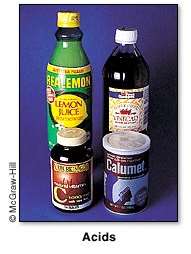
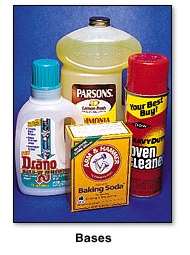
Acids and bases are found in many household products and foods.
Acids: Lemon juice, vinegar, vitamin C tablets, baking powder.
Bases: Ammonia solution, baking soda, oven cleaner, drain cleaner.
Environmental Context: Carbon Dioxide and Water
CO2 in Water
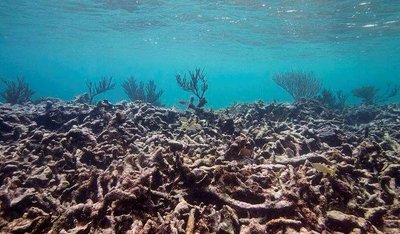
Carbon dioxide dissolves in water, forming carbonic acid and contributing to the acidity of natural waters.
Overall:
This process is important in environmental chemistry, such as ocean acidification and the dissolution of calcium carbonate (CaCO3).
Summary Table: Key Concepts in Acid-Base Chemistry
Concept | Key Points |
|---|---|
Acid/Base Definitions | Arrhenius, Brønsted-Lowry, Lewis |
Acid Strength | Measured by Ka; strong acids dissociate completely |
Base Strength | Measured by Kb; strong bases dissociate completely |
pH Scale | pH = –log[H+]; pH + pOH = 14 at 25°C |
Polyprotic Acids | More than one ionizable proton; each step has its own Ka |
Salt Solutions | pH depends on the acid/base properties of the ions |
CO2 in Water | Forms carbonic acid, affects environmental pH |
