 Back
BackChapter 17: Chemical Kinetics – Reaction Rates and Mechanisms
Study Guide - Smart Notes
 Tailored notes based on your materials, expanded with key definitions, examples, and context.
Chapter 17: Chemical Kinetics
Introduction to Chemical Kinetics
Chemical kinetics is the branch of chemistry that studies the rates at which chemical reactions occur and the factors that influence these rates. Unlike thermodynamics, which predicts whether a reaction is possible, kinetics explains how fast a reaction proceeds and the steps involved in the transformation from reactants to products.
Kinetics focuses on reaction rates and mechanisms.
Mechanism describes the sequence of steps (bond breaking/forming) in a reaction.
Kinetics does not determine if a reaction will occur (that is the domain of thermodynamics).
Chemical Reaction Rates
Definition and Measurement
The rate of a reaction is the change in concentration of a reactant or product per unit time. It is commonly expressed in units of molarity per second (M/s).
Rate =
For reactants: (negative because concentration decreases)
For products: (positive because concentration increases)
All reaction rates are presented as positive values.
Example: If the concentration of B increases from 0.034 M to 0.083 M in 14.8 s, the average rate is:
M/s
Stoichiometry and Rate Expressions
Reaction rates must be consistent with the stoichiometry of the balanced equation. For the reaction:
2N2O5(g) → 4NO2(g) + O2(g)
The rate expressions are:
Average vs. Instantaneous Reaction Rates
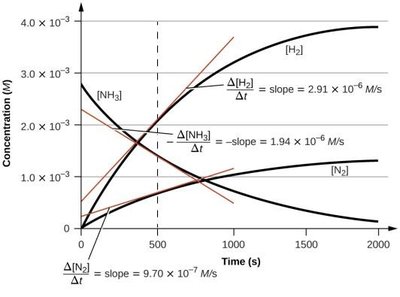
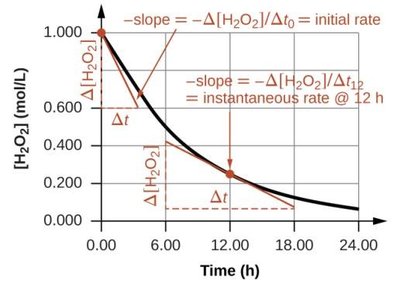
Average rate: Calculated over a time interval using initial and final concentrations. Instantaneous rate: The rate at a specific moment, determined by the slope of the tangent to the concentration vs. time curve.
Initial rate: The instantaneous rate at time zero.
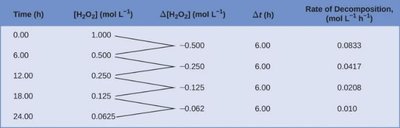
Tabular Data Example: Decomposition of H2O2
Time (h) | [H2O2] (mol L-1) | Δ[H2O2] (mol L-1) | Δt (h) | Rate of Decomposition (mol L-1 h-1) |
|---|---|---|---|---|
0.00 | 1.000 | -0.500 | 6.00 | 0.0833 |
6.00 | 0.500 | -0.250 | 6.00 | 0.0417 |
12.00 | 0.250 | -0.125 | 6.00 | 0.0208 |
18.00 | 0.125 | -0.062 | 6.00 | 0.010 |
24.00 | 0.0625 |
Factors Affecting Reaction Rates
Nature of Reactants
The chemical nature and inherent stability of reactants influence their reactivity. Unstable substances react more quickly.
Physical State and Surface Area
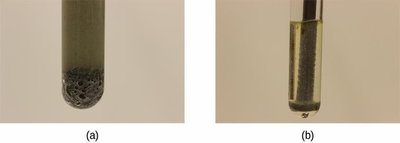
Reactions occur faster when reactants are in the same phase or have greater surface area contact.
Powdered solids react faster than large chunks due to increased surface area.
Temperature
Increasing temperature generally increases reaction rates by providing more kinetic energy for collisions.
Concentration
Higher concentrations of reactants lead to more frequent collisions and faster reactions.
Catalysts
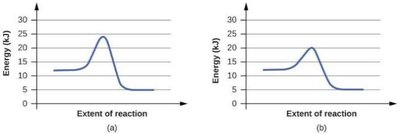
Catalysts speed up reactions by providing alternative pathways with lower activation energies, without being consumed.
Rate Laws and Reaction Order
Rate Law Definition
The rate law expresses the relationship between the reaction rate and the concentrations of reactants. For a general reaction:
A + B → products
Rate = k[A]m[B]n
m and n are the orders with respect to A and B, respectively, and must be determined experimentally.
k is the rate constant, specific to each reaction and temperature.
Determining Reaction Order: Method of Initial Rates
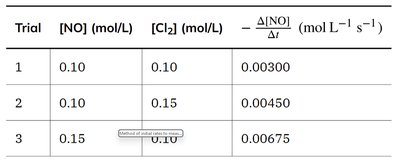
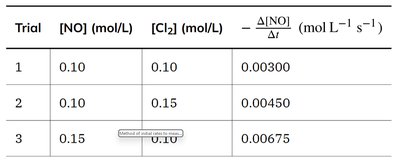
By measuring initial rates at different reactant concentrations, the order with respect to each reactant can be found.
Trial | [NO] (mol/L) | [Cl2] (mol/L) | −Δ[NO]/Δt (mol L−1 s−1) |
|---|---|---|---|
1 | 0.10 | 0.10 | 0.00300 |
2 | 0.10 | 0.15 | 0.00450 |
3 | 0.15 | 0.10 | 0.00675 |
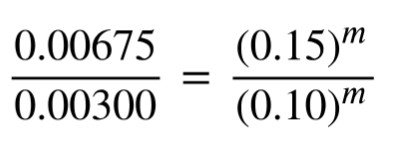
To determine the order with respect to NO:
Simplifies to
To determine the order with respect to Cl2:
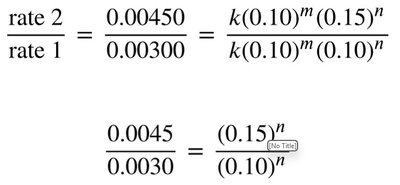
Thus, the rate law is:
Rate = k[NO]2[Cl2]

Integrated Rate Laws
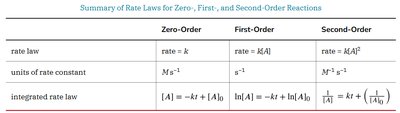
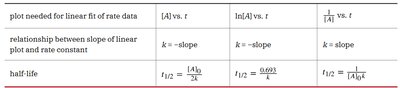
Zero, First, and Second Order Reactions
Integrated rate laws relate concentration and time for different reaction orders.
Zero-Order | First-Order | Second-Order | |
|---|---|---|---|
Rate Law | rate = k | rate = k[A] | rate = k[A]2 |
Integrated Rate Law | |||
Half-life |
Graphical Representation
First-order: Plot of ln[A] vs. time is linear (slope = –k).
Second-order: Plot of 1/[A] vs. time is linear (slope = k).
![Second-order reaction: 1/[A] vs. time plot](https://static.studychannel.pearsonprd.tech/study_guide_files/general-chemistry/sub_images/51858a89_image_17.png)
Collision Theory and Activation Energy
Collision Theory
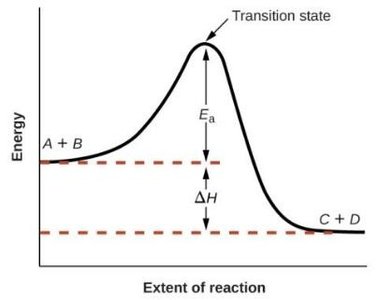
Reactants must collide with sufficient energy and proper orientation to react. Only a fraction of collisions are effective.
Activation energy (Ea): Minimum energy required for a reaction to occur.
Transition state: High-energy, unstable arrangement of atoms at the peak of the energy diagram.
Effect of Temperature
Increasing temperature increases the fraction of molecules with energy ≥ Ea, thus increasing the reaction rate.
Arrhenius Equation
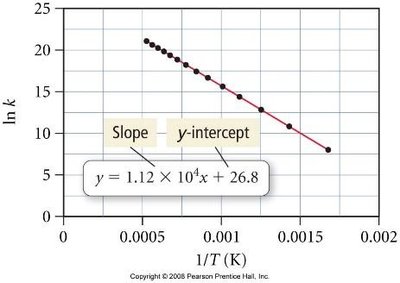
The Arrhenius equation relates the rate constant (k) to temperature (T) and activation energy (Ea):
ln(k) = ln(A) –
Reaction Mechanisms
Elementary Steps and Molecularity
Most reactions occur via a series of elementary steps. The molecularity of a step is the number of reactant particles involved:
Unimolecular: One particle (rate = k[A])
Bimolecular: Two particles (rate = k[A][B] or k[A]2)
Termolecular: Three particles (rare; rate = k[A][B][C])
Rate-Determining Step
The slowest step in a reaction mechanism determines the overall rate law. The rate law for the overall reaction matches the rate law for the rate-determining step.

Validating Mechanisms
Elementary steps must sum to the overall reaction.
The predicted rate law must match the experimentally observed rate law.
Catalysis and Enzymes
Catalysts
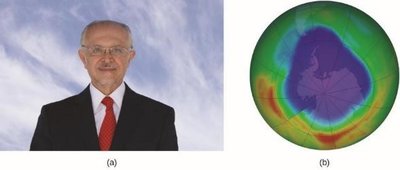
A catalyst increases the rate of a reaction by providing an alternative pathway with a lower activation energy. It is not consumed in the reaction and is regenerated at the end.
Homogeneous catalyst: Same phase as reactants.
Heterogeneous catalyst: Different phase than reactants.
Enzymes
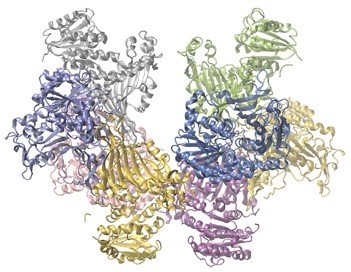
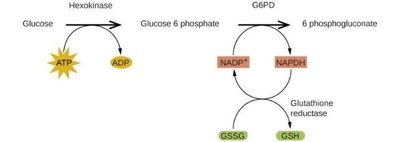
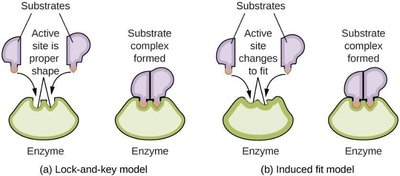
Enzymes are biological catalysts, usually proteins, that speed up biochemical reactions by lowering activation energy. They bind substrates at their active sites, often using a lock-and-key or induced fit model.
Additional info: This summary covers all major aspects of chemical kinetics, including reaction rates, rate laws, integrated rate laws, collision theory, reaction mechanisms, catalysis, and enzyme activity, as outlined in a standard general chemistry curriculum.
