 Back
BackChapter 18: Ionic Equilibrium – Buffers, Titrations, and Solubility
Study Guide - Smart Notes
 Tailored notes based on your materials, expanded with key definitions, examples, and context.
Chapter 18: Ionic Equilibrium
Introduction to Ionic Equilibrium
Ionic equilibrium involves the balance between ions in solution, particularly in weak acid and base systems, buffer solutions, and solubility equilibria. Understanding these concepts is essential for predicting the behavior of solutions in chemical reactions and biological systems.
Buffers: Solutions that Resist pH Changes
Definition and Importance of Buffers
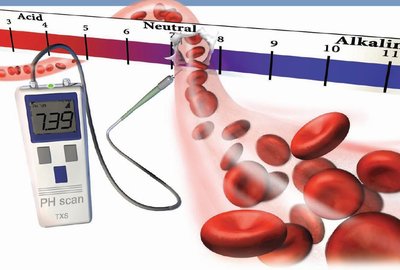
Buffers are solutions that resist changes in pH when small amounts of acid or base are added. They are crucial in biological and chemical systems where maintaining a stable pH is necessary, such as in blood plasma.
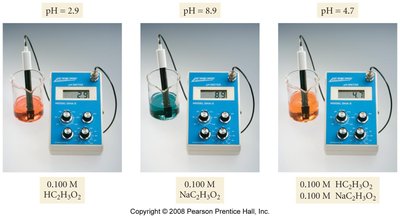
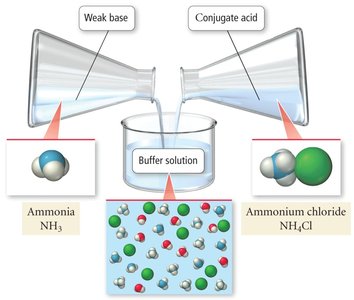
Composed of significant amounts of a weak acid and its conjugate base, or a weak base and its conjugate acid.
Example: Blood contains a buffer system of H2CO3 (carbonic acid) and HCO3− (bicarbonate).
How Buffers Work
Buffers function by neutralizing added acids (H3O+) or bases (OH−), minimizing pH changes.
When acid is added, the conjugate base reacts with H3O+ to form the weak acid.
When base is added, the weak acid reacts with OH− to form the conjugate base and water.
The Common Ion Effect
The common ion effect occurs when a solution contains two substances that share a common ion, suppressing the ionization of a weak acid or base and stabilizing the pH.
Buffer Range and Buffer Capacity
Buffer Range
The buffer range is the pH range over which a buffer is effective. A buffer is most effective when the concentrations of acid and base are nearly equal.
Effective when
Effective pH range:
Buffer Capacity
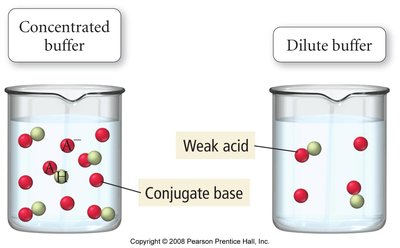
Buffer capacity is the amount of acid or base a buffer can neutralize before the pH changes significantly. It increases with the absolute concentrations of the buffer components.
Concentrated buffers have higher capacity than dilute buffers.
Effectiveness of Buffers
Most effective when
Effective when
Calculating Buffer pH: The Henderson-Hasselbalch Equation
Henderson-Hasselbalch Equation
The pH of a buffer can be calculated using the Henderson-Hasselbalch equation:
= concentration of conjugate base
= concentration of weak acid
Example Calculation
Calculate the pH of a buffer containing 0.14 M HF (pKa = 3.15) and 0.071 M KF:
Buffer pH Change Upon Addition of Acid or Base
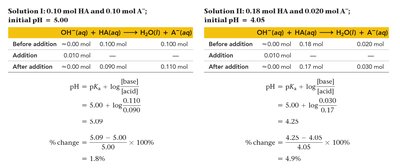
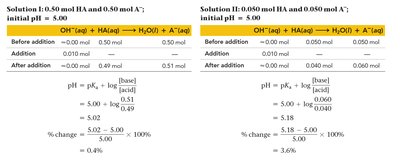
When a strong acid or base is added to a buffer, perform a stoichiometry calculation to determine the new concentrations, then recalculate pH using the Henderson-Hasselbalch equation.
Titration and Titration Curves
Acid-Base Titration
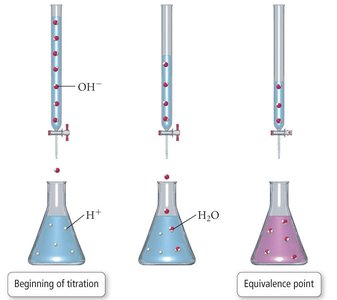
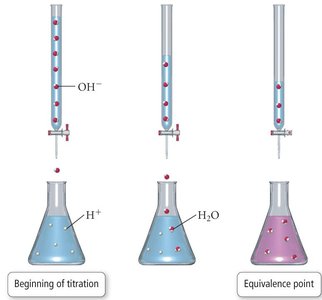
Titration is a laboratory technique used to determine the concentration of an unknown acid or base by reacting it with a standard solution of known concentration.
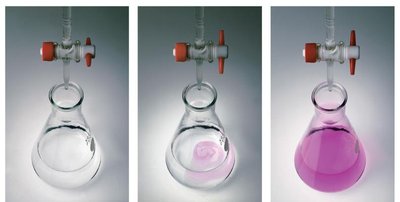
The equivalence point is reached when the amount of titrant added is stoichiometrically equivalent to the amount of analyte present.
The end point is detected by an indicator, which changes color near the equivalence point.
Titration Curves
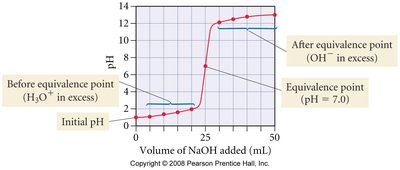
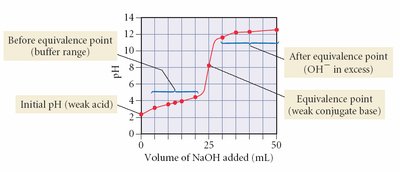
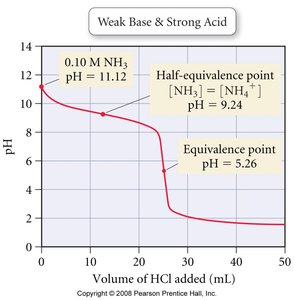
A titration curve is a plot of pH versus volume of titrant added. The shape of the curve depends on the strengths of the acid and base involved.
Strong acid with strong base: sharp rise at equivalence point (pH = 7).
Weak acid with strong base: buffer region before equivalence point, equivalence point at pH > 7.
Weak base with strong acid: buffer region before equivalence point, equivalence point at pH < 7.
Polyprotic acids: multiple equivalence points.
Indicators
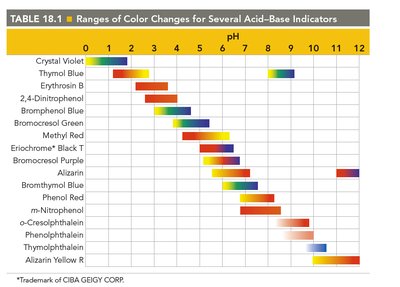
Acid-base indicators are weak acids or bases that change color at specific pH ranges, used to signal the end point of a titration.
Indicator | pH Range |
|---|---|
Methyl Red | 4.2–6.3 |
Phenolphthalein | 8.3–10.0 |
Bromothymol Blue | 6.0–7.6 |
Solubility Equilibria
Solubility Product Constant (Ksp)
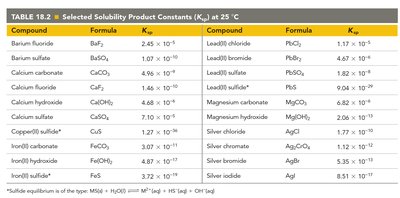
The solubility product constant, , expresses the equilibrium between a solid and its ions in a saturated solution.
For :
Low indicates low solubility.
Compound | Ksp | Solubility (M) |
|---|---|---|
Mg(OH)2 | 2.06 × 10⁻¹³ | 3.72 × 10⁻⁵ |
CaF2 | 1.46 × 10⁻¹⁰ | 3.32 × 10⁻⁴ |
Calculating Molar Solubility
To find the molar solubility of a salt, set up an ICE table and solve for the concentration of ions at equilibrium.
For :
Common Ion Effect on Solubility
The presence of a common ion decreases the solubility of a salt due to Le Châtelier's principle.
Example: Adding NaCl to a PbCl2 solution decreases PbCl2 solubility.
Effect of pH on Solubility
The solubility of salts containing basic anions increases as pH decreases (solution becomes more acidic).
Examples: PbS, MgCO3, Ca(OH)2
Precipitation and Separation of Ions
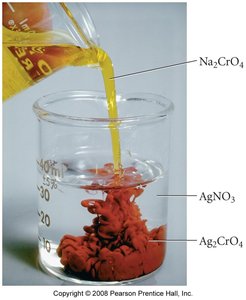
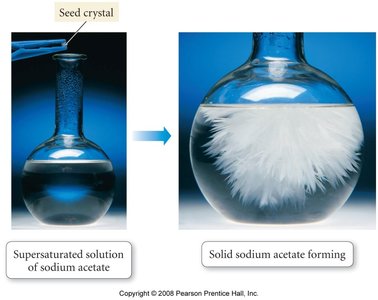
Precipitation Conditions
Precipitation occurs when the ion product exceeds :
If , precipitation occurs.
If , no precipitation.
Complex Ion Equilibria
Complex Ion Formation
Complex ions are formed when a metal cation binds to one or more ligands (Lewis bases) via coordinate covalent bonds.
Example:
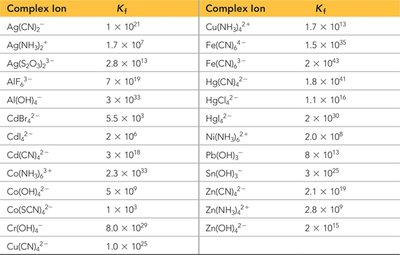
The equilibrium constant for complex ion formation is the formation constant ():
Complex Ion | Kf |
|---|---|
Ag(NH3)2+ | 1.7 × 10⁷ |
Cu(NH3)42+ | 1.7 × 10¹³ |
Effect of Complex Ion Formation on Solubility
The solubility of a salt containing a metal cation increases in the presence of ligands that form stable complex ions with the cation.
Example: Adding NH3 to AgCl increases AgCl solubility by forming [Ag(NH3)2]+.
Additional info: This guide covers the essential concepts of ionic equilibrium, buffer systems, titration analysis, solubility equilibria, precipitation, and complex ion formation, as outlined in a standard general chemistry curriculum.
