 Back
BackChapter 19: Chemical Thermodynamics – Study Notes
Study Guide - Smart Notes
 Tailored notes based on your materials, expanded with key definitions, examples, and context.
Chapter 19: Chemical Thermodynamics
19.1 Spontaneous Processes
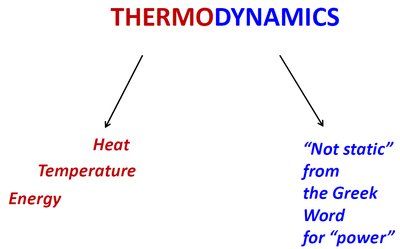
Chemical thermodynamics studies energy changes and the direction of chemical and physical processes. A spontaneous process is one that occurs without continuous external intervention. The spontaneity of a process is determined by thermodynamic properties, not by the rate at which it occurs.
Thermodynamics tells us if a process can occur (spontaneity).
Kinetics tells us how fast a process occurs.
Equilibrium describes the extent to which a reaction proceeds.

Example: The conversion of diamond to graphite is thermodynamically favorable but occurs extremely slowly due to kinetic barriers.
At equilibrium, the rates of the forward and reverse reactions are equal, and concentrations remain constant.
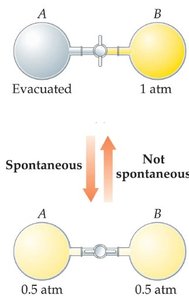
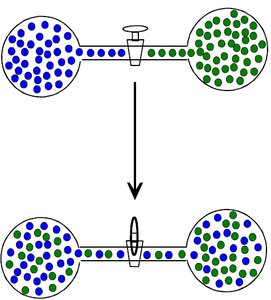
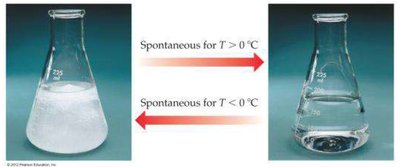
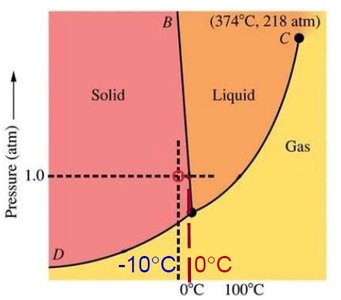
Spontaneity depends on conditions such as temperature and pressure. For example, ice melts spontaneously above 0°C but freezes spontaneously below 0°C.
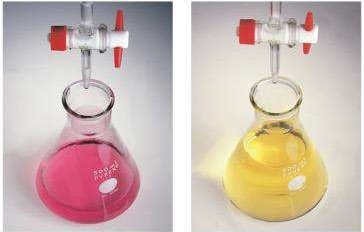
Spontaneous does not mean fast. For example, rusting of iron is spontaneous but slow, while acid-base neutralization is spontaneous and fast.
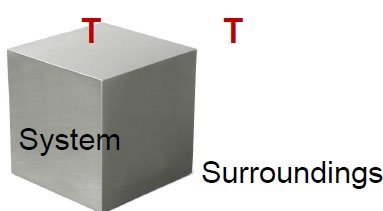
The First Law of Thermodynamics (Law of Conservation of Energy) states that energy cannot be created or destroyed, only transferred or converted. However, it does not predict spontaneity or equilibrium position.
Energy lost by the system = Energy gained by the surroundings, and vice versa.
Equation:
To determine spontaneity, we must consider enthalpy (H) and entropy (S) in addition to internal energy (U).
Enthalpy (H): Heat absorbed or released at constant pressure.
Entropy (S): Measure of disorder or randomness in a system.

Reversible and Irreversible Processes
A reversible process can be reversed by infinitesimal changes, restoring both system and surroundings to their original states. In reality, all real processes are irreversible due to friction, dissipation, or other factors.
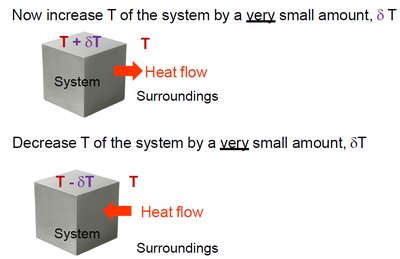
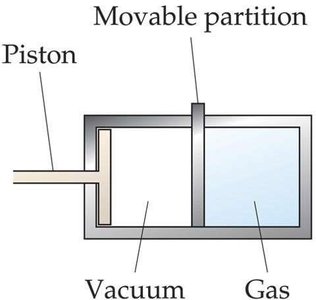
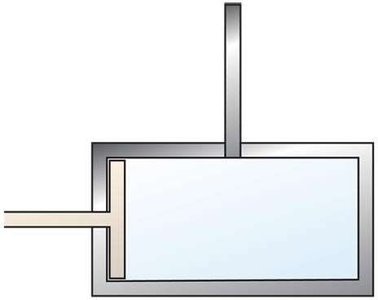
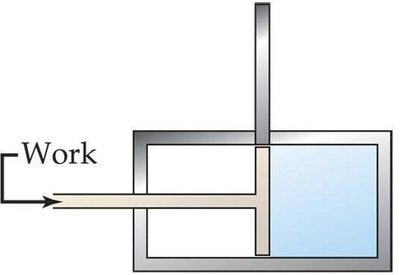
All spontaneous processes are irreversible, but not all irreversible processes are spontaneous.
The driving force for spontaneity is the tendency toward greater disorder (higher probability states).
19.2 Entropy and the Second Law of Thermodynamics
Entropy (S) quantifies the extent of disorder or randomness in a system. It is a state function, meaning its change depends only on the initial and final states, not the path taken.

For an isothermal process (constant temperature):

Units: J·K⁻¹
Entropy change for the universe:
For spontaneous processes:
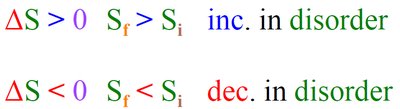

The Second Law of Thermodynamics states that the entropy of the universe increases for spontaneous processes and remains unchanged for reversible processes.

19.3 The Molecular Interpretation of Entropy and the Third Law of Thermodynamics
Entropy is related to the number of possible microstates (W) of a system. The more microstates, the higher the entropy.
Boltzmann's Equation: where J/K (Boltzmann constant).
Change in entropy:
Molecular motions contribute to entropy:
Translational: Movement through space (3 modes).
Rotational: Rotation about axes (2 for linear, 3 for nonlinear molecules).
Vibrational: Oscillation of atoms (3N-5 for linear, 3N-6 for nonlinear molecules, where N = number of atoms).
As molecular complexity increases, so does entropy.
Entropy increases with phase changes (solid → liquid → gas), temperature, number of particles, molecular complexity, and volume.
Breaking intermolecular forces (e.g., dissolving salt in water) increases entropy.
19.4 Entropy Changes in Chemical Reactions
Standard molar entropy (S°) is the entropy of 1 mol of a substance in its standard state (1 atm, 298 K, 1 M for solutions). S° values are always positive and increase with molar mass and molecular complexity.
Aspect | Standard Molar Entropy (S°) | Standard Molar Enthalpy of Formation (ΔHf°) |
|---|---|---|
Definition | Entropy of 1 mol in standard state | Enthalpy change for forming 1 mol from elements |
Reference Value | Not zero for elements at 298 K | Zero for elements at 298 K |
Units | J·mol⁻¹·K⁻¹ | kJ·mol⁻¹ |
Dependence | Increases with molar mass & complexity | Depends on bond energies |
Phase Trend | Gases > liquids > solids | No general order |
Use | Calculate ΔS° for reactions | Calculate ΔH° for reactions |
Standard entropy change for a reaction:
19.5 Gibbs Free Energy (G)
Gibbs free energy (G) is the energy available to do useful work at constant temperature and pressure. It predicts spontaneity:
Change in free energy:
Standard free energy change:
If , the process is spontaneous; if , non-spontaneous; if , equilibrium.
19.6 Free Energy and Temperature
The temperature dependence of is primarily due to the term. For example, ice melts spontaneously above 0°C () and freezes below 0°C ().
At the temperature where :
19.7 Free Energy and the Equilibrium Constant (K)
The relationship between free energy and equilibrium constant is given by:
At equilibrium (, ):
If , (products favored).
If , (reactants favored).
If , (equilibrium).
Summary Table: Key Thermodynamic Quantities
Quantity | Symbol | Definition | Units |
|---|---|---|---|
Enthalpy | H | Heat at constant pressure | J or kJ |
Entropy | S | Disorder/randomness | J·K⁻¹ |
Gibbs Free Energy | G | Energy available for work | J or kJ |
Key Equations:
First Law:
Entropy (isothermal):
Gibbs Free Energy:
Equilibrium:
