 Back
Chapter 19: Chemical Thermodynamics – Study Notes
Study Guide - Smart Notes
 Tailored notes based on your materials, expanded with key definitions, examples, and context.
Chapter 19: Chemical Thermodynamics
Introduction to Chemical Thermodynamics
Chemical thermodynamics is the study of heat, work, and energy changes in chemical systems. It helps us understand why certain reactions occur spontaneously and others do not, and how energy is transferred between a system and its surroundings.
System: The part of the universe under study (e.g., the contents of a flask).
Surroundings: Everything outside the system.
Energy (ΔE): The capacity to do work or transfer heat.
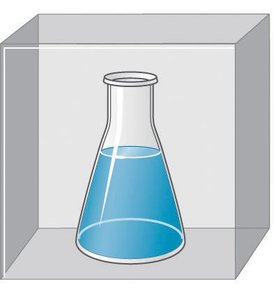
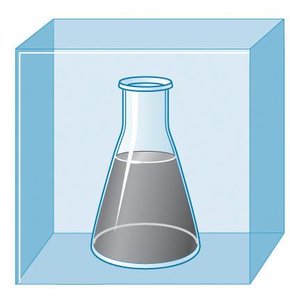
Forms of Energy and the First Law of Thermodynamics
The first law of thermodynamics states that energy cannot be created or destroyed, only transferred or transformed. The change in internal energy (ΔE) of a system is given by:
ΔE = q + w, where q is heat and w is work.
At constant pressure and volume, ΔE = q.
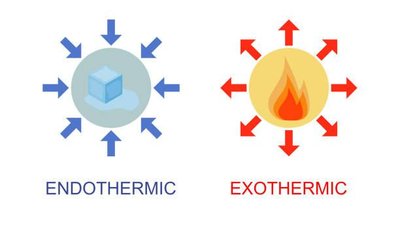
Energy changes can be classified as:
Endothermic: System absorbs heat from surroundings.
Exothermic: System releases heat to surroundings.
19.1 – Spontaneous and Nonspontaneous Processes
Thermodynamic processes are directional. A spontaneous process occurs naturally without external work, while a nonspontaneous process requires energy input.
Spontaneous processes can be irreversible (occur in one direction only) or reversible (can proceed in both directions under specific conditions).
Example: Rusting of iron is a spontaneous process.


19.2 – Entropy and the Second Law of Thermodynamics
Entropy (S) is a measure of the disorder or randomness of a system. The second law of thermodynamics states that the entropy of the universe increases in any spontaneous process.
ΔS = S_{final} - S_{initial}
Spontaneous processes are accompanied by an increase in entropy.

19.3 – Molecular Interpretation of Entropy (Third Law of Thermodynamics)
Entropy can be understood in terms of the number of possible arrangements (microstates) of particles in a system. The third law of thermodynamics states that the entropy of a perfect crystal at absolute zero (0 K) is zero.
Microstate: A specific arrangement of the positions and energies of particles.
More microstates = higher entropy.
Types of molecular motion contributing to entropy:
Translational motion: Movement through space.
Vibrational motion: Atoms vibrating within molecules.
Rotational motion: Molecules rotating about axes.
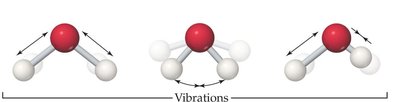
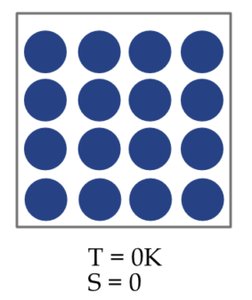
Degrees of Freedom and Entropy
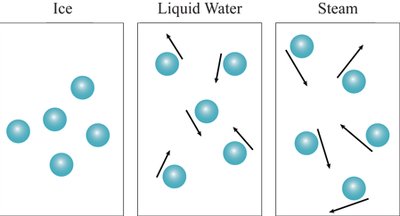
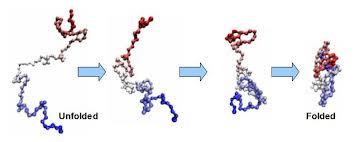
The number of ways molecules can organize or orient themselves (degrees of freedom) increases with:
Increasing number of particles
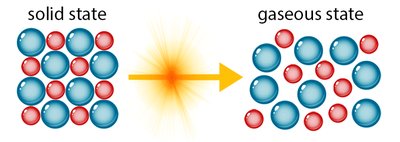
Phase changes (solid → liquid → gas)
Increasing temperature
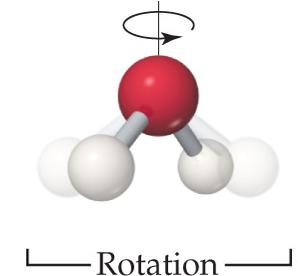
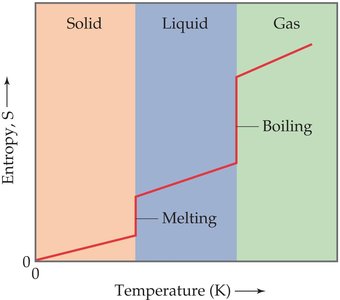
Examples of Entropy Changes
Solid to gas: Entropy increases (e.g., CO2(s) → CO2(g)).
Formation of a solid from ions in solution: Entropy decreases (e.g., Ag+(aq) + Cl-(aq) → AgCl(s)).
19.4 – Entropy Changes in Chemical Reactions
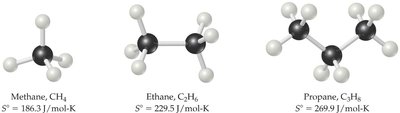
Entropy changes can be calculated for chemical reactions using standard molar entropy values (S˚) from reference tables (Appendix C).
Standard molar entropy (S˚): Entropy of 1 mol of a substance in its standard state.
ΔS˚ = Σ S˚(products) – Σ S˚(reactants)
19.5 – Gibbs Free Energy
Gibbs Free Energy (G) combines enthalpy (ΔH) and entropy (ΔS) to predict spontaneity at constant temperature and pressure. A process is spontaneous if ΔG is negative.
ΔG = ΔH – TΔS
ΔG˚: Standard Gibbs Free Energy change (standard conditions).
Calculated from standard enthalpy and entropy values, or from standard Gibbs Free Energies of formation (ΔG˚f).
19.6 – Free Energy and Temperature
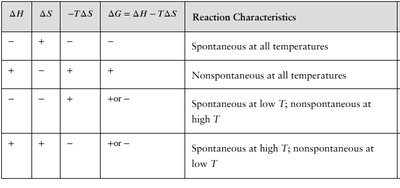
The spontaneity of a reaction depends on the signs and magnitudes of ΔH and ΔS, and the temperature (T). The table below summarizes the relationship:
ΔH | ΔS | –TΔS | ΔG = ΔH – TΔS | Reaction Characteristics |
|---|---|---|---|---|
– | + | – | – | Spontaneous at all temperatures |
+ | – | + | + | Nonspontaneous at all temperatures |
– | – | + | +/– | Spontaneous at low T; nonspontaneous at high T |
+ | + | – | +/– | Spontaneous at high T; nonspontaneous at low T |
Example: Melting Ice
H2O(s) → H2O(l)
ΔH = (+), ΔS = (+)
Spontaneous at high temperatures (above 0°C)
19.7 – Free Energy and the Equilibrium Constant
Gibbs Free Energy is related to the equilibrium constant (K) of a reaction. At equilibrium, ΔG = 0 and Q = K.
ΔG = ΔG˚ + RT \ln Q
At equilibrium: ΔG˚ = –RT \ln K
K = e^{–ΔG˚/RT}
Where R is the gas constant (8.314 J/mol·K) and T is temperature in Kelvin.
Practice Problems
Compare entropy for different substances and predict which has greater entropy.
Predict the sign of ΔS for various physical and chemical changes.
Calculate ΔS˚ and ΔG˚ for reactions using standard values.
Relate ΔG˚ to the equilibrium constant K for a reaction.
