 Back
BackChapter 19: Free Energy and Thermodynamics – Study Notes
Study Guide - Smart Notes
 Tailored notes based on your materials, expanded with key definitions, examples, and context.
Free Energy and Thermodynamics
Introduction to Spontaneity and Thermodynamics
Thermodynamics allows us to predict whether a chemical or physical process will occur spontaneously under given conditions. Spontaneous processes proceed without continuous external influence, but spontaneity is not related to the rate of the process. Understanding spontaneity involves concepts such as entropy, free energy, and the laws of thermodynamics.
Spontaneous process: Occurs naturally without ongoing outside intervention (e.g., ice melting at room temperature, combustion of methane).
Nonspontaneous process: The reverse of a spontaneous process; does not occur naturally without external input.
Key questions: Can we change conditions to make a nonspontaneous process occur? What determines the value of the equilibrium constant (K)?
Spontaneity and Probability
Probability and Molecular Arrangements
The likelihood of a process is related to the number of ways particles can be arranged. For example, with four distinguishable molecules in a box, the most probable arrangement is an even distribution on both sides. As the number of particles increases, the probability of observing the most probable state increases dramatically.
Probability of a state: Number of arrangements for that state divided by the total number of arrangements.
Most probable state: The arrangement with the highest number of possible configurations.
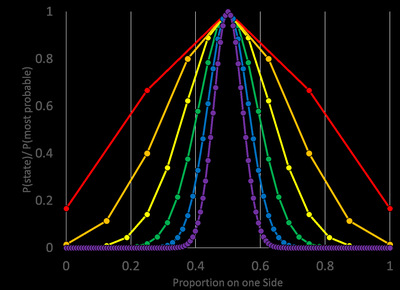
Additional info: The graph shows how, as the number of particles increases, the probability distribution becomes sharply peaked around the most probable state (even distribution).
Entropy and Boltzmann's Equation
Entropy (S) is a measure of the disorder or randomness of a system and is the driving force for spontaneous processes. The relationship between entropy and probability is given by Boltzmann's equation:
Boltzmann's equation:
kB: Boltzmann constant ( J K-1)
W: Number of microstates (ways to arrange the system)
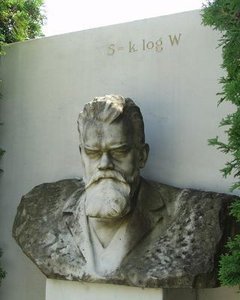
Additional info: The equation is inscribed on a monument, highlighting its foundational role in statistical thermodynamics.
Entropy and Physical States
Entropy and Phases of Matter
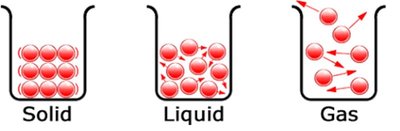
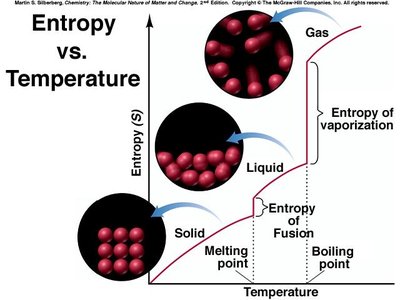
Entropy increases as matter transitions from solid to liquid to gas. This is because the number of possible arrangements (microstates) increases as particles become more free to move.
Solids: Lowest entropy (particles fixed in place)
Liquids: Intermediate entropy (particles can move past each other)
Gases: Highest entropy (particles move freely and occupy more space)
Energy, Work, and Entropy Changes
First Law of Thermodynamics and Work
The first law of thermodynamics states that the energy of the universe is constant. For a system, the change in internal energy () is the sum of heat () and work ():
For gases, (work done by the system during expansion)
1 L·atm = 101.3 J (unit conversion for work)
Isothermal Expansion of an Ideal Gas
Isothermal processes occur at constant temperature. The work done during isothermal, reversible expansion of an ideal gas is maximized and can be calculated using calculus.
Reversible process: Transformation done in infinitely small steps, yielding maximum work.
Work for reversible isothermal expansion:
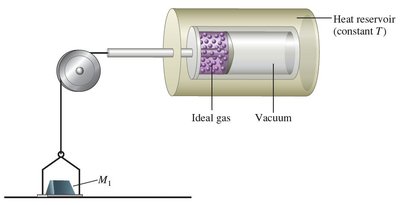
Additional info: The apparatus demonstrates how work is done by an ideal gas against a constant external pressure at constant temperature.
PV Diagrams and Work
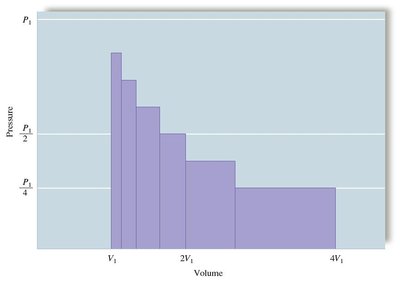
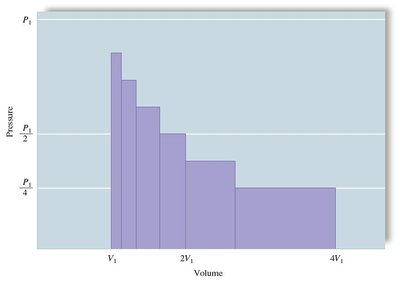
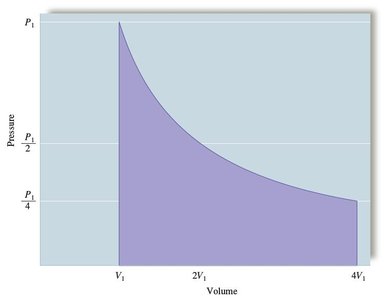
PV diagrams visually represent the work done during gas expansion. The area under the curve corresponds to the work performed. More steps in the expansion (approaching a reversible process) yield more work.
Two-step vs. six-step expansion: More steps mean the process is closer to reversible and more work is done.
Infinite-step (reversible) expansion: Maximum possible work is achieved.
Entropy Calculations
Definition and Calculation of Entropy Change
Entropy change () for a process can be calculated using the heat transferred in a reversible process divided by the temperature:
For isothermal expansion of an ideal gas: , so
For temperature changes at constant volume or pressure: or
For phase changes: (fusion), (vaporization)
Entropy and Temperature
Entropy increases with temperature. The relationship between entropy and temperature for phase changes and heating is illustrated in the following diagram:
The Second and Third Laws of Thermodynamics
The Second Law of Thermodynamics
The second law states that the entropy of the universe increases for a spontaneous process:
for spontaneous processes
If , the process is nonspontaneous
If , the process is reversible (at equilibrium)
The Third Law of Thermodynamics
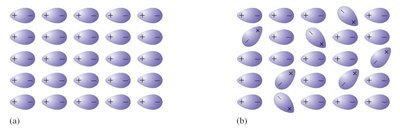
The third law states that the entropy of a perfect crystal at absolute zero (0 K) is zero. At this temperature, the crystal is perfectly ordered, and there is only one possible arrangement (microstate).
; if , then
Gibbs Free Energy and Spontaneity
Gibbs Free Energy (G)
Gibbs free energy determines the spontaneity of a process at constant temperature and pressure. It is defined as:
Change in free energy:
Spontaneity conditions:
: Spontaneous process
: Nonspontaneous process
: System at equilibrium
Relationship to entropy of the universe:
(at constant T and P)
Predicting Spontaneity with Enthalpy and Entropy
The sign of depends on the signs of and :
and : Spontaneous at all temperatures
and : Spontaneous at high temperatures
and : Spontaneous at low temperatures
and : Never spontaneous
Standard Molar Entropy and Entropy Changes in Reactions
Standard Molar Entropy (So)
Standard molar entropy is the entropy of one mole of a substance in its standard state at 1 bar and 25°C. Gases generally have higher entropy than liquids or solids, and more complex molecules have higher entropy values.
Calculating Entropy Change for a Reaction
The standard entropy change for a reaction is calculated as:
Free Energy, Equilibrium, and the Equilibrium Constant
Relationship Between Free Energy and Equilibrium
The standard free energy change () is related to the equilibrium constant () by:
At equilibrium (), :
Effect of Temperature on K (van't Hoff Equation)
The van't Hoff equation relates the change in the equilibrium constant with temperature:
Summary Table: Spontaneity, Free Energy, and Equilibrium
Condition | ΔGo | K | Favorability |
|---|---|---|---|
Spontaneous | < 0 | > 1 | Product favored |
Nonspontaneous | > 0 | < 1 | Reactant favored |
Equilibrium | = 0 | = 1 | Neither favored |
Key Concepts for Exam Preparation
Definition and calculation of entropy and free energy
Relationship between entropy, probability, and spontaneity
How to use to predict spontaneity
How to calculate entropy and free energy changes for reactions and phase changes
Relationship between and the equilibrium constant
Effect of temperature on equilibrium (van't Hoff equation)
