 Back
BackChapter 21: Nuclear Chemistry – Study Notes
Study Guide - Smart Notes
 Tailored notes based on your materials, expanded with key definitions, examples, and context.
Chapter 21: Nuclear Chemistry
Introduction to Nuclear Chemistry
Nuclear chemistry is the study of the structure of atomic nuclei and the changes they undergo. Unlike chemical reactions, which involve electrons, nuclear reactions involve changes in the nucleus and can result in the transformation of one element into another. These reactions release or absorb much greater amounts of energy than chemical reactions.
Nuclear reactions can change one element into another and involve protons and neutrons.
Chemical reactions only rearrange electrons and do not change the identity of elements.
Nuclear reactions are not affected by temperature, pressure, or catalysts, unlike chemical reactions.
The Nucleus and Subatomic Particles
The nucleus is a dense region at the center of an atom, composed of protons and neutrons (collectively called nucleons). Protons and neutrons themselves are made of quarks. The nucleus is held together by the strong nuclear force, which acts over very short distances.
Proton (p or p+): Mass = 1.0073 amu, Charge = +1
Neutron (n or n0): Mass = 1.0087 amu, Charge = 0
Electron (e-): Mass = 0.0005458 amu, Charge = -1
Nuclear diameter ≈ 10-12 cm; density ≈ 2 × 10¹⁴ g/cm3
Neutron-Proton Ratio and Nuclear Stability
The stability of a nucleus depends on its neutron-to-proton (n/p) ratio. Isotopes are atoms of the same element with different numbers of neutrons. Nuclei with even numbers of protons and neutrons are generally more stable. Certain numbers of nucleons, called magic numbers (2, 8, 20, 28, 50, 82, 126), confer extra stability due to closed nuclear shells.
Nuclear Stability and Binding Energy
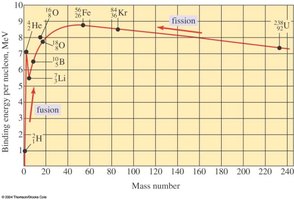
The mass defect is the difference between the mass of a nucleus and the sum of the masses of its individual protons and neutrons. This missing mass has been converted into binding energy, which holds the nucleus together. The binding energy can be calculated using Einstein’s equation:
where is the mass defect and is the speed of light.
Radioactive Decay
Nuclei that are unstable due to their n/p ratio undergo radioactive decay, emitting particles or radiation to become more stable. The type of decay depends on the position of the nucleus relative to the band of stability.
Alpha (α) decay: Emission of a helium nucleus ()
Beta (β) decay: Emission of an electron () or positron ()
Gamma (γ) emission: Emission of high-energy photons
Radioactive decay changes the identity or energy state of the nucleus and is accompanied by a change in binding energy.
Equations for Nuclear Reactions
Nuclear reaction equations must obey two conservation laws:
The sum of mass numbers (A) is conserved.
The sum of atomic numbers (Z) is conserved.
Example: In the beta decay of iodine-131:
Detection of Radiation
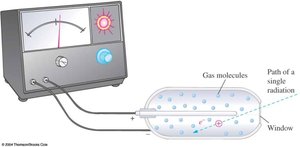
Radiation can be detected using devices such as the Geiger-Mueller counter, which measures ionization produced by radiation in a gas-filled tube. The resulting current is amplified and measured.
Biological Effects of Radiation
The biological impact of radiation depends on its type and energy. Gamma rays (γ) penetrate tissues more deeply than beta (β) or alpha (α) particles. Ionizing radiation can damage biological molecules, leading to health risks such as cancer.
Becquerel (Bq): SI unit for radioactivity; 1 Bq = 1 disintegration per second.
Curie (Ci): 1 Ci = 3.7 × 10¹⁰ disintegrations per second.
Radon and Environmental Exposure
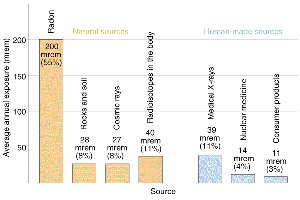
Radon-222 is a radioactive noble gas produced from uranium decay in the earth. It is a significant source of natural radiation exposure and can accumulate in homes, posing a lung cancer risk. The EPA recommends keeping indoor radon levels below 4 pCi/L.

Rates of Radioactive Decay
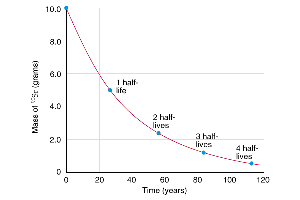
The rate at which a radioactive substance decays is characterized by its half-life (), the time required for half of the sample to decay. Radioactive decay follows first-order kinetics:
where is the amount remaining, is the initial amount, is the decay constant, and is time.
Disintegration Series
Some heavy nuclei decay through a series of steps, known as a disintegration series, to reach a stable isotope. Examples include the uranium-238, uranium-235, and thorium-232 series.
Radioactive Dating
Radioactive isotopes are used to date ancient materials. Radiocarbon dating uses the decay of carbon-14 to estimate the age of organic materials. Other methods, such as potassium-argon and uranium-lead dating, are used for older geological samples.
Artificial Transmutations of Elements
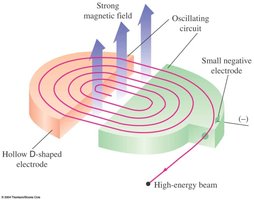
Artificial transmutation involves bombarding nuclei with particles to create new elements or isotopes. This process is used in research and medicine. Cyclotrons and nuclear reactors are common sources of the necessary particles.
Nuclear Fission
Nuclear fission is the splitting of a heavy nucleus into two lighter nuclei, accompanied by the release of energy and neutrons. Fission is energetically favorable for elements with atomic numbers greater than 80 and is the basis for nuclear power and atomic bombs.
Example:
Nuclear Fission Reactors
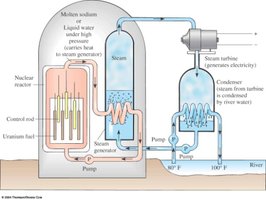
Nuclear reactors use controlled fission reactions to generate electricity. Key components include fuel rods (uranium or plutonium), moderators (to slow neutrons), control rods (to absorb neutrons), coolants, and shielding. Safety is a major concern due to the risk of core meltdown and radiation release.
Nuclear Fusion
Nuclear fusion is the process of combining light nuclei to form heavier nuclei, releasing even more energy than fission. Fusion powers stars and has the potential to provide a nearly limitless energy source if it can be controlled on Earth. Fusion requires extremely high temperatures to overcome the repulsion between nuclei.
Example:
