 Back
BackChapter 3: Molecules and Compounds – General Chemistry Study Notes
Study Guide - Smart Notes
 Tailored notes based on your materials, expanded with key definitions, examples, and context.
Chapter 3: Molecules and Compounds
Introduction to Molecules and Compounds
The diversity of substances in nature arises from the ability of elements to combine and form compounds. When elements combine, they create new substances with properties distinct from the original elements.
Elements, Compounds, and Mixtures
Elements: Pure substances consisting of only one type of atom.
Compounds: Substances formed when two or more elements combine in fixed, definite proportions.
Mixtures: Combinations of elements or compounds in variable proportions, not chemically bonded.
Definite Proportion in Compounds
Compounds always have a fixed ratio of elements. For example, water (H2O) always contains two hydrogen atoms for every one oxygen atom.
Chemical Bonds
Atoms in compounds are held together by chemical bonds, which arise from attractions between charged particles (electrons and protons). Chemical bonds are classified as:
Ionic Bonds: Involve the transfer of electrons from a metal to a nonmetal, forming cations and anions.
Covalent Bonds: Involve the sharing of electrons between two or more nonmetals, forming molecules.
Ionic Bonds
Formed between metals and nonmetals.
Result in the formation of a lattice structure in the solid phase.
Covalent Bonds
Formed between nonmetals.
Result in discrete molecules.
Representing Compounds: Chemical Formulas and Molecular Models
Chemical formulas indicate the elements present and the relative number of atoms or ions. There are three main types:
Empirical Formula: Shows the simplest whole-number ratio of atoms.
Molecular Formula: Shows the actual number of atoms of each element in a molecule.
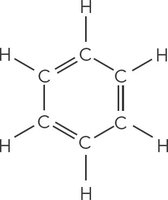
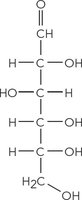
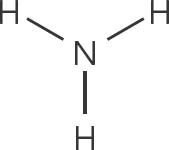
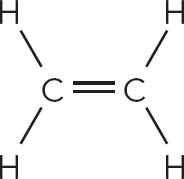
Structural Formula: Shows how atoms are connected and bonded, including geometry.
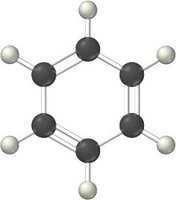
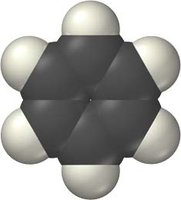
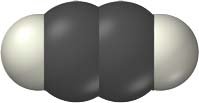
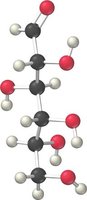
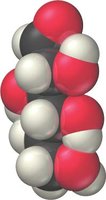
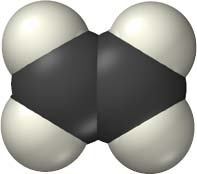
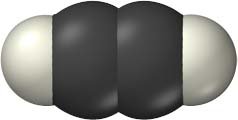
Examples of Structural and Molecular Models
Compound | Structural Formula | Ball-and-Stick Model | Space-Filling Model |
|---|---|---|---|
Benzene |
|
|
|
Acetylene |
| ||
Glucose |
|
|
|
Ammonia |
|
|
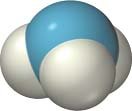
Atomic-Level View of Elements and Compounds
Atomic Elements: Exist as single atoms (e.g., Na, Ne, K, Mg).
Molecular Elements: Exist as molecules (e.g., diatomic elements like H2, N2, O2).
Molecular Compounds: Composed of covalently bonded nonmetals.
Ionic Compounds: Composed of cations and anions bound by ionic bonds.
Ionic Compounds: Formulas and Names
Ionic compounds contain positive (cation) and negative (anion) ions.
The sum of charges in the formula must be zero.
Formulas reflect the smallest whole-number ratio of ions.
Naming Ionic Compounds
Type One: Metal forms only one type of cation (e.g., Na+, Ca2+).
Type Two: Metal forms more than one type of cation (e.g., Fe2+, Fe3+).
Type Two cations are specified with Roman numerals (e.g., iron(II) chloride).
Polyatomic Ions and Oxyanions
Polyatomic Ions: Groups of covalently bonded atoms with an overall charge (e.g., NO3-, SO42-).
Oxyanions: Anions containing oxygen and another element. Naming depends on the number of oxygen atoms (e.g., nitrate vs. nitrite).
Hydrated Ionic Compounds
Hydrates contain a specific number of water molecules per formula unit.
Prefixes indicate the number of water molecules (e.g., heptahydrate = 7 H2O).
Molecular Compounds: Formulas and Names
Composed of two or more nonmetals.
Prefixes indicate the number of atoms (mono-, di-, tri-, etc.).
If only one atom of the first element, the prefix mono- is omitted.
Acids: Formulas and Naming
Acids: Molecular compounds that release H+ ions in water.
Binary Acids: Composed of hydrogen and a nonmetal (e.g., HCl).
Oxyacids: Composed of hydrogen and an oxyanion (e.g., HNO3).
Naming: Binary acids use hydro- prefix and -ic ending; oxyacids use -ic or -ous depending on the oxyanion.
Formula Mass and Molar Mass
Formula Mass: Sum of the atomic masses in a molecule or formula unit.
Molar Mass: Mass in grams of 1 mole of molecules or formula units; numerically equal to formula mass (g/mol).
Using Molar Mass to Count Molecules
Use molar mass to convert mass to moles.
Use Avogadro’s number () to convert moles to number of molecules.
Composition of Compounds
Mass percentage of each element can be determined from the formula and experimental analysis.
Mass percent composition can be used as a conversion factor between mass of element and mass of compound.
Determining Empirical and Molecular Formulas
Empirical Formula: Simplest whole-number ratio of atoms.
Determined from percent composition or elemental analysis.
Molecular Formula: Whole-number multiple of empirical formula; requires empirical formula and molar mass.
Combustion Analysis
Used to determine empirical formula of organic compounds.
Burn a known mass and measure products to deduce original composition.
Organic Compounds and Hydrocarbons
Organic Compounds: Contain carbon, often with hydrogen, oxygen, nitrogen, and other elements.
Hydrocarbons: Organic compounds containing only carbon and hydrogen; common fuels.
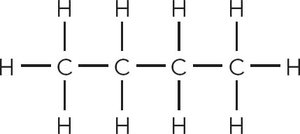
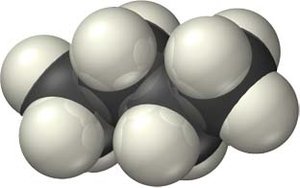
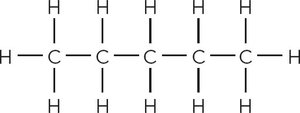
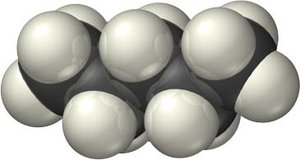
Common Hydrocarbons: Structural and Space-Filling Models
Name | Structural Formula | Space-Filling Model |
|---|---|---|
Methane |
|
|
Ethane |
|
|
Propane |
|
|
Butane |
|
|
Ethylene |
|
|
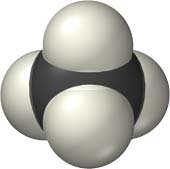
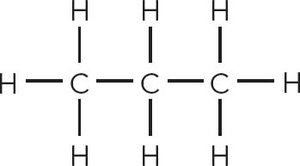
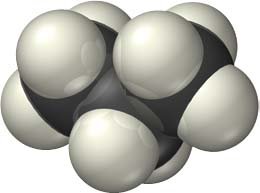
Key Equations
Molar Mass Calculation:
Mass Percent Composition:
Conversion Using Molar Mass:
Number of Molecules:
Summary Table: Types of Chemical Formulas
Type | Description | Example |
|---|---|---|
Empirical Formula | Relative number of atoms | CH2O |
Molecular Formula | Actual number of atoms | C6H12O6 |
Structural Formula | Shows connectivity |
|
Additional info: Some content was inferred and expanded for academic completeness, including definitions, examples, and formula tables.
