 Back
Chapter 3: Molecules, Compounds, and Chemical Equations – Structured Study Notes
Study Guide - Smart Notes
 Tailored notes based on your materials, expanded with key definitions, examples, and context.
Molecules, Compounds, and Chemical Equations
Formation of Compounds from Elements
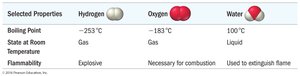
Elements can combine to form compounds, resulting in substances with properties distinct from their constituent elements. For example, hydrogen and oxygen are both gases, but when combined, they form water, a liquid with very different properties.
Dalton’s Atomic Theory: States that elements are composed of atoms, and compounds are formed when atoms of different elements combine in fixed ratios.
Law of Definite Proportions: A compound always contains the same elements in the same proportion by mass.
Law of Multiple Proportions: When two elements form more than one compound, the ratios of the masses of the second element that combine with a fixed mass of the first element are simple whole numbers.
Compound Properties: The properties of a compound are entirely different from those of its constituent elements.
Chemical Bonds
Atoms in compounds are held together by chemical bonds, which are forces of attraction arising from interactions between protons and electrons. The type of bond formed depends on the elements involved.
Ionic Bonds: Formed between a metal and a nonmetal; involve the transfer of electrons.
Covalent Bonds: Formed between two nonmetals; involve the sharing of electrons.
Metallic Bonds: Formed between metals; involve a 'sea' of shared electrons.
Ionic Bonds and Ionic Compounds
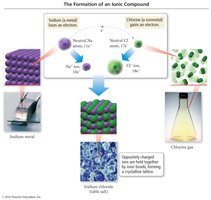
Ionic bonds occur when electrons are transferred from a metal atom to a nonmetal atom, resulting in the formation of cations (positive ions) and anions (negative ions). These ions are held together by electrostatic forces, which can be quantified using Coulomb’s law:
Coulomb’s Law: , where F is the force, q1 and q2 are the charges, r is the distance between ions, and k is a constant.
Ionic Compounds: Composed of a lattice of cations and anions, resulting in a crystalline structure.
Covalent Bonds and Molecular Compounds
Covalent bonding occurs between nonmetal elements, where atoms share electrons to achieve stability. The bond is a balance between attractive and repulsive forces:
Attractive Forces: Protons of one atom attract electrons of another.
Repulsive Forces: Electrons repel each other; protons repel each other.
Molecular Compounds: Compounds formed by covalent bonds, often existing as discrete molecules.
Chemical Formulas
A chemical formula represents the composition of a substance, indicating the types and numbers of atoms present. For example, ethanol has the formula C2H6O, meaning it contains two carbon, six hydrogen, and one oxygen atom per molecule.
Molecular Mass: The sum of atomic masses of all atoms in a molecule. For ethanol, .
Types of Chemical Formulas
There are three main types of chemical formulas:
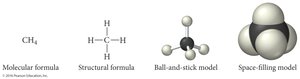
Molecular Formula: Shows the exact number and types of atoms (e.g., H2O2 for hydrogen peroxide).
Empirical Formula: Shows the simplest ratio of atoms (e.g., HO for hydrogen peroxide).
Structural Formula: Shows how atoms are connected.
Empirical Formulas
Empirical formulas provide the simplest whole-number ratio of atoms in a compound. They do not indicate the shape or connectivity of atoms.
Example: Oxalic acid has a molecular formula C2H2O4 and an empirical formula CHO2.
Molecular Models
Molecular models help visualize the three-dimensional structure of compounds:
Ball-and-stick models: Use balls for atoms and sticks for bonds.
Space-filling models: Show electron clouds and atomic sizes.
Classification of Elements and Compounds
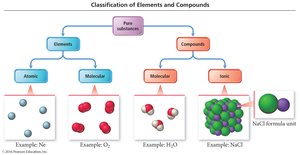
Pure substances are classified as elements or compounds. Elements can be atomic or molecular, while compounds can be molecular or ionic.
Ionic Compounds: Metal + nonmetal or metal + polyatomic ion.
Molecular Compounds: Nonmetal + nonmetal.
Ionic vs. Molecular Compounds
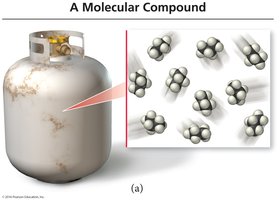
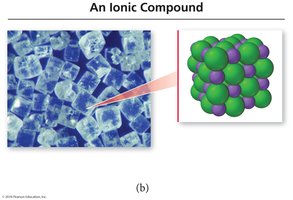
Ionic compounds consist of a lattice of ions, while molecular compounds consist of discrete molecules.
Example: Propane (C3H8) is molecular; sodium chloride (NaCl) is ionic.
Oxidation States and Common Charges
Elements and groups have characteristic oxidation states, which help determine chemical formulas for ionic compounds.
Alkali metals: +1
Alkaline earth metals: +2
Halogens: -1
5A column nonmetals: -3
6A column nonmetals: -2
Aluminum: +3
Hydrogen: +1 (with nonmetals), -1 (with metals)
Polyatomic Ions
Polyatomic ions are groups of atoms with a net charge, commonly found in ionic compounds (e.g., NO3-, NH4+).
Naming Ionic Compounds
Ionic compounds are named by stating the metal first, followed by the nonmetal with its ending changed to "-ide." For metals with variable oxidation states, Roman numerals are used to indicate the charge.
Example: MgCl2 is magnesium chloride; Fe2O3 is iron(III) oxide.
Oxyanions
Oxyanions are polyatomic ions containing oxygen. Prefixes and suffixes indicate the number of oxygen atoms:
Hypo-: Less than
Per-: More than
-ite: Fewer oxygen atoms
-ate: More oxygen atoms
Hydrated vs. Anhydrous Compounds
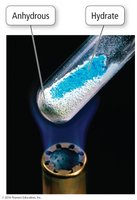
Hydrates are ionic compounds containing water molecules, while anhydrous compounds lack water. Heating can drive off water from hydrates.
Example: CuSO4·5H2O (hydrate) vs. CuSO4 (anhydrous)
Naming Molecular Compounds
Molecular compounds are named by indicating the number of atoms with prefixes and changing the ending of the second element to "-ide." The more metallic element is named first.
Prefixes: mono-, di-, tri-, tetra-, penta-, hexa-, hepta-, octa-, nona-, deca-
Example: CO2 is carbon dioxide; P2O5 is diphosphorus pentoxide.
Acids
Acids release hydrogen ions (H+) in water. They are classified as binary acids (H and a nonmetal) or oxyacids (H and a polyatomic ion containing oxygen).
Binary Acids: HCl (hydrochloric acid)
Oxyacids: HNO3 (nitric acid), HNO2 (nitrous acid)
Naming Acids
The endings of anions change when naming acids:
-ide: becomes "hydro-...ic acid"
-ate: becomes "...ic acid"
-ite: becomes "...ous acid"
Molecular Weight and Molar Mass
Molecular weight (or molar mass) is the sum of atomic masses of all atoms in a molecule, expressed in grams per mole. Atomic mass is the mass of one mole of an element.
Example: One mole of H2O has a molecular mass of 18.0 g/mol.
Stoichiometry: Mass, Mole, and Number of Particles Conversions
Stoichiometry involves converting between mass, moles, and number of atoms or molecules using chemical formulas and molar masses.
Mass to Mole:
Mole to Mass:
Mass to Number of Atoms:
Atoms to Mass:
Molecules to Mass:
Percent Composition
Percent composition expresses the proportion by mass of each element in a compound.
Example: Ethanol (C2H6O) has 52.31% C, 13.15% H, and 34.72% O by mass.
Determining Empirical and Molecular Formulas from Percent Composition
To determine the empirical formula:
Convert percent composition to mass.
Convert mass to moles.
Divide by the smallest number of moles.
Multiply to obtain whole numbers if necessary.
To determine the molecular formula:
Calculate the empirical formula mass.
Divide the molecular mass by the empirical formula mass.
Multiply the empirical formula by this whole number.
Combustion Analysis
Combustion analysis is used to determine the empirical and molecular formulas of compounds, especially organic compounds. By burning a known mass and measuring the products, the original composition can be deduced.
All C forms CO2, all H forms H2O, and O is found by subtraction.
Organic Chemistry Overview
Organic compounds are primarily composed of carbon and hydrogen, sometimes with O, N, P, S, and other elements. Carbon forms four covalent bonds and can create chains, branches, and rings.
Hydrocarbons: Organic compounds containing only carbon and hydrogen.
Methane (CH4): The simplest hydrocarbon.
