 Back
Chapter 3: Molecules, Compounds, and Chemical Bonds
Study Guide - Smart Notes
 Tailored notes based on your materials, expanded with key definitions, examples, and context.
Chapter Three: Molecules and Compounds
Hydrogen, Oxygen, and Water
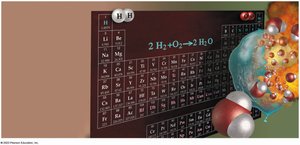
Elements combine to form compounds, resulting in substances with properties distinct from their constituent elements. For example, when hydrogen and oxygen combine, they form water, which is chemically and physically different from both hydrogen and oxygen.
Mixtures vs. Compounds: In mixtures, elements can combine in any proportion. In compounds, elements combine in fixed, definite proportions.
Example: Water always has a mass ratio of 1 g hydrogen to 8 g oxygen, or a ratio of 2 hydrogen atoms to 1 oxygen atom.
Chemical Bonds
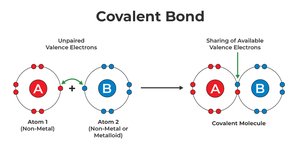
A chemical bond is the force that holds atoms or ions together in a compound. Chemical bonds arise from either the transfer or sharing of electrons, resulting in two main types: ionic and covalent bonds.
Ionic Bonds: Formed by the transfer of electrons from a metal to a nonmetal, creating oppositely charged ions that attract each other.
Covalent Bonds: Formed by the sharing of electrons between two or more nonmetals, resulting in molecules.
Ionic Bonding
Ionic bonding occurs between metals and nonmetals. The metal atom loses electrons to become a cation, while the nonmetal atom gains electrons to become an anion. The electrostatic attraction between these ions forms the ionic bond.
Properties of Ionic Compounds:
High melting and boiling points due to strong electrostatic forces.
Conduct electricity when dissolved in water or melted, as ions are free to move.
Hard and brittle; break when force is applied.
Often appear as crystalline solids.
Solubility in water; many ionic compounds dissociate into ions.
Covalent Bonding
Covalent bonds occur between nonmetals, where atoms share electrons to form molecules. These compounds are also known as molecular compounds.
Properties of Covalent Compounds:
Poor conductors of electricity, even when dissolved or melted.
Low melting and boiling points (except for network solids).
Soft or brittle.
Variable solubility in water, depending on polarity.
Can exist as solids, liquids, or gases.
Major Divisions of the Periodic Table
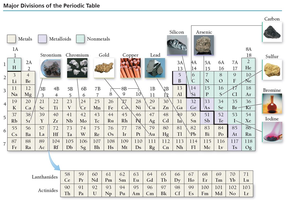
The periodic table is divided into metals, metalloids, and nonmetals, which helps predict the types of bonds formed between elements.
Metals: Tend to lose electrons and form cations.
Nonmetals: Tend to gain electrons and form anions or share electrons in covalent bonds.
Metalloids: Exhibit properties intermediate between metals and nonmetals.
Representing Compounds: Chemical Formulas and Molecular Models
Chemists use chemical symbols and formulas to represent elements and compounds. A chemical formula is a shorthand notation for a compound, indicating the types and numbers of atoms present.
Examples:
Water: H2O
Sodium chloride: NaCl
Carbon monoxide: CO
Carbon dioxide: CO2
Carbon tetrachloride: CCl4
Types of Chemical Formulas
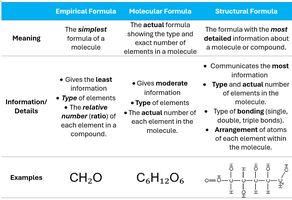
Chemical formulas can be categorized as empirical, molecular, or structural formulas, each providing different levels of information about a compound.
Type | Meaning | Information/Details | Examples |
|---|---|---|---|
Empirical Formula | The simplest formula of a molecule | Gives the least information; shows the relative number (ratio) of each element in a compound | CH2O |
Molecular Formula | The actual formula showing the type and exact number of elements in a molecule | Gives moderate information; shows the actual number of each element in the molecule | C6H12O6 |
Structural Formula | The formula with the most detailed information about a molecule or compound | Communicates the most information; shows the type and actual number of elements, type of bonding, and arrangement of atoms |
|
Molecular Models
Molecular models provide visual representations of compounds, helping to understand their structure and shape. The two main types are ball-and-stick and space-filling models.
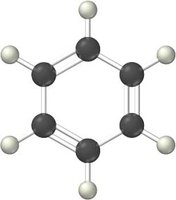
Ball-and-Stick Model: Atoms are depicted as balls and bonds as sticks, showing connectivity and molecular shape. Colors are used to represent different elements.
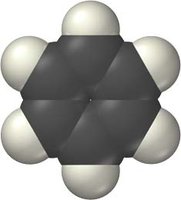
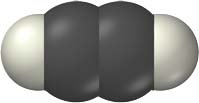
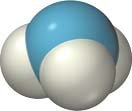
Space-Filling Model: Atoms fill the space between each other, approximating the molecule's actual appearance at a visible scale.
Examples of Representing Compounds
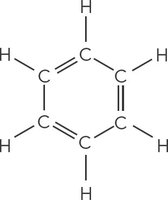
Below are examples of different ways to represent molecules, using structural formulas, ball-and-stick models, and space-filling models.
Benzene (C6H6):
Structural formula:
Ball-and-stick model:
Space-filling model:
Carbon Dioxide (CO2):
Space-filling model:
Glucose (C6H12O6):
Structural formula:
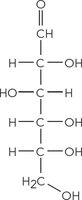
Ball-and-stick model:
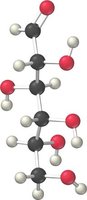
Space-filling model:
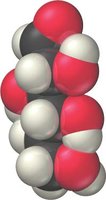
Ammonia (NH3):
Structural formula:
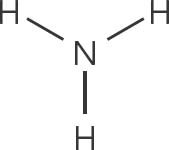
Space-filling model:
Summary Table: Properties of Ionic vs. Covalent Compounds
Property | Ionic Compounds | Covalent Compounds |
|---|---|---|
Melting/Boiling Point | High | Low (except network solids) |
Electrical Conductivity | Conducts when melted or dissolved | Poor conductor |
Physical State | Crystalline solids | Solids, liquids, or gases |
Solubility in Water | Often soluble | Variable, depends on polarity |
Hardness/Brittleness | Hard and brittle | Soft or brittle |
Key Equations
Law of Definite Proportions: In a compound, elements combine in fixed ratios by mass.
Example (Water):
