 Back
Chapter 4: Chemical Reactions and Chemical Quantities - Study Guide
Study Guide - Smart Notes
 Tailored notes based on your materials, expanded with key definitions, examples, and context.
Chapter 4: Chemical Reactions and Chemical Quantities
The Greenhouse Effect and Global Warming
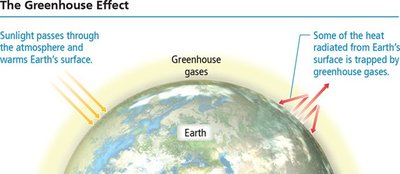
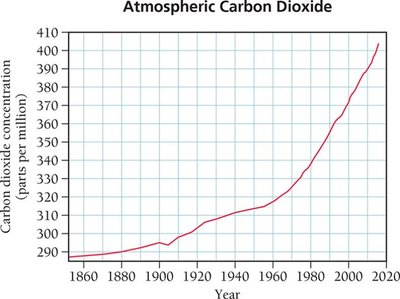
The greenhouse effect is a natural process that warms the Earth's surface. Greenhouse gases allow sunlight to enter the atmosphere, warming the surface, and prevent some of the heat from escaping back into space. The balance between incoming and outgoing energy determines Earth's average temperature. Scientists have observed a rise in atmospheric temperature and carbon dioxide levels since 1860, raising questions about the causes of global warming.
Greenhouse gases: Trap heat radiated from Earth's surface.
Global warming: May be influenced by both natural and human sources, such as fossil fuel combustion and volcanic activity.
Atmospheric CO2 and temperature: Both have increased significantly over the past century.

Chemical Reactions
A chemical reaction is a process in which one or more substances are converted into different substances. These reactions involve chemical changes that result in new chemical substances. A combustion reaction is a specific type of chemical reaction where a substance combines with oxygen to form oxygen-containing compounds and emits heat.
Combustion reaction: Substance + O2 → CO2 + H2O (often emits heat)
Example: Burning methane gas produces carbon dioxide and water.
Chemical Equations
Chemical equations are shorthand representations of chemical reactions. They provide information about the reactants and products, their states, and the relative numbers of molecules involved. Balancing chemical equations is essential to obey the Law of Conservation of Mass, ensuring equal numbers of atoms for each element on both sides of the equation.
States of matter: Indicated by abbreviations: (g) gas, (l) liquid, (s) solid, (aq) aqueous.
Balancing equations: Adjust coefficients, not subscripts, to balance atoms.
Abbreviation | State |
|---|---|
(g) | Gas |
(l) | Liquid |
(s) | Solid |
(aq) | Aqueous (water solution) |
Balancing the Combustion of Methane
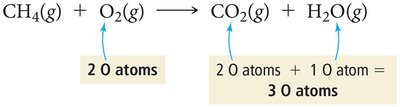
When methane burns, it reacts with oxygen to produce carbon dioxide and water. The equation must be balanced to reflect the Law of Conservation of Mass.
Unbalanced equation:
Balancing: Adjust coefficients to ensure equal numbers of each atom.
Balanced equation:


Stoichiometry: Quantities in Chemical Reactions
Stoichiometry is the study of the numerical relationships between chemical quantities in a reaction. The coefficients in a balanced equation specify the relative amounts in moles of each substance involved.
Law of Conservation of Mass: Mass is conserved in chemical reactions.
Mole ratios: Used as conversion factors between reactants and products.
Example: 2 moles of reactant A react with 25 moles of reactant B to form 16 moles of product C and 18 moles of product D.
Mole-to-Mole and Mass-to-Mass Conversions
Stoichiometric ratios from balanced equations allow conversion between amounts of reactants and products. Molar mass is used to convert between mass and moles.
Mole-to-mole conversion: Use coefficients as conversion factors.
Mass-to-mass conversion: Use molar mass and stoichiometric ratios.

Limiting Reactant, Theoretical Yield, and Percent Yield
In reactions with multiple reactants, the limiting reactant is the one that is completely consumed first, limiting the amount of product formed. The theoretical yield is the maximum amount of product that can be made based on the limiting reactant. The actual yield is the amount actually produced, and percent yield measures efficiency.
Limiting reactant: Completely consumed, limits product formation.
Excess reactant: Not completely consumed.
Theoretical yield: Maximum product based on limiting reactant.
Actual yield: Product actually obtained.
Percent yield:
Types of Chemical Reactions
Combustion Reactions
Combustion reactions involve a substance reacting with oxygen to form oxygen-containing compounds, often including water, and emit heat.
Example:
Ethanol combustion: Ethanol reacts with oxygen to form carbon dioxide and water.
Alkali Metal Reactions
Alkali metals react vigorously with nonmetals and water, forming metal ions, hydroxide ions, and hydrogen gas. The reactions become more vigorous down the group.
Example: Sodium reacts with chlorine to form sodium chloride.
Halogen Reactions
Halogens react with metals to form metal halides, with hydrogen to form hydrogen halides, and with each other to form interhalogen compounds.
Example: Chlorine reacts with sodium to form sodium chloride.
Summary Table: Limiting Reactant and Yield
Term | Definition |
|---|---|
Limiting Reactant | Reactant completely consumed, limits product |
Excess Reactant | Reactant not completely consumed |
Theoretical Yield | Maximum product based on limiting reactant |
Actual Yield | Product actually obtained |
Percent Yield | Efficiency of reaction: |
Key Equations
Balancing equations: Adjust coefficients to balance atoms.
Percent yield:
Stoichiometric conversions: Use mole ratios and molar mass as conversion factors.
Conceptual Connections and Visual Representations
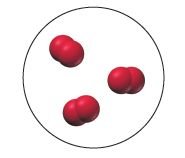
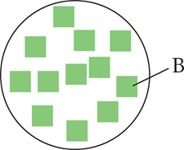
Visual diagrams and conceptual questions help reinforce understanding of stoichiometry, limiting reactants, and yield calculations. For example, diagrams showing reactant and product molecules illustrate the relationships and help identify limiting reactants.


Additional info:
Some content was inferred and expanded for completeness and clarity, such as definitions and examples.
Tables and diagrams were recreated and described for academic context.
