 Back
BackChapter 4: Chemical Reactions and Chemical Quantities – Study Notes
Study Guide - Smart Notes
 Tailored notes based on your materials, expanded with key definitions, examples, and context.
Chemical Reactions and Chemical Quantities
Introduction to Chemical Reactions
Chemical reactions are processes in which substances (reactants) are transformed into new substances (products) through the breaking and forming of chemical bonds. These reactions are fundamental to chemistry and are represented using chemical equations.
Chemical reaction: A process where one or more substances are converted into different substances.
Combustion reaction: A type of reaction where a substance reacts with oxygen to form oxygen-containing compounds and releases heat.
Chemical Equations
Chemical equations provide a shorthand way to describe chemical reactions, indicating the formulas, states, and relative quantities of reactants and products.
States of matter: Indicated in equations as (g) for gas, (l) for liquid, (s) for solid, and (aq) for aqueous solution.
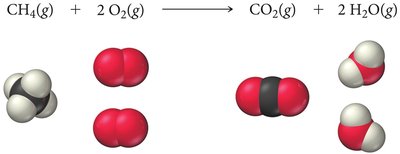
Balancing equations: Ensures the law of conservation of mass is obeyed by having equal numbers of each type of atom on both sides of the equation.
Example: Combustion of Methane
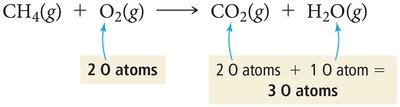
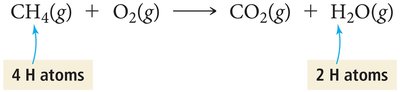
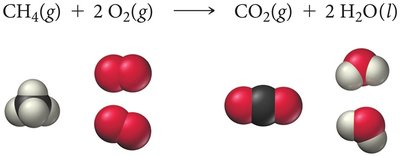
The combustion of methane demonstrates the need to balance chemical equations:
Unbalanced:
Balance O and H atoms to obey conservation of mass.
Balanced equation:
Steps for Balancing Chemical Equations
Balancing equations involves systematic steps to ensure atom conservation:
Write the skeletal equation with correct formulas.
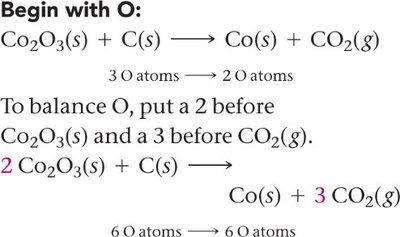
Balance atoms in complex substances first, then pure elements.
Balance free elements last by adjusting coefficients.
If fractional coefficients are present, multiply all coefficients to clear fractions.
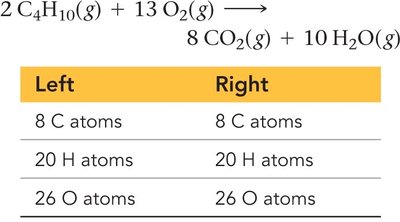
Check that all atoms are balanced on both sides.
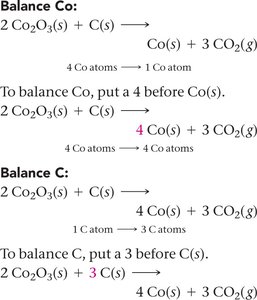
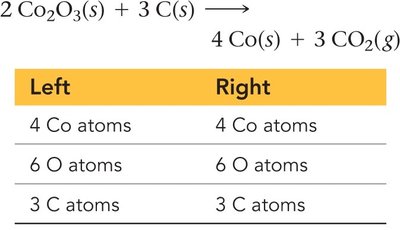
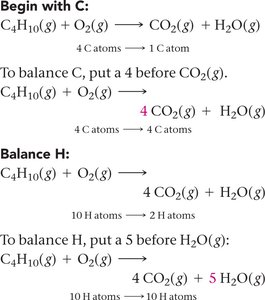
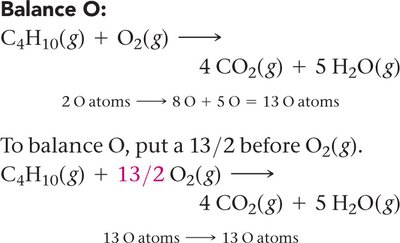
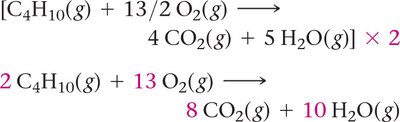
Example: Combustion of Butane
Unbalanced:
Balance C, then H, then O.
Balancing Equations with Polyatomic Ions
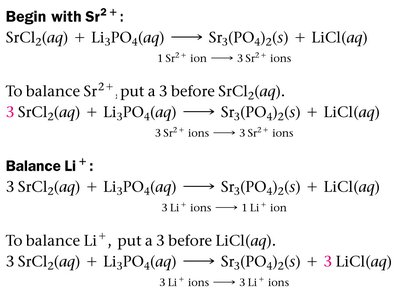
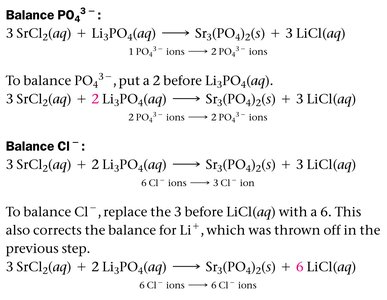
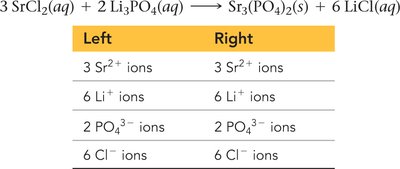
When polyatomic ions appear unchanged on both sides of the equation, balance them as units.
Balance cations first, then anions, then check all atoms/ions.
Stoichiometry: Quantitative Relationships in Chemical Reactions
Reaction Stoichiometry
Stoichiometry is the study of the quantitative relationships between reactants and products in a chemical reaction, based on the balanced equation.
Stoichiometric coefficients indicate the relative number of moles of each substance.
These ratios are used as conversion factors in calculations.
Mole-to-Mole Conversions
Use the coefficients from the balanced equation to convert between moles of reactants and products.
Example:
Stoichiometric ratio:
Mass-to-Mass Conversions
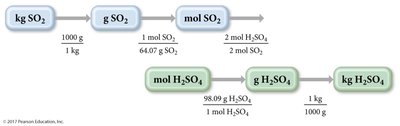
To relate the mass of one substance to the mass of another, follow these steps:
Convert mass of A to moles of A.
Use the stoichiometric ratio to convert to moles of B.
Convert moles of B to mass of B.




Limiting Reactant, Theoretical Yield, and Percent Yield
Limiting Reactant
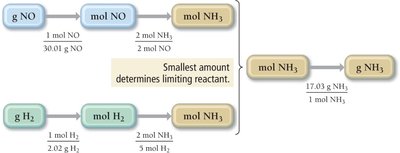
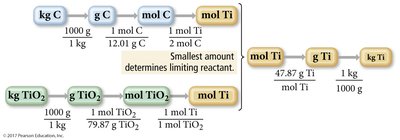
The limiting reactant is the reactant that is completely consumed first, thus limiting the amount of product formed.
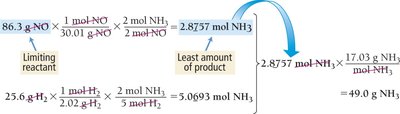
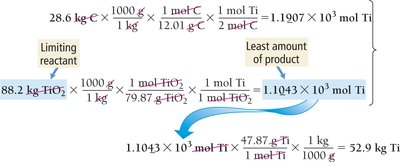
Identify by calculating the amount of product each reactant can produce; the smallest amount determines the limiting reactant.

Theoretical Yield
The theoretical yield is the maximum amount of product that can be formed from the limiting reactant, as predicted by stoichiometry.
Percent Yield
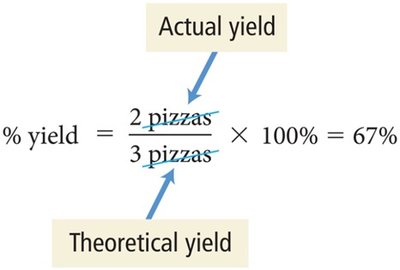
Percent yield measures the efficiency of a reaction, comparing the actual yield to the theoretical yield:
Example: Limiting Reactant in Methane Combustion
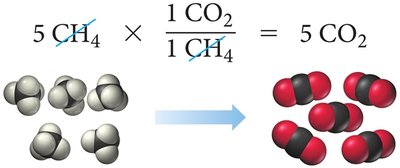
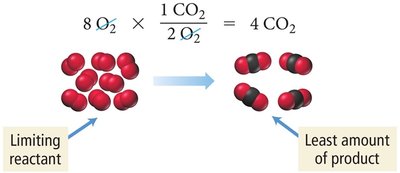
Example: Limiting Reactant and Percent Yield in Magnesium Oxide Formation
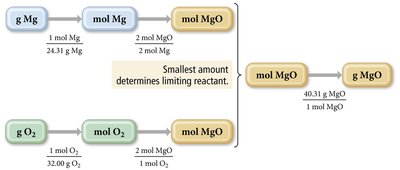
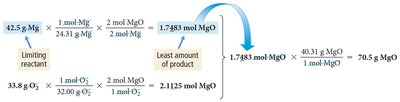

Example: Limiting Reactant and Theoretical Yield in Ammonia Synthesis
Example: Limiting Reactant and Theoretical Yield in Titanium Production
Types of Chemical Reactions
Combustion Reactions
Combustion reactions involve a substance reacting with oxygen to form one or more oxygen-containing compounds, often releasing heat and light.
General form: (for hydrocarbons)
Alkali Metal Reactions
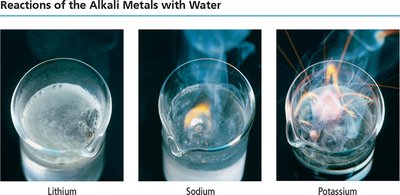
Alkali metals react vigorously with nonmetals and water:
With nonmetals: Form ionic compounds (metal halides).
With water: Form hydroxide ions and hydrogen gas.
Halogen Reactions
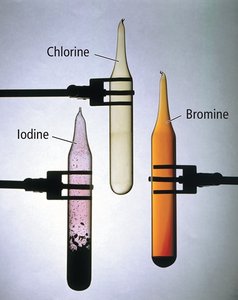
Halogens react with metals to form metal halides, with hydrogen to form hydrogen halides, and with each other to form interhalogen compounds.
Summary Table: Key Stoichiometric Relationships
Concept | Definition | Key Equation |
|---|---|---|
Limiting Reactant | Reactant that determines the maximum amount of product | Calculate product for each reactant; smallest is limiting |
Theoretical Yield | Maximum possible amount of product | Based on limiting reactant |
Percent Yield | Efficiency of reaction |
