 Back
Chapter 4: Molecules and Compounds – Structure, Classification, and Representation
Study Guide - Smart Notes
 Tailored notes based on your materials, expanded with key definitions, examples, and context.
Molecules and Compounds
Introduction to Elements and Compounds
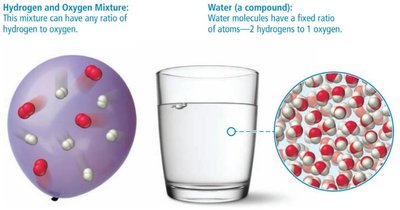
In chemistry, elements are pure substances consisting of only one type of atom, while compounds are substances composed of two or more different elements chemically bonded together. Understanding the distinction between elements and compounds is fundamental to the study of chemical substances and their interactions.
Element: A substance that cannot be broken down into simpler substances by chemical means. Examples include gold (Au) and oxygen (O2).
Compound: A substance formed when two or more elements are chemically bonded in a fixed ratio. Examples include water (H2O) and sodium chloride (NaCl).
Mixture: A physical combination of two or more substances where each retains its own properties and the ratio can vary.
Chemical Bonds
Types of Chemical Bonds
Chemical bonds are the forces that hold atoms together in compounds. They are broadly classified into two main types:
Ionic bonds: Formed when electrons are transferred from one atom to another, resulting in the formation of oppositely charged ions that attract each other. Common in compounds formed between metals and nonmetals (e.g., NaCl).
Covalent bonds: Formed when two atoms share one or more pairs of electrons. Common in compounds formed between nonmetals (e.g., H2O, CO2).
Representing Compounds: Chemical Formulas and Models
Types of Chemical Formulas
Chemists use different types of formulas to represent compounds, each conveying varying levels of information:
Empirical Formula: Shows the simplest whole-number ratio of atoms in a compound.
Molecular Formula: Shows the actual number of each type of atom in a molecule.
Structural Formula: Shows how atoms are connected or bonded to each other within the molecule.
Example Problems: Give the empirical formulas for the following molecular formulas:
C4H8 → CH2
Hg2Cl2 → HgCl
C2H2O4 → CHO2
CCl4 → CCl4 (already simplest form)
Molecular Models
To visualize molecules, chemists use several types of models:
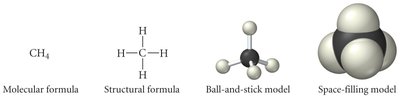
Molecular Formula: Indicates the types and numbers of atoms (e.g., CH4).
Structural Formula: Shows the arrangement of atoms and bonds.
Ball-and-Stick Model: Represents atoms as spheres and bonds as sticks, showing geometry.
Space-Filling Model: Shows the relative sizes of atoms and how they overlap in a molecule.
Atomic-Level View of Elements and Compounds
Forms of Elements
Elements can exist as single atoms or as molecules:
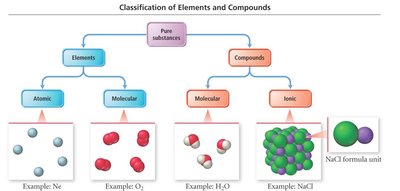
Atomic Elements: Exist as single atoms (e.g., Ne, Fe).
Molecular Elements: Exist as molecules composed of two or more atoms of the same element (e.g., O2, N2).
Types of Compounds
Molecular Compounds: Composed of molecules formed by covalent bonds (e.g., H2O, CO2).
Ionic Compounds: Composed of ions held together by ionic bonds (e.g., NaCl, CaF2).
Polyatomic Ions: Charged species composed of two or more atoms covalently bonded (e.g., NO3-, NH4+).
Classification Practice
Identifying Types of Substances
Classify each of the following as an atomic element, molecular element, molecular compound, or ionic compound:
Substance | Classification |
|---|---|
Xenon (Xe) | Atomic Element |
Bromine (Br2) | Molecular Element |
NO2 | Molecular Compound |
N2O | Molecular Compound |
NaNO3 | Ionic Compound (contains polyatomic ion NO3-) |
Fluorine (F2) | Molecular Element |
Silver (Ag) | Atomic Element |
Fe2O3 | Ionic Compound |
Sulfur (S8) | Molecular Element |
Practice Questions
Which is a pure atomic element? a) Ozone gas (O3) b) A wedding ring made of 24 karat gold (Au) ← Correct c) Dinitrogen monoxide gas (N2O) d) Ammonium chloride (NH4Cl)
Which contains a polyatomic ion? a) Ozone gas (O3) b) A wedding ring made of 24 karat gold (Au) c) Dinitrogen monoxide gas (N2O) d) Ammonium chloride (NH4Cl) ← Correct (contains NH4+)
Additional info: Polyatomic ions are ions composed of more than one atom, such as ammonium (NH4+) and nitrate (NO3-), and are commonly found in ionic compounds.
