Back
BackChapter 4: Reactions in Aqueous Solution – General Chemistry Study Notes
Study Guide - Smart Notes
 Tailored notes based on your materials, expanded with key definitions, examples, and context.
Reactions in Aqueous Solution
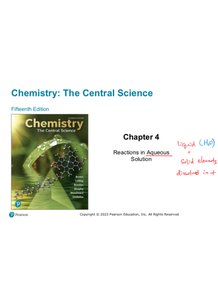
Introduction to Aqueous Solutions
Aqueous solutions are central to many chemical reactions, especially in general chemistry. An aqueous solution is a mixture where water acts as the solvent, dissolving various solutes. Understanding the behavior of substances in water is essential for predicting reaction outcomes and properties.
Solutions: Definitions and Components
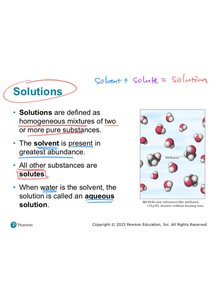
Solutions are homogeneous mixtures of two or more pure substances. The solvent is the component present in the greatest amount, while solutes are the other substances dissolved in the solvent. When water is the solvent, the solution is termed an aqueous solution.
Solvent: Substance in greatest abundance (e.g., water in aqueous solutions).
Solute: Substance(s) dissolved in the solvent.
Homogeneous mixture: Uniform composition throughout.
Types of Dissolution in Water
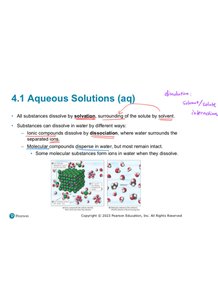
Substances dissolve in water through solvation, where solvent molecules surround solute particles. The process varies depending on the nature of the solute:
Ionic compounds: Dissolve by dissociation, separating into ions surrounded by water molecules.
Molecular compounds: Disperse in water, often remaining intact, though some may ionize.
Solvation: The interaction between solvent and solute molecules.
Electrolytes and Conductivity
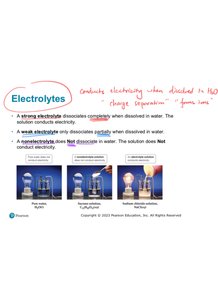
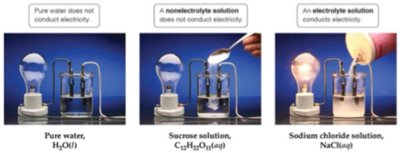
Electrolytes are substances that produce ions when dissolved in water, enabling the solution to conduct electricity. The degree of ionization determines whether an electrolyte is strong, weak, or a nonelectrolyte:
Strong electrolytes: Completely dissociate into ions; solution conducts electricity well.
Weak electrolytes: Partially dissociate; solution conducts electricity poorly.
Nonelectrolytes: Do not dissociate; solution does not conduct electricity.
Strong vs. Weak Electrolytes – Equilibrium
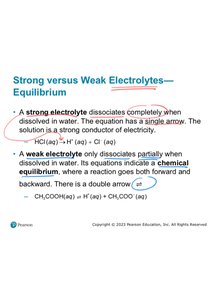
The distinction between strong and weak electrolytes is reflected in their chemical equations:
Strong electrolytes: Single arrow in equation, indicating complete dissociation (e.g., ).
Weak electrolytes: Double arrow, indicating equilibrium between dissociated and undissociated forms (e.g., ).
Electrolytes and Nonelectrolytes: Examples
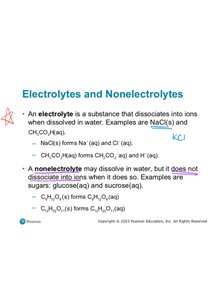
Electrolytes dissociate into ions in water, while nonelectrolytes do not. Examples include:
Electrolytes: Sodium chloride (), potassium chloride (), acetic acid ().
Nonelectrolytes: Glucose (), sucrose ().
Precipitation Reactions
Definition and Process
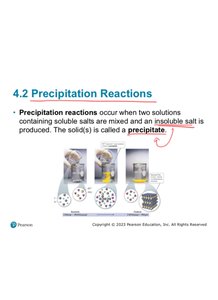
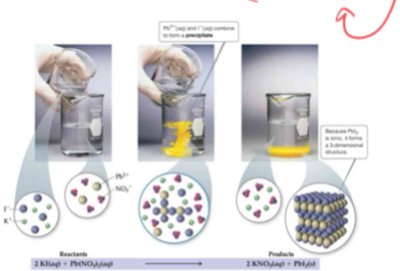
Precipitation reactions occur when two solutions containing soluble salts are mixed, resulting in the formation of an insoluble salt called a precipitate. These reactions are important for separating substances and identifying ions in solution.
Precipitate: The solid formed from an insoluble salt.
Solubility: Determines whether a salt will remain dissolved or form a precipitate.
Solubility of Ionic Compounds
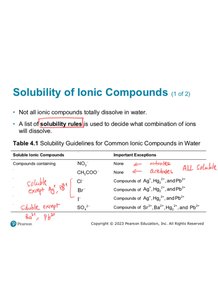
Not all ionic compounds are soluble in water. Solubility rules help predict which combinations of ions will dissolve. The following table summarizes common solubility guidelines:
Soluble Ionic Compounds | Important Exceptions |
|---|---|
Compounds containing NO3-, CH3COO- | None (All soluble) |
Compounds containing Cl-, Br-, I- | Compounds of Ag+, Hg22+, Pb2+ |
Compounds containing SO42- | Compounds of Sr2+, Ba2+, Hg22+, Pb2+ |
Insoluble Ionic Compounds include those containing S2-, CO32-, PO43-, and OH-, except when paired with NH4+ or alkali metal cations.
Predicting Precipitate Formation
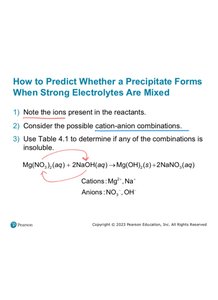
To predict whether a precipitate forms when strong electrolytes are mixed:
Identify the ions present in the reactants.
Consider all possible cation-anion combinations.
Use solubility rules to determine if any combination is insoluble.
Metathesis (Exchange) Reactions
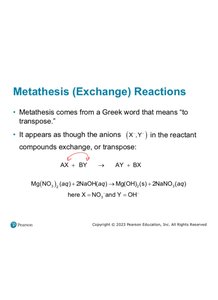
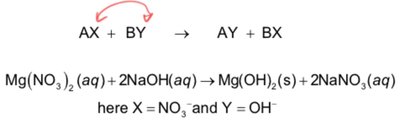
Metathesis reactions (also called exchange reactions) involve the swapping of ions between two reactants. The general form is:
Example:
Completing and Balancing Metathesis Equations
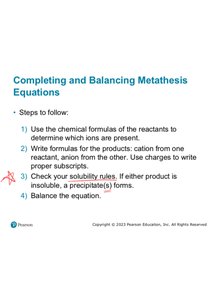
To complete and balance metathesis equations:
Determine the ions present from reactant formulas.
Write product formulas by combining cations and anions.
Check solubility rules to identify precipitates.
Balance the equation.
Net Ionic Equations
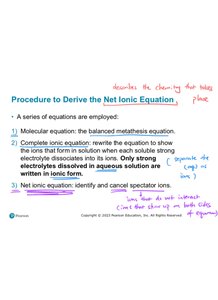
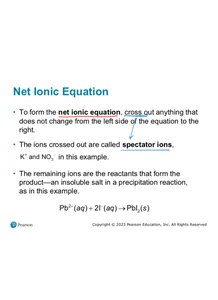
Net ionic equations show only the species that participate in the reaction, omitting spectator ions (ions that do not change during the reaction). The process involves:
Writing the molecular equation.
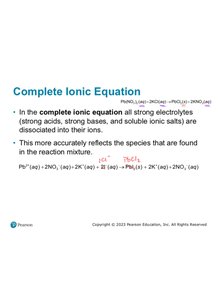
Writing the complete ionic equation (all strong electrolytes dissociated).
Canceling spectator ions to obtain the net ionic equation.
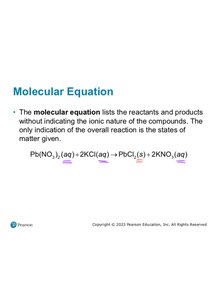
Example: Precipitation Reaction Equations
Consider the reaction between lead(II) nitrate and potassium iodide:
Molecular equation:
Complete ionic equation:
Net ionic equation:



Acids, Bases, and Neutralization
Acids and Bases: Definitions
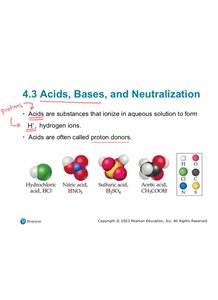
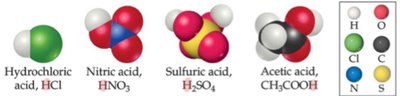
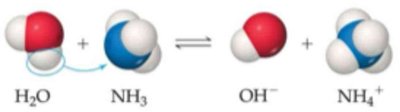
Acids are substances that ionize in aqueous solution to produce hydrogen ions (), often called proton donors. Bases are substances that accept ions or increase the concentration of hydroxide ions () in solution.
Acids: Hydrochloric acid (), nitric acid (), sulfuric acid (), acetic acid ().
Bases: Sodium hydroxide (), ammonia ().
Strong and Weak Acids and Bases
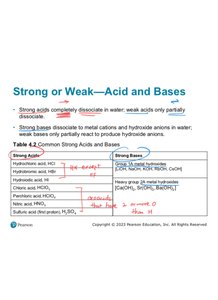
Strong acids and strong bases dissociate completely in water, while weak acids and bases only partially dissociate. The following table summarizes common strong acids and bases:
Strong Acids | Strong Bases |
|---|---|
Hydrochloric acid (HCl) | Group 1A metal hydroxides (LiOH, NaOH, KOH, RbOH, CsOH) |
Hydrobromic acid (HBr) | Heavy group 2A metal hydroxides (Ca(OH)2, Sr(OH)2, Ba(OH)2) |
Hydroiodic acid (HI) | |
Chloric acid (HClO3) | |
Perchloric acid (HClO4) | |
Nitric acid (HNO3) | |
Sulfuric acid (first proton, H2SO4) |
Electrolytic Behavior of Compounds
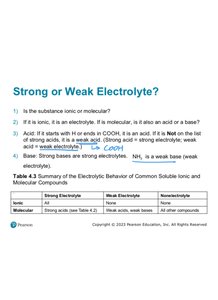
The electrolytic behavior of a compound depends on its nature:
Ionic compounds: All are strong electrolytes.
Molecular compounds: Strong acids are strong electrolytes; weak acids and bases are weak electrolytes; all other molecular compounds are nonelectrolytes.
Type | Strong Electrolyte | Weak Electrolyte | Nonelectrolyte |
|---|---|---|---|
Ionic | All | None | None |
Molecular | Strong acids | Weak acids, weak bases | All other compounds |
Neutralization Reactions
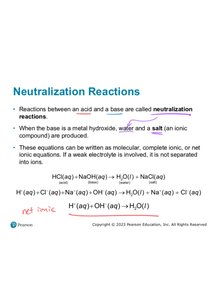
Neutralization reactions occur when an acid reacts with a base, typically producing water and a salt. These reactions can be represented as molecular, complete ionic, or net ionic equations.
Molecular equation:
Net ionic equation:



Neutralization Reactions with Gas Formation
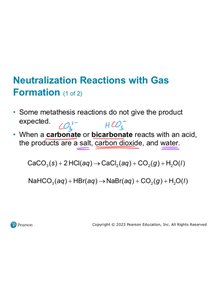
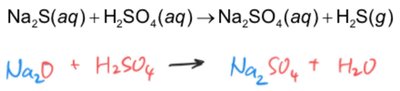
Some neutralization reactions produce gases, such as carbon dioxide or hydrogen sulfide, instead of only water and salt. For example:
Carbonate or bicarbonate + acid → salt + CO2 (gas) + H2O
Sulfide + acid → salt + H2S (gas)


Application: Antacids
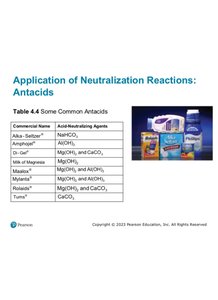
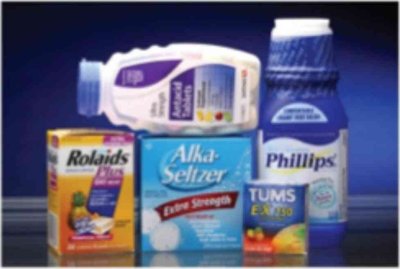
Neutralization reactions are used in antacids to relieve stomach acidity. Common antacid agents include sodium bicarbonate, magnesium hydroxide, calcium carbonate, and aluminum hydroxide.
Commercial Name | Acid-Neutralizing Agents |
|---|---|
Alka-Seltzer | NaHCO3 |
Amphojel | Al(OH)3 |
Di-Gel | Mg(OH)2 and CaCO3 |
Milk of Magnesia | Mg(OH)2 |
Maalox | Mg(OH)2 and Al(OH)3 |
Mylanta | Mg(OH)2 and Al(OH)3 |
Rolaids | Mg(OH)2 and CaCO3 |
Tums | CaCO3 |
Oxidation-Reduction (Redox) Reactions
Definition and Process
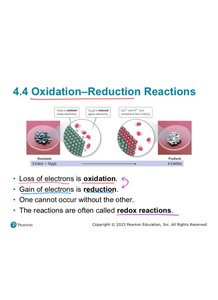
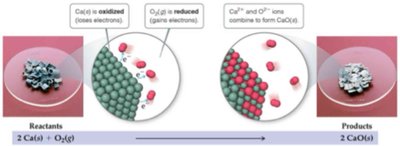
Oxidation-reduction reactions (redox reactions) involve the transfer of electrons between substances. Oxidation is the loss of electrons, while reduction is the gain of electrons. These processes always occur together.
Oxidation: Loss of electrons (e.g., Ca → Ca2+).
Reduction: Gain of electrons (e.g., O2 → O2-).
Assigning Oxidation Numbers
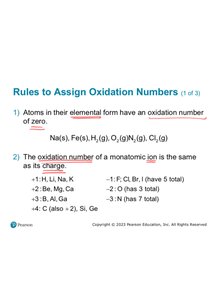
Oxidation numbers are used to track electron transfer in redox reactions. The rules for assigning oxidation numbers are:
Atoms in their elemental form have an oxidation number of zero.
The oxidation number of a monatomic ion equals its charge.
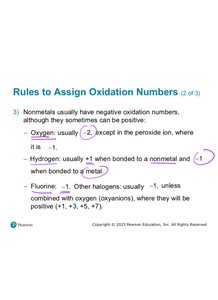
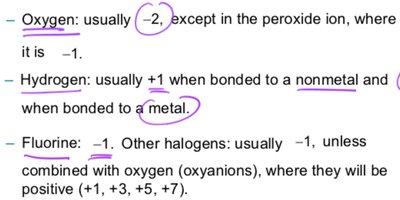
Nonmetals usually have negative oxidation numbers, but can be positive in certain compounds.
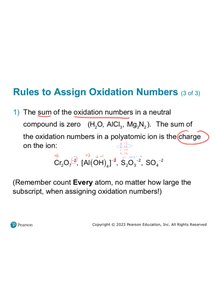
The sum of oxidation numbers in a neutral compound is zero; in a polyatomic ion, it equals the ion's charge.


Displacement Reactions
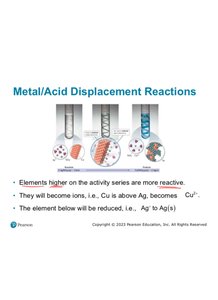
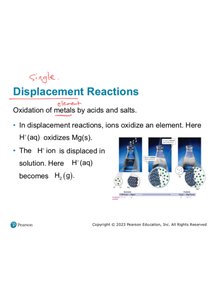
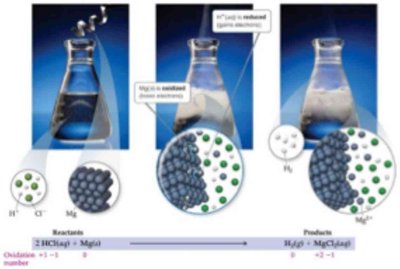
Displacement reactions involve the oxidation of metals by acids or salts. An ion oxidizes an element, displacing another ion in solution. For example, oxidizes to , and becomes .
Activity Series and Metal Reactivity
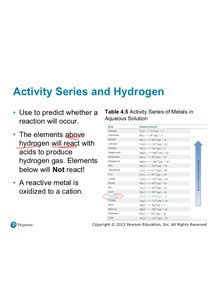
The activity series ranks metals by their tendency to be oxidized. Metals above hydrogen in the series react with acids to produce hydrogen gas; those below do not. The series helps predict whether a displacement reaction will occur.
Metal | Oxidation Reaction |
|---|---|
Lithium | Li(s) → Li+(aq) + e- |
Potassium | K(s) → K+(aq) + e- |
... | ... |
Hydrogen | H2(g) → 2H+(aq) + 2e- |
Copper | Cu(s) → Cu2+(aq) + 2e- |
Silver | Ag(s) → Ag+(aq) + e- |
Gold | Au(s) → Au+(aq) + e- |
Metal/Acid Displacement Reactions
Elements higher on the activity series are more reactive and will become ions, while elements lower will be reduced. For example, copper is above silver and will oxidize to Cu2+, while silver ions are reduced to metallic silver.