 Back
Chapter 5: Gases – General Chemistry Study Notes
Study Guide - Smart Notes
 Tailored notes based on your materials, expanded with key definitions, examples, and context.
Gases and Their Properties
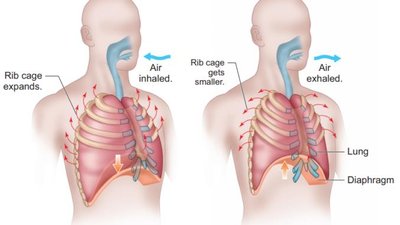
Breathing and Gas Pressure
Breathing is a practical example of gas laws in action, where pressure differences drive the movement of air in and out of the lungs. The expansion and compression of the chest cavity alter the volume and pressure inside the lungs, facilitating inhalation and exhalation.
Inhalation: Chest cavity expands, lung volume increases, pressure inside decreases, air flows in.
Exhalation: Chest cavity contracts, lung volume decreases, pressure inside increases, air flows out.
Key Principle: Gas molecules move from regions of higher pressure to lower pressure to balance differences.
Example: Approximately 8500 L/day of air moves through human lungs.
Pressure and Molecular Collisions
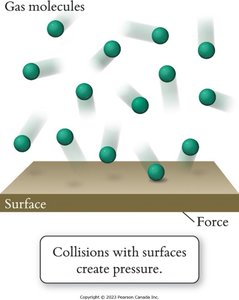
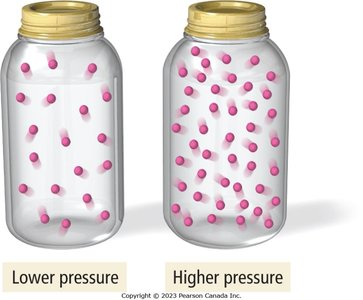
Gas pressure arises from the collisions of gas particles with each other and with the surfaces of their container. The force exerted by these collisions, divided by the area of the surface, defines pressure.
Pressure Formula: (Pressure equals force divided by area)
More Particles: Higher number of gas particles in a given volume increases pressure.
Example: Collisions with container walls create measurable pressure.
Units of Pressure
Common Pressure Units and Measurement
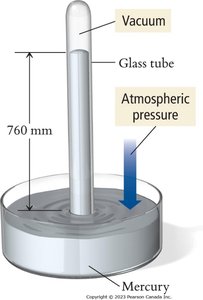
Pressure can be measured in several units, with the atmosphere (atm), pascal (Pa), and millimeters of mercury (mmHg or Torr) being the most common. The mercury barometer is a classic instrument for measuring atmospheric pressure.
1 atm = 760 mmHg = 760 Torr = 101,325 Pa
SI Unit: Pascal (Pa)
Other Units: psi (pounds per square inch), inHg (inches of mercury), bar
Example: Air pressure at sea level is 1 atm; at Mount Everest (~8,849 m), it is about 0.31 atm.

Unit | Abbreviation | Average Air Pressure at Sea Level |
|---|---|---|
pascal | Pa | 101,325 Pa |
psi | psi | 14.7 psi |
torr (mmHg) | torr | 760 torr |
inches of mercury | inHg | 29.92 inHg |
atmosphere | atm | 1 atm |
bar | bar | 1.013 bar |
The Manometer
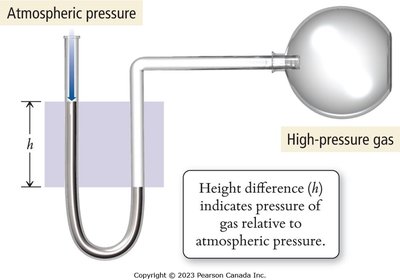
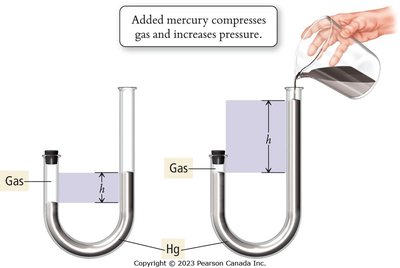
A manometer is used to measure the pressure of a gas in a container relative to atmospheric pressure. The height difference (h) in the mercury column indicates whether the gas pressure is higher or lower than atmospheric pressure.
If Pgas > Patm: Mercury level on the left is higher.
If Pgas < Patm: Mercury level on the right is higher.
If Pgas = Patm: Levels are equal.
The Simple Gas Laws
Boyle’s Law: Volume and Pressure
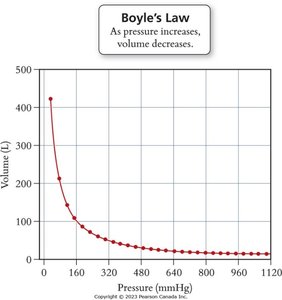
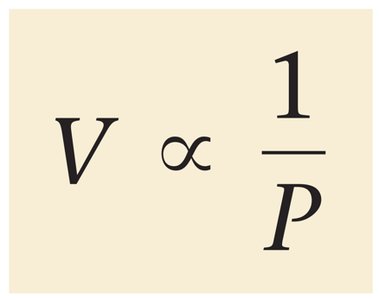
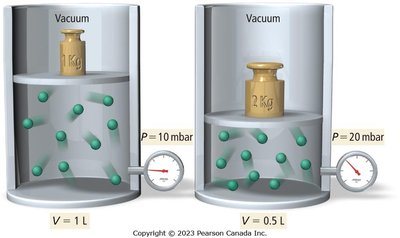
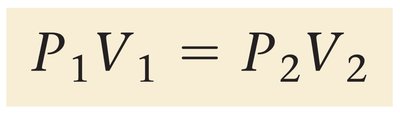
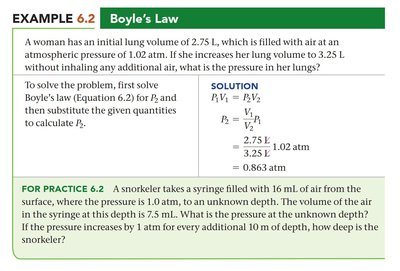
Boyle’s Law describes the relationship between the pressure and volume of a gas at constant temperature and amount of gas. As pressure increases, volume decreases, and vice versa.
Mathematical Relationship:
Equation:
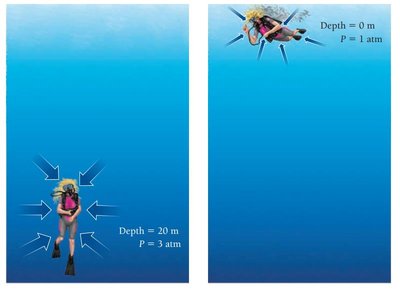
Example: Lung volume changes during breathing; diving safety relies on Boyle’s Law.


Charles’s Law: Volume and Temperature
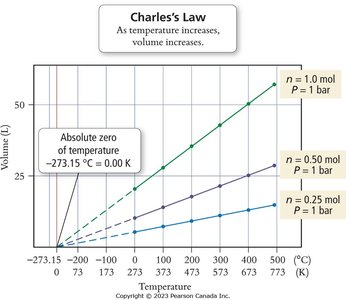
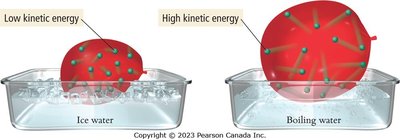
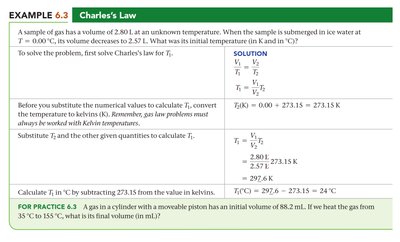
Charles’s Law states that the volume of a gas is directly proportional to its temperature (in Kelvin) at constant pressure and amount of gas. As temperature increases, volume increases.
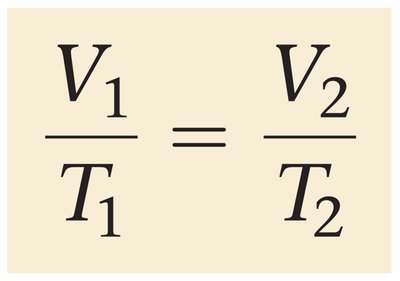
Mathematical Relationship:
Equation:
Temperature must be in Kelvin for calculations.
Example: Hot-air balloons rise because heated air expands and becomes less dense.


Avogadro’s Law: Volume and Amount of Gas
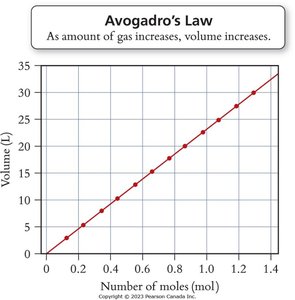
Avogadro’s Law states that the volume of a gas is directly proportional to the number of moles of gas at constant pressure and temperature. As the amount of gas increases, the volume increases.
Mathematical Relationship:
Equation:
Example: Blowing up a balloon increases the amount of gas and its volume.


The Ideal Gas Law
Definition and Conditions
The Ideal Gas Law combines Boyle’s, Charles’s, and Avogadro’s laws into a single equation. It describes the behavior of an ideal gas, which is a theoretical gas whose particles do not interact and occupy negligible volume.
Equation:
R (Ideal Gas Constant): or
Conditions for Ideal Behavior: High temperature, low pressure, small particle size, insignificant interactions.
Real Gases: Deviate from ideal behavior at low temperatures and high pressures.

Other Relationships: Gay-Lussac’s Law
Gay-Lussac’s Law relates the pressure and temperature of a gas at constant volume and amount of gas.
Equation:
Example: Used in calculations involving gas-filled tires and containers.
Applications of the Ideal Gas Law
Molar Volume at STP
The molar volume is the volume occupied by one mole of a gas at standard temperature and pressure (STP: 0°C or 273.15 K, 1.00 atm). At STP, one mole of any ideal gas occupies approximately 22.4 L.
Conversion Factor: 1 mol = 22.4 L at STP
Example: Used in stoichiometric calculations involving gases.

Density of a Gas
The density of a gas can be calculated using the ideal gas law and the molar mass. Density increases with molar mass and decreases with temperature.
Equation:
Derived from Ideal Gas Law:
Example: Calculating the density of helium at given conditions.

Molar Mass of a Gas
The molar mass of a gas can be determined from its mass, volume, pressure, and temperature using the ideal gas law.
Equation:
Example: Finding the molar mass of a gas sample from experimental data.
Mixture of Gases and Partial Pressures
Partial Pressure and Dalton’s Law
In a mixture of ideal gases, each component acts independently, and the total pressure is the sum of the partial pressures of each gas. Dalton’s Law of Partial Pressures states: "The sum of the partial pressures equals the total pressure."
Partial Pressure Formula:
Total Pressure:
Mole Fraction (χ):
Example: Calculating the mass of argon in a gas mixture.
Gas | Percent by Volume (%) |
|---|---|
Nitrogen (N2) | 78 |
Oxygen (O2) | 21 |
Argon (Ar) | 0.9 |
Carbon dioxide (CO2) | 0.04 |
Gases and Stoichiometry
Stoichiometric Calculations with Gases
Stoichiometry involving gases often uses the ideal gas law to relate volumes, moles, and masses of reactants and products. At STP, the molar volume (22.4 L) is a useful conversion factor.
Example: Calculating the volume of hydrogen needed to synthesize methanol.
Example: Determining the mass of Ag2O decomposed to form O2 gas.
Example: Finding the grams of water formed from a given volume of H2 gas at STP.
Additional info: These exercises reinforce the application of gas laws in chemical reactions and laboratory settings.
