 Back
BackChapter 5: Introduction to Solutions and Aqueous Reactions – Study Notes
Study Guide - Smart Notes
 Tailored notes based on your materials, expanded with key definitions, examples, and context.
Introduction to Solutions and Aqueous Reactions
Molecular Gastronomy and Precipitation Reactions
Molecular gastronomy applies chemistry to food preparation, often utilizing precipitation reactions. In a precipitation reaction, two solutions are mixed, resulting in the formation of a solid (precipitate). This principle is used in culinary techniques such as spherification, where liquids are encapsulated by forming a solid shell.
Solution Concentration
Definitions and Types of Solutions
A solution is a homogeneous mixture composed of a solvent (majority component) and a solute (minority component). When water is the solvent, the solution is termed an aqueous solution.
Concentrated vs. Dilute Solutions
Solutions are described as dilute or concentrated based on the relative amount of solute present:
Dilute solution: Small amount of solute compared to solvent.
Concentrated solution: Large amount of solute compared to solvent.
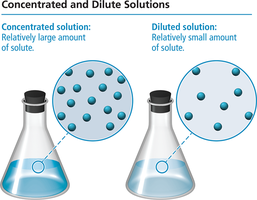
Quantifying Solution Concentration
The concentration of a solution is the amount of solute relative to the solvent. Because solutions are mixtures, their composition can vary between samples.
Molarity (M) – Expressing Solution Concentration
Molarity (M) is a common unit for solution concentration, defined as:
Amount of solute (in moles) divided by volume of solution (in liters).
The formula for molarity is:
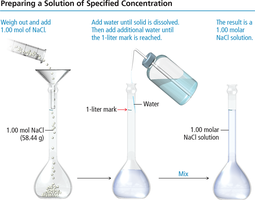
Preparing a Solution of Specified Concentration
To prepare a solution of known molarity, follow these steps:
Weigh out the required amount of solute (e.g., NaCl).
Add water to dissolve the solute.
Add additional water until the desired total volume is reached.
Using Molarity in Calculations
Molarity as a Conversion Factor
Molarity can be used to convert between moles of solute and liters of solution:
From liters to moles:
From moles to liters:


Example: Calculating Solution Concentration
To find the molarity of a solution:
Convert mass of solute to moles using molar mass.
Divide moles of solute by volume of solution in liters.
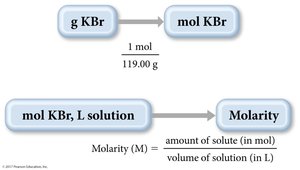
For example, for 25.5 g KBr in 1.75 L solution:
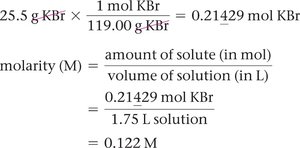
Example: Using Molarity to Find Volume
To find the volume of solution needed for a given amount of solute:
Use molarity as a conversion factor:
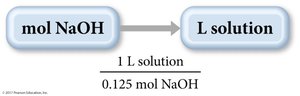
Solution Dilution
Concept and Equation
Stock solutions are often diluted to obtain lower concentrations. The amount of solute remains constant, but the volume increases. The dilution equation is:
= initial molarity
= initial volume
= final molarity
= final volume
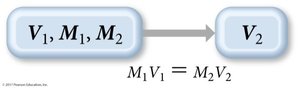
To solve for final volume:
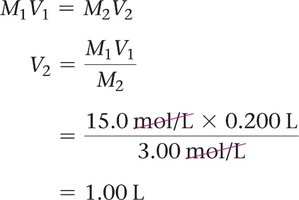
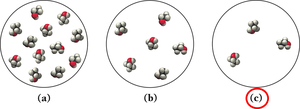
Visual Representation of Dilution
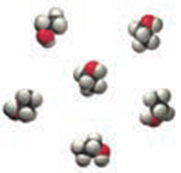
When additional solvent is added, the concentration of solute decreases, but the total number of solute particles remains the same.
Solution Stoichiometry
Stoichiometric Calculations in Aqueous Reactions
In aqueous reactions, the volume and concentration of reactants can be used to calculate the amount in moles. The stoichiometric coefficients from the balanced equation allow conversion between reactants and products.
General plan: Volume A → Amount A (mol) → Amount B (mol) → Volume B

Example: Stoichiometry with Solutions
Given the volume and concentration of Pb(NO3)2 and KCl solutions, calculate the volume of KCl needed to react completely:
Use molarity to convert volume to moles.
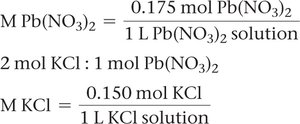
Apply stoichiometric coefficients from the balanced equation.
Convert moles of KCl to volume using its molarity.
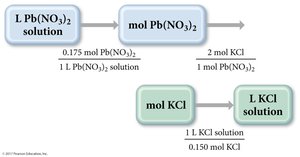
For example, to react 0.150 L of 0.175 M Pb(NO3)2 with 0.150 M KCl:

Summary Table: Key Solution Concepts
Concept | Definition/Formula | Example |
|---|---|---|
Solution | Homogeneous mixture of solvent and solute | Salt water |
Molarity (M) | 1.00 M NaCl | |
Dilution | Stock solution diluted to lower concentration | |
Stoichiometry | Use balanced equation to relate reactants/products | Pb(NO3)2 + 2 KCl → PbCl2 + 2 KNO3 |
