 Back
BackChapter 5: Introduction to Solutions and Aqueous Reactions – Study Notes
Study Guide - Smart Notes
 Tailored notes based on your materials, expanded with key definitions, examples, and context.
Chapter 5: Introduction to Solutions and Aqueous Reactions
Introduction: Real-World Chemistry of Solutions
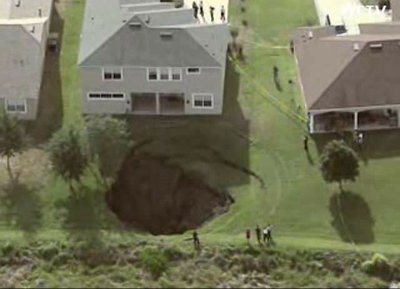
Solutions and aqueous reactions are central to both natural processes and human activities. For example, the formation of cenotes (sinkholes) in limestone regions and the Flint Water Crisis are both consequences of chemical reactions in aqueous solutions. Understanding the properties of solutions, their concentrations, and the reactions that occur within them is essential for predicting and controlling chemical behavior in the environment and laboratory.


Components and Properties of Solutions
Components of a Solution
A solution is a homogeneous mixture of two or more pure substances. The solvent is the component present in the greatest amount, while solutes are present in lesser amounts. An aqueous solution is one in which water acts as the solvent.
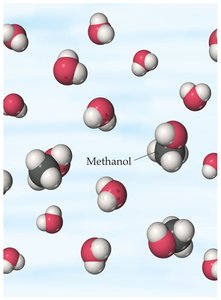
Solvent: The substance in greatest abundance (e.g., water in an aqueous solution).
Solute: The substance(s) dissolved in the solvent (e.g., salt in saltwater).
Concentration of Solutions: Molarity
The concentration of a solution describes the amount of solute dissolved in a given quantity of solvent or solution. The most common unit is molarity (M), defined as moles of solute per liter of solution:
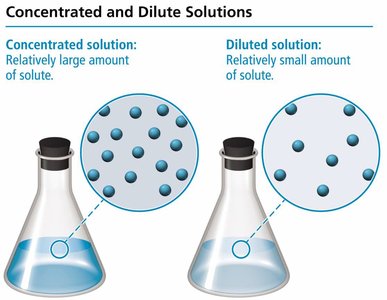
Concentrated solution: Contains a large amount of solute relative to solvent.
Dilute solution: Contains a small amount of solute relative to solvent.
Preparing Solutions of Specified Molarity
To prepare a solution of a specific molarity, dissolve the calculated amount of solute in a volume of solvent to reach the desired final volume. For example, to make 0.100 L (100.0 mL) of a 0.278 M glucose solution, dissolve 0.0278 mol of glucose in water and dilute to 100.0 mL.
Example: Calculate the molarity of a solution made by dissolving 5.00 g (0.0278 mol) of glucose (C6H12O6, 180.18 g/mol) in 100.0 mL of solution.
Solution Dilution
Stock solutions are concentrated solutions that are diluted to lower concentrations for laboratory use. The number of moles of solute remains constant before and after dilution:
To calculate the new concentration or volume after dilution, use the relationship:
where and are the molarity and volume of the concentrated solution, and and are those of the diluted solution.
Example: How many milliliters of 3.0 M H2SO4 are needed to make 450 mL of 0.10 M H2SO4?
Solution Stoichiometry
In aqueous reactions, the quantities of reactants and products are often specified in terms of volumes and concentrations. Stoichiometric coefficients from balanced chemical equations are used to relate the amounts of different substances.

Example: What is the molarity of aqueous lithium bromide if 25.0 mL of LiBr completely reacts with 10.0 mL of 0.250 M Pb(NO3)2?
Types of Aqueous Solutions and Solubility
Solute-Solvent Interactions
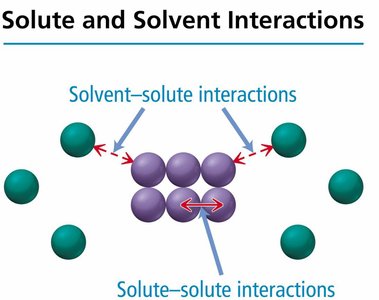
When a solid is placed in a liquid solvent, two main interactions compete: solute-solute interactions (holding the solid together) and solute-solvent interactions (attractive forces between solvent molecules and solute particles). Dissolution occurs when solute-solvent interactions are strong enough to overcome solute-solute interactions.
Electrolytes and Nonelectrolytes
Electrolytes are substances that dissociate into ions when dissolved in water, allowing the solution to conduct electricity. Nonelectrolytes do not dissociate and do not conduct electricity.
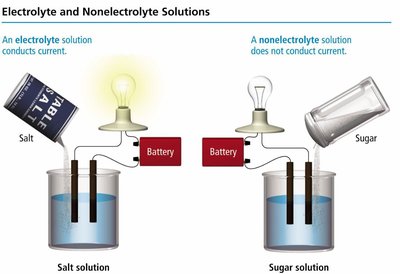
Strong electrolytes: Completely dissociate into ions (e.g., NaCl, HCl).
Weak electrolytes: Partially dissociate into ions (e.g., acetic acid).
Nonelectrolytes: Do not dissociate (e.g., sugar).
Strong and Weak Acids
Acids are molecular compounds that ionize in water. Strong acids completely ionize, while weak acids only partially ionize, establishing an equilibrium.
Example (Strong acid):
Example (Weak acid):
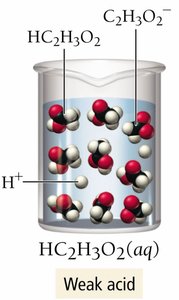
Solubility of Ionic Compounds
The solubility of an ionic compound in water depends on the interactions between the ions and water molecules. Compounds that dissolve are termed soluble; those that do not are insoluble. Solubility rules, based on experimental observations, help predict whether a compound will dissolve.
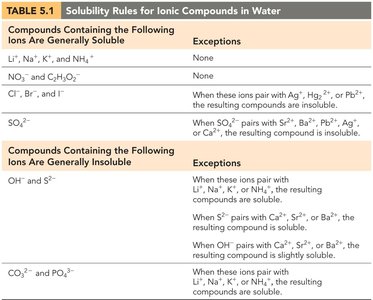
Example: According to the solubility rules, Na2CO3 is soluble, while AgI is insoluble.
Precipitation, Acid-Base, and Redox Reactions in Aqueous Solution
Precipitation Reactions
When two aqueous solutions are mixed, an insoluble product (precipitate) may form. Precipitation reactions are predicted using solubility rules. If no insoluble product forms, no reaction occurs.
Example: Mixing aqueous solutions of barium chloride and potassium sulfate forms a precipitate of barium sulfate.
Representing Aqueous Reactions
Chemical reactions in solution can be represented in three ways:
Molecular equation: Shows complete, neutral formulas for all compounds.
Complete ionic equation: Shows all strong electrolytes as ions.
Net ionic equation: Shows only the species that actually change during the reaction; spectator ions are omitted.
Example: For the reaction of AgNO3(aq) and KCl(aq):
Molecular:
Net ionic:
Acid-Base (Neutralization) Reactions
An acid-base reaction involves an acid (producing H+ in solution) reacting with a base (producing OH-) to form water and a salt. Acids can be monoprotic (one ionizable proton) or polyprotic (more than one ionizable proton).
Example:
Acid-Base Titrations
Titration is a technique to determine the concentration of an unknown solution by reacting it with a solution of known concentration. The equivalence point is reached when the moles of H+ equal the moles of OH-. Indicators are used to signal the equivalence point by changing color.
Gas-Evolution Reactions
Some aqueous reactions produce a gas that bubbles out of solution. These are called gas-evolution reactions.
Oxidation-Reduction (Redox) Reactions
Redox reactions involve the transfer of electrons between reactants. Oxidation is the loss of electrons, and reduction is the gain of electrons. The mnemonic "OIL RIG" (Oxidation Is Loss, Reduction Is Gain) helps remember this concept.
Oxidation state (number): Assigned to atoms to track electron transfer. Free elements have an oxidation state of 0; monoatomic ions have an oxidation state equal to their charge.
Example: In Na2SO3, sodium is +1, oxygen is -2, and sulfur is +4.
Predicting Redox Reactions: The Activity Series
The activity series ranks metals by their tendency to be oxidized. A metal higher in the series will reduce the ions of a metal lower in the series. This allows prediction of whether a redox reaction will occur.
Example: Magnesium metal will reduce Cu2+ ions, but copper metal will not reduce Mg2+ ions.
Summary Table: Solubility Rules for Ionic Compounds in Water
Compounds Containing the Following Ions Are Generally Soluble | Exceptions |
|---|---|
Li+, Na+, K+, and NH4+ | None |
NO3- and C2H3O2- | None |
Cl-, Br-, and I- | When these ions pair with Ag+, Hg22+, or Pb2+, the resulting compounds are insoluble. |
SO42- | When SO42- pairs with Sr2+, Ba2+, Pb2+, Ag+, or Ca2+, the resulting compound is insoluble. |
Compounds Containing the Following Ions Are Generally Insoluble | Exceptions |
OH- and S2- | When these ions pair with Li+, Na+, K+, or NH4+, the resulting compounds are soluble. S2- is also soluble with Ca2+, Sr2+, or Ba2+. OH- is slightly soluble with Ca2+, Sr2+, or Ba2+. |
CO32- and PO43- | When these ions pair with Li+, Na+, K+, or NH4+, the resulting compounds are soluble. |
Additional info: This summary covers all major learning goals for Chapter 5, including solution composition, concentration calculations, dilution, solution stoichiometry, types of aqueous solutions, solubility, precipitation, acid-base and redox reactions, and the use of the activity series. Practice problems and real-world examples (cenotes, Flint Water Crisis) are included to reinforce concepts.
