 Back
BackChapter 5: Solutions and Their Properties – General Chemistry Study Notes
Study Guide - Smart Notes
 Tailored notes based on your materials, expanded with key definitions, examples, and context.
Solutions
Definition and Components
A solution is a homogeneous mixture composed of a solute (minor component) dissolved in a solvent (major component). The solute is uniformly distributed within the solvent. An aqueous solution is one where water is the solvent.
Solute: The substance being dissolved (e.g., salt in salt water).
Solvent: The substance doing the dissolving (e.g., water in salt water).
Concentration: Indicates how much solute is dissolved in the solvent.
Unsaturated solution: Less than the maximum solute dissolved.
Saturated solution: Maximum solute dissolved; excess remains undissolved.
Supersaturated solution: More solute dissolved than normally possible, often by heating.
Dynamic equilibrium: Rate of dissolution equals rate of precipitation in a saturated solution.
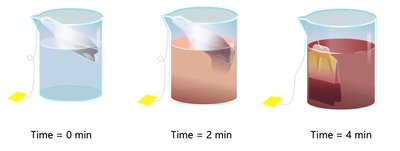
Solubility
Solubility is the ability of a substance to dissolve in a solvent, especially water. Different salts have varying solubility in water, governed by solubility rules.
Soluble salts: Group 1 metal cations, NO3-, ClO4-, C2H3O2-, NH4+
Insoluble salts: Ag+, Pb2+, Hg22+, OH-, S2-, CO32-, PO43-
Rule: Soluble component generally trumps insoluble component.
Electrolytes
Types of Electrolytes
Electrolytes are substances that dissociate into ions in water, conducting electricity. They are classified as:
Strong electrolytes: Fully dissociate (soluble ionic compounds, strong acids, strong bases).
Weak electrolytes: Partially dissociate (weak acids and bases).
Non-electrolytes: Do not dissociate (e.g., glucose, methanol).
Solubility and Phase Rules
Temperature and Pressure Effects
Solids: More soluble at higher temperatures.
Gases: More soluble at lower temperatures and higher pressures.
Polarity and Intermolecular Forces
Polarity
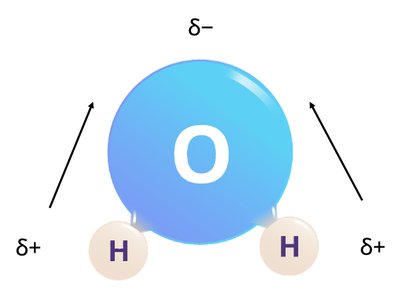
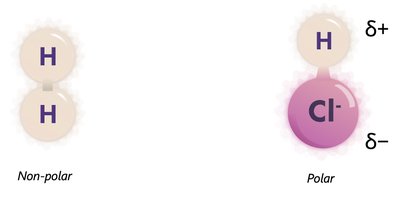
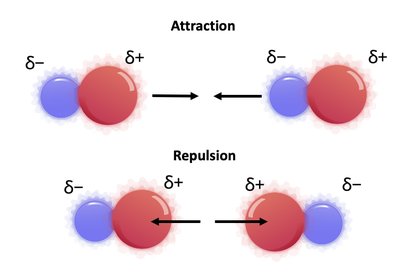
Polarity arises from differences in electronegativity and molecular geometry. Polar molecules have a positive and negative end, while non-polar molecules have an equal distribution of charge.
Polar molecule example: Water (H2O) – oxygen is partially negative, hydrogens are partially positive.
Non-polar molecule example: Hydrogen (H2).
Intermolecular Forces
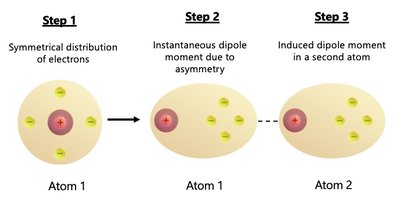
London Dispersion Forces: Weakest, arise from temporary dipoles.
Dipole-Dipole Interactions: Medium strength, occur between polar molecules.
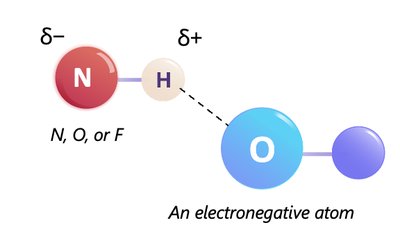
Hydrogen Bonding: Strongest, occurs when H is bonded to N, O, or F.
"Like Dissolves Like" Principle
Polar solvents dissolve polar solutes.
Non-polar solvents dissolve non-polar solutes.
Polar and non-polar substances do not mix.
Classification of Matter
Types of Matter
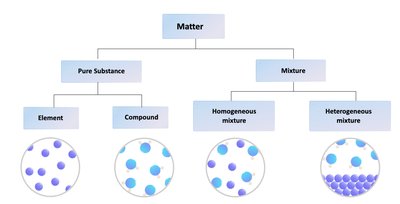
Matter is classified as pure substances (elements and compounds) or mixtures (homogeneous and heterogeneous).
Element: One type of atom (e.g., Na).
Compound: Two or more elements chemically combined (e.g., NaCl).
Homogeneous mixture: Uniform composition (e.g., air, solutions).
Heterogeneous mixture: Non-uniform composition (e.g., salad).
Concentration Calculations
Molarity (M)
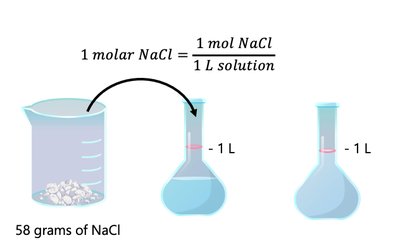
Molarity is moles of solute per liter of solution.
Formula:
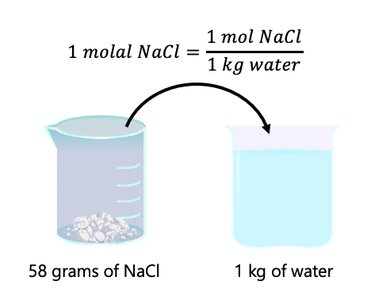
Molality (m)
Molality is moles of solute per kilogram of solvent. Used when temperature changes, as mass is unaffected by temperature.
Formula:
Dilution
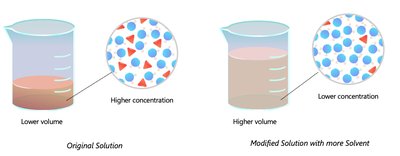
Dilution reduces the concentration of a solution by adding more solvent.
Formula:
Types of Solutions
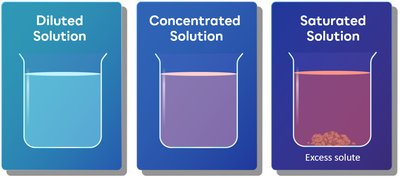
Diluted: Low solute concentration.
Concentrated: High solute concentration.
Saturated: Maximum solute dissolved; excess visible.
Normality (N)
Normality is the concentration in terms of equivalents per liter of solution, used for acids and bases.
Formula:
Mole Fraction (X)
Mole fraction is the ratio of moles of one component to total moles in solution.
Formula:
Colligative and Non-Colligative Properties
Non-Colligative Properties
Surface tension: Resistance to external force due to cohesion.
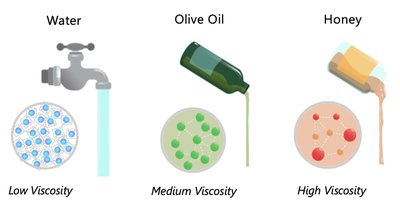
Viscosity: Resistance to flow.
Solubility: Ability to dissolve.
Volatility: Ease of evaporation.
Color & Density: Depend on identity of molecules.
Colligative Properties
Vapor-pressure depression: Lower vapor pressure in solution than pure solvent.
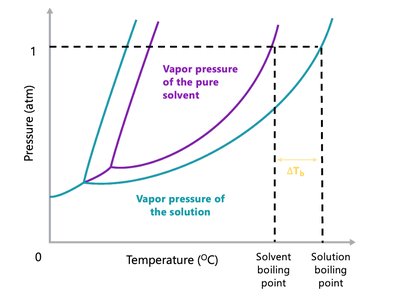
Boiling point elevation: Higher boiling point in solution.
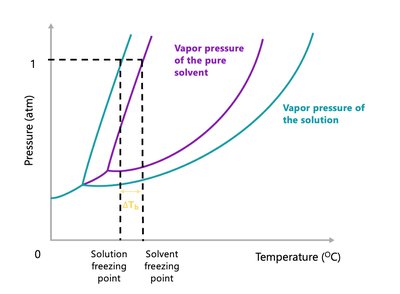
Freezing point depression: Lower freezing point in solution.
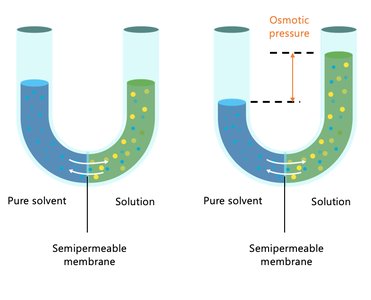
Osmotic pressure: Pressure needed to stop osmosis.
Vapor-Pressure Depression
Raoult’s Law:
Vapor pressure and boiling point are inversely related.
Boiling Point Elevation
Formula:
Van’t Hoff factor (i): Number of particles solute dissociates into.
Freezing Point Depression
Formula:
Negative sign indicates decrease in freezing point.
Osmotic Pressure
Formula:
Osmosis: Water moves from low to high solute concentration across a semipermeable membrane.
Net Ionic Equations
Molecular, Ionic, and Net Ionic Equations
Molecular equation: All compounds written as molecules.
Ionic equation: Ionic compounds written as separate ions.
Spectator ions: Ions not involved in the reaction.
Net ionic equation: Only shows ions and compounds directly involved in the reaction.
Example:
Molecular: NaCl(aq) + AgNO3(aq) ⇌ NaNO3(aq) + AgCl(s)
Ionic: Na+(aq) + Cl-(aq) + Ag+(aq) + NO3-(aq) ⇌ Na+(aq) + NO3-(aq) + AgCl(s)
Net ionic: Cl-(aq) + Ag+(aq) ⇌ AgCl(s)
