 Back
BackChapter 5: Thermochemistry – Energy, Enthalpy, and Calorimetry
Study Guide - Smart Notes
 Tailored notes based on your materials, expanded with key definitions, examples, and context.
5.1 The Nature of Chemical Energy
Kinetic and Potential Energy
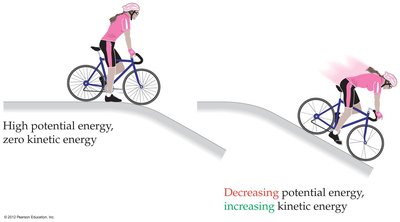
Chemical systems possess energy in two primary forms: kinetic energy (energy of motion) and potential energy (energy due to position or composition). In chemistry, we are particularly interested in the kinetic energy of atoms and molecules, as well as the potential energy stored in chemical bonds.
Kinetic Energy (Ek): The energy associated with the motion of an object. It depends on the object's mass (m) and velocity (v).
Formula:
Potential Energy: The energy stored due to an object's position or the arrangement of its parts. In chemistry, this often refers to energy stored in chemical bonds.
Potential energy can be converted to kinetic energy and vice versa.
Electrostatic Potential Energy (Eel)
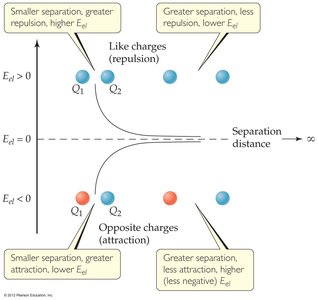
One of the most important forms of potential energy in chemistry is electrostatic potential energy, which arises from interactions between charged particles. The energy depends on the magnitude of the charges and the distance between them.
Formula:
Where and are the charges, is the separation distance, and is a proportionality constant ( J·m/C2).
Like charges (repulsion): ; Opposite charges (attraction): .
As separation increases, approaches zero.
5.2 The First Law of Thermodynamics
System and Surroundings
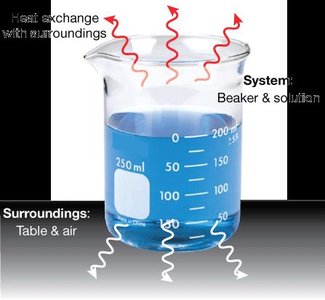
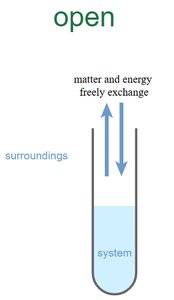
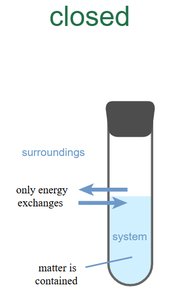
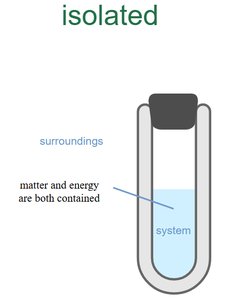
To study energy changes, we define a system (the part of the universe under study) and the surroundings (everything else). The type of system determines how matter and energy are exchanged:
Open system: Exchanges both matter and energy with surroundings.
Closed system: Exchanges only energy, not matter.
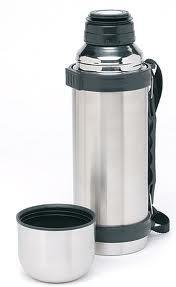
Isolated system: Exchanges neither matter nor energy.
The First Law of Thermodynamics
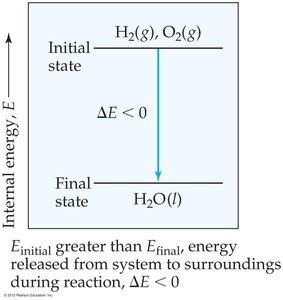
The first law states that energy cannot be created or destroyed, only converted from one form to another. The internal energy (E) of a system is the sum of all kinetic and potential energies of its components. In thermodynamics, we focus on the change in internal energy ():
Formula:
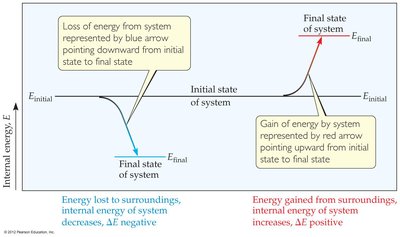
For chemical reactions, the initial state is reactants, and the final state is products.
Energy lost by the system is gained by the surroundings, and vice versa.
Heat (q) and Work (w)
When a system undergoes a change, the change in internal energy is given by:
Formula:
q: Heat added to or released from the system
w: Work done on or by the system
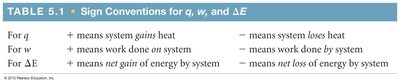
Quantity | + Sign | – Sign |
|---|---|---|
q (heat) | System gains heat | System loses heat |
w (work) | Work done on system | Work done by system |
ΔE | Net gain of energy by system | Net loss of energy by system |
Endothermic and Exothermic Processes
Endothermic: System absorbs heat (). Example: melting ice.
Exothermic: System releases heat (). Example: combustion of gasoline.
Pressure-Volume Work
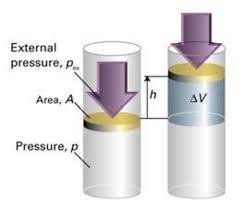
Work done by or on a system during expansion or compression of gases is called pressure-volume (P-V) work:
Formula:
If the system expands (), is negative (system does work on surroundings).
If the system contracts (), is positive (work done on system).
State Functions
State functions are properties that depend only on the state of the system, not on how it got there (e.g., pressure, volume, temperature, internal energy, enthalpy). Heat and work are not state functions.
5.3 Enthalpy
Definition and Properties
Enthalpy (H) is a thermodynamic quantity equivalent to the total heat content of a system. It is defined as:
Formula:
The change in enthalpy () at constant pressure equals the heat absorbed or released.
Formula:
Enthalpy is a state function.
5.4 Enthalpies of Reaction
Thermochemical Equations and Enthalpy Diagrams
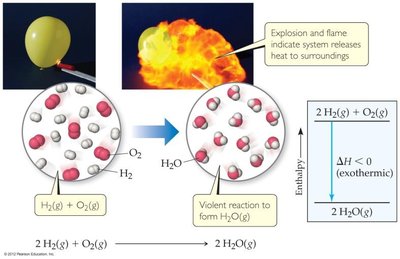
A thermochemical equation shows the enthalpy change as well as the mass relationships in a chemical reaction. The sign and magnitude of indicate whether a reaction is exothermic or endothermic.
If , is negative (exothermic).
If , is positive (endothermic).
Guidelines for Thermochemical Equations
Extensive property: Enthalpy depends on the amount of substance.
Reverse reaction: changes sign for the reverse reaction.
Physical states: depends on the physical states of reactants and products.
Relating to Quantities of Reactants and Products
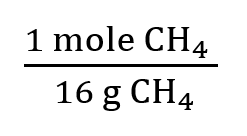
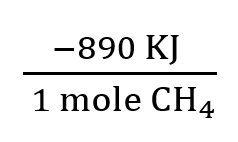
The enthalpy change is proportional to the amount of reactant consumed or product formed. For example, burning 4.50 g of methane:
Given: , kJ
Convert grams to moles, then use per mole to find total heat released.
5.5 Calorimetry
Measuring Heat Flow
Calorimetry is the measurement of heat flow. A calorimeter is a device used to measure the heat absorbed or released during a chemical or physical process. The amount of heat absorbed depends on the substance's heat capacity and the mass present.
Heat Capacity (C): Amount of heat required to raise the temperature of a given amount of substance by 1°C (or 1 K).
Molar Heat Capacity: Heat capacity per mole (J/mol·K).
Specific Heat Capacity (Cs): Heat capacity per gram (J/g·K).
Formula: or
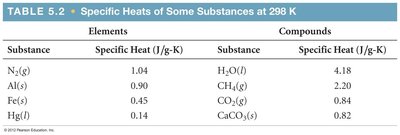
Substance | Specific Heat (J/g·K) |
|---|---|
H2O(l) | 4.18 |
CH4(g) | 2.20 |
CO2(g) | 0.84 |
CaCO3(s) | 0.82 |
N2(g) | 1.04 |
Al(s) | 0.90 |
Fe(s) | 0.45 |
Hg(l) | 0.14 |
Water's high specific heat makes it valuable for temperature regulation in biological and industrial systems.
Calculating Heat Transfer
To calculate the heat required to change the temperature of a substance:
Example: Heating 250 g of water from 22°C to 98°C with J/g·K:
J or 79.42 kJ
Determining Specific Heat
Given the heat released or absorbed, mass, and temperature change, the specific heat can be calculated:
Example: A 25.0 g metal releases –669.4 J as it cools from 100.0°C to 30.0°C: J/g·°C
