 Back
Chapter 5 – Thermochemistry: Energy, Enthalpy, and Heat in Chemical Reactions
Study Guide - Smart Notes
 Tailored notes based on your materials, expanded with key definitions, examples, and context.
Thermochemistry and Energy
Introduction to Energy and Thermochemistry
Thermochemistry is a branch of chemistry that studies the energy and heat associated with chemical reactions. Energy is defined as the ability to do work or transfer heat, and it is a fundamental concept in understanding how chemical reactions occur and how energy is transformed.
Energy is the capacity to do work or transfer heat.
Work is energy used to move an object with mass.
Heat is energy used to cause a temperature change in an object.
Thermochemistry focuses on the relationship between chemical reactions and energy changes involving heat.
Kinetic and Potential Energy
Energy exists in two primary forms: kinetic and potential.
Kinetic energy is the energy of motion, possessed by moving objects.
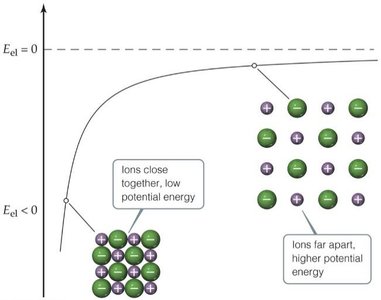
Potential energy is stored energy, often due to position or arrangement. In molecules, the most important form is electrostatic potential energy (), which arises from interactions between charged particles.
Electrostatic Potential Energy Formula
The electrostatic potential energy between two charges is given by: where is a proportionality constant ( J·m/C2), and are the charges, and is the distance between them. 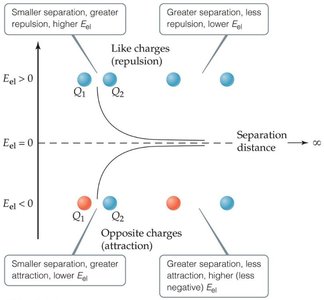
Units of Energy
The SI unit of energy is the Joule (J).
An older unit, the calorie (cal), is still used: 1 cal = 4.184 J.
Food calories are actually kilocalories (1 kcal = 1000 cal).
First Law of Thermodynamics
System and Surroundings
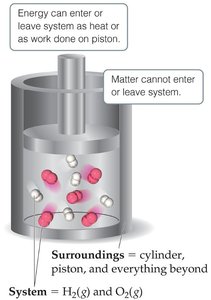
In thermochemistry, the universe is divided into the system (the part under study, e.g., reactants) and the surroundings (everything else).
System: The specific part of the universe being studied (e.g., hydrogen and oxygen molecules).
Surroundings: Everything outside the system (e.g., cylinder, piston, and environment).
Types of Systems
Open system: Exchanges both mass and energy with surroundings.
Closed system: Exchanges energy but not mass.
Isolated system: Exchanges neither mass nor energy.
Internal Energy and Its Change
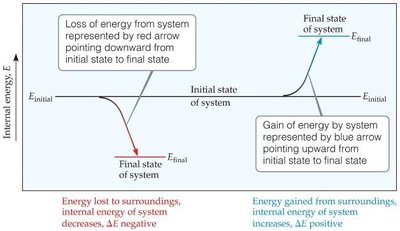
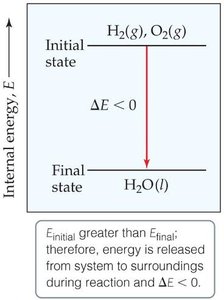
The internal energy () of a system is the sum of all kinetic and potential energies of its components. The change in internal energy () is:
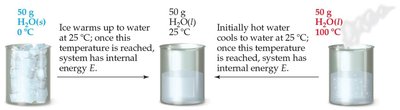
is a state function: it depends only on the initial and final states, not the path taken.
Thermodynamic Quantities and Sign Conventions
Thermodynamic quantities have three parts: a number, a unit, and a sign.
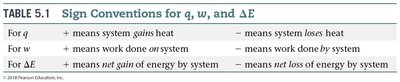
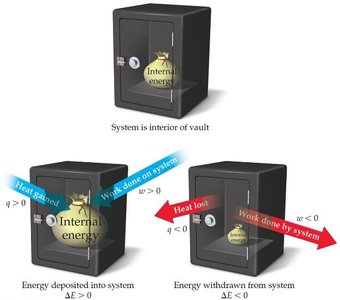
A positive means the system gains energy.
A negative means the system loses energy.
Energy exchange occurs as heat (q) or work (w).
State Functions and Path Functions
State Functions
State function: A property determined by the state of the system, not how it was reached (e.g., internal energy, enthalpy).
Heat () and work () are not state functions; they depend on the path.
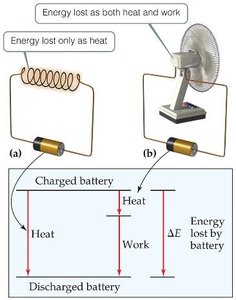
Work and Pressure-Volume Work
Mechanical Work in Chemistry
Work is often associated with changes in gas volume.
Pressure-volume work is calculated as:
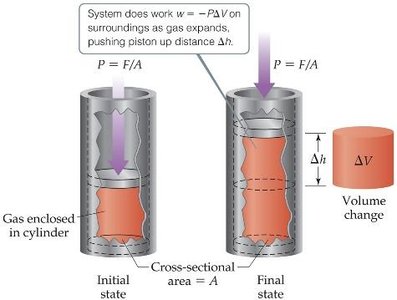
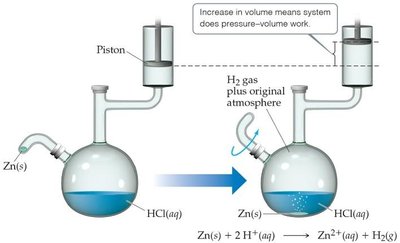
Enthalpy and Heat Flow
Definition of Enthalpy
Enthalpy (H) is the sum of internal energy and the product of pressure and volume:
At constant pressure, the change in enthalpy () is:
For reactions at constant pressure, equals the heat exchanged.
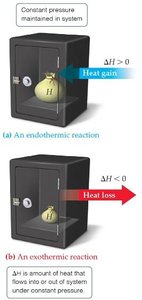
Enthalpy of Reaction
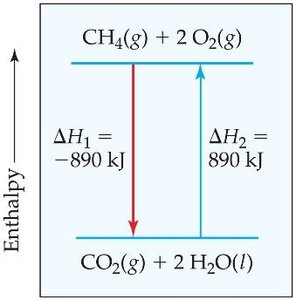
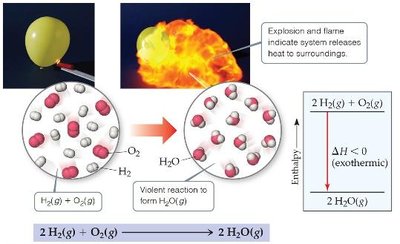
is the enthalpy change for a chemical reaction:
Endothermic: (heat absorbed)
Exothermic: (heat released)
Calorimetry: Measuring Heat Flow
Constant Pressure Calorimetry
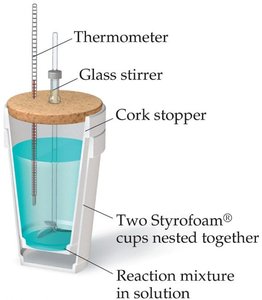
Calorimetry is the measurement of heat flow in a reaction. A calorimeter is used to measure heat changes, often in aqueous solutions.
The specific heat of water is 4.184 J/g·K.
Heat change is calculated as: where is mass, is specific heat, and is temperature change.
Heat Capacity and Specific Heat
Heat capacity: Energy required to raise the temperature of a substance by 1 K.
Specific heat: Energy required to raise 1 g of a substance by 1 K.
Molar heat capacity: Energy required to raise 1 mole of a substance by 1 K.
Hess's Law
Calculating Enthalpy Changes
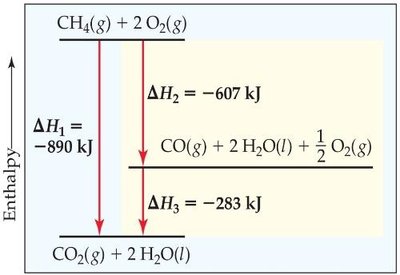
Hess's Law: The total enthalpy change for a reaction is the sum of the enthalpy changes for individual steps.
Enthalpy is a state function, so the path does not affect the total change.
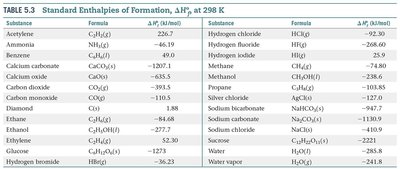
Standard Enthalpies of Formation
Definition and Use
Standard enthalpy of formation (): The enthalpy change for forming 1 mole of a compound from its elements in their standard states.
The standard enthalpy of formation for an element in its most stable form is zero.
Bond Enthalpy and Estimating Reaction Enthalpy
Bond Enthalpy
Bond enthalpy: The energy required to break one mole of a specific bond in a gaseous substance.
Bond enthalpy is always positive; stronger bonds have higher values.
Energy is released when bonds are formed.
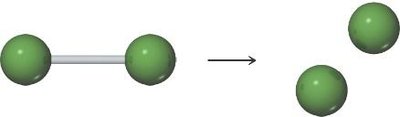
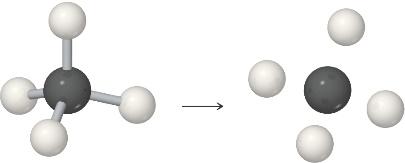
Estimating Enthalpy of Reaction Using Bond Enthalpies
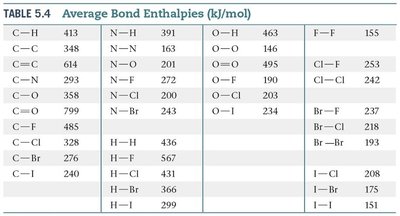
Estimate by summing bond energies for bonds broken (energy absorbed) and bonds formed (energy released).
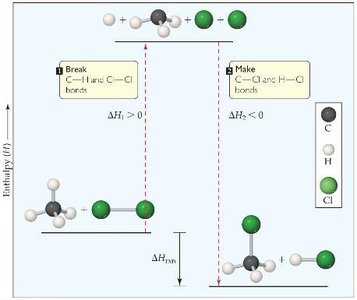

Summary Table: Sign Conventions for q, w, and ΔE
Quantity | Positive Sign | Negative Sign |
|---|---|---|
q (heat) | System gains heat | System loses heat |
w (work) | Work done on system | Work done by system |
ΔE (internal energy) | Net gain of energy by system | Net loss of energy by system |
Summary Table: Average Bond Enthalpies (kJ/mol)
Bond | Enthalpy (kJ/mol) |
|---|---|
C–H | 413 |
O–H | 463 |
Cl–Cl | 242 |
H–H | 436 |
Br–Br | 193 |
Others | See image_22 for full table |
Summary Table: Standard Enthalpies of Formation (ΔHf° at 298 K)
Substance | Formula | ΔHf° (kJ/mol) |
|---|---|---|
Acetylene | C2H2(g) | 226.7 |
Ammonia | NH3(g) | -46.19 |
Benzene | C6H6(l) | 49.0 |
Water (liquid) | H2O(l) | -285.8 |
Water (vapor) | H2O(g) | -241.8 |
Others | See image_18 for full table |
