 Back
BackChapter 5: Thermochemistry – Study Notes for General Chemistry
Study Guide - Smart Notes
 Tailored notes based on your materials, expanded with key definitions, examples, and context.
Thermochemistry
Introduction to Energy and Thermochemistry
Thermochemistry is a branch of thermodynamics that focuses on the study of energy changes, particularly heat, during chemical reactions. Understanding energy transformations is essential for predicting reaction behavior and designing chemical processes.
Energy: The ability to do work or transfer heat. It is a central concept in chemistry and physics.
Thermodynamics: The study of energy and its transformations.
Thermochemistry: The study of chemical reactions and the energy changes that involve heat.
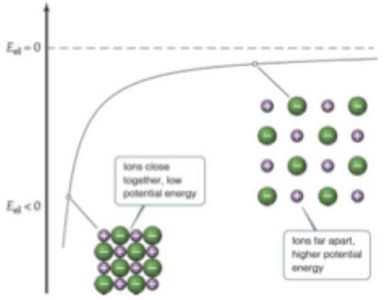
Electrostatic Attraction: Energy is released when chemical bonds are formed; energy is consumed when bonds are broken (endothermic).
Endothermic Process: Energy is absorbed when bonds are broken.

First Law of Thermodynamics
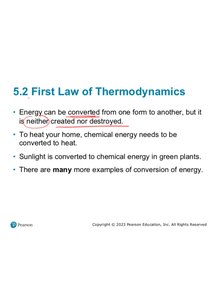
The first law of thermodynamics states that energy can be converted from one form to another, but it cannot be created or destroyed. This principle is fundamental to all energy transformations in chemistry.
Energy Conservation: Energy is neither created nor destroyed.
Examples: Chemical energy converted to heat (heating homes), sunlight converted to chemical energy (photosynthesis).
System and Surroundings
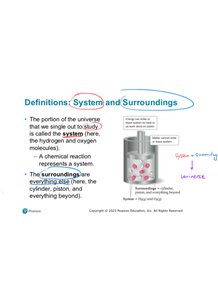
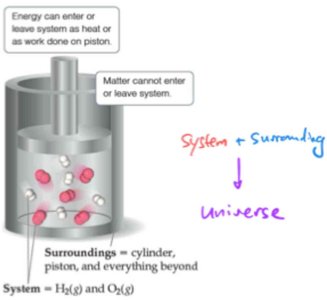
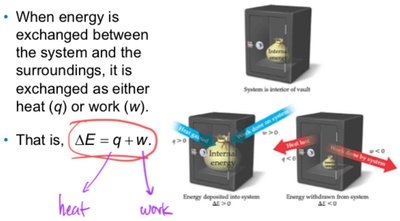
In thermochemistry, the universe is divided into the system (the part under study) and the surroundings (everything else). Energy can be exchanged between the system and surroundings as heat or work.
System: The portion of the universe singled out for study (e.g., reactants in a chemical reaction).
Surroundings: Everything outside the system.
Types of Systems
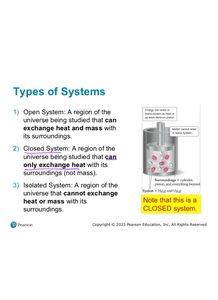
Systems are classified based on their ability to exchange energy and matter with their surroundings.
Open System: Exchanges both energy and matter.
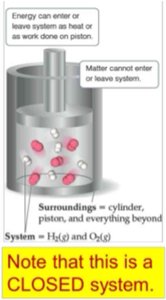
Closed System: Exchanges energy but not matter.
Isolated System: Exchanges neither energy nor matter.
Internal Energy
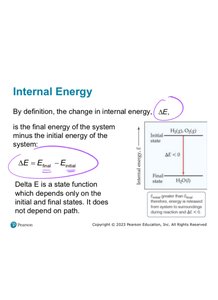
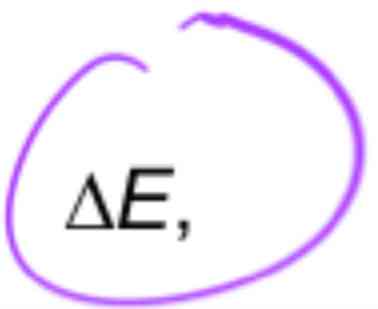
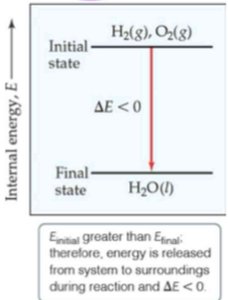
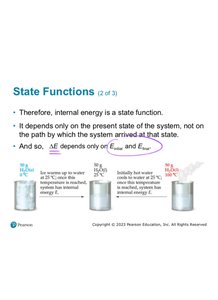
Internal energy (E) is the sum of all kinetic and potential energies of the components of a system. The change in internal energy (ΔE) is a key concept in thermochemistry.
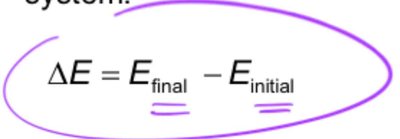
ΔE = E_{final} - E_{initial}
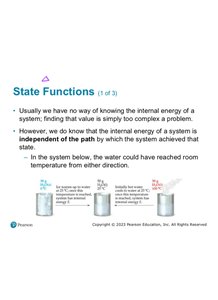
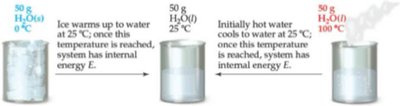
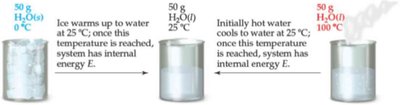
ΔE is a state function: It depends only on the initial and final states, not the path taken.
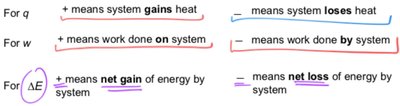
Sign conventions: Positive ΔE means the system gains energy; negative ΔE means the system loses energy.
Relating Internal Energy to Heat and Work
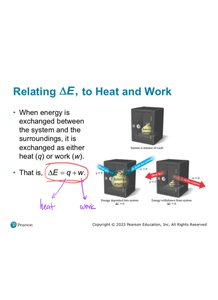
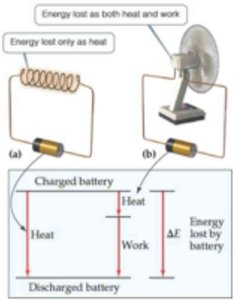
Energy exchange between the system and surroundings occurs as heat (q) or work (w). The relationship is given by:
Sign conventions for q and w:
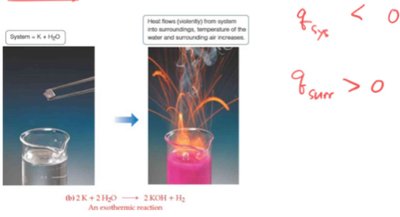
q > 0: System gains heat
q < 0: System loses heat
w > 0: Work done on system
w < 0: Work done by system
Endothermic and Exothermic Processes
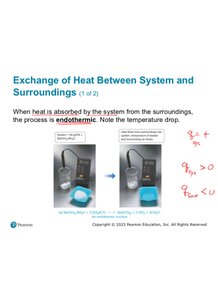
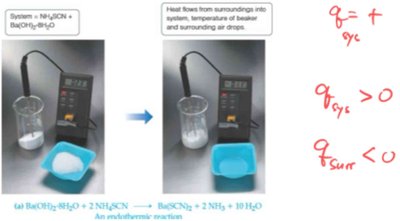
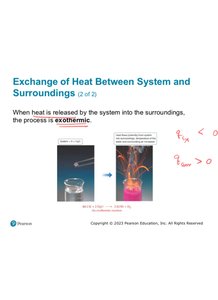
Heat exchange between the system and surroundings determines whether a process is endothermic or exothermic.
Endothermic: System absorbs heat; temperature drops.
Exothermic: System releases heat; temperature rises.
State Functions
State functions depend only on the current state of the system, not on the path taken to reach that state. Internal energy is a state function, but heat and work are not.
Examples: Internal energy, enthalpy, pressure, volume.
Path-dependent quantities: Heat (q), work (w).
Enthalpy
Definition and Calculation
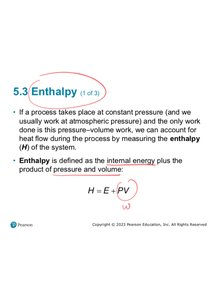
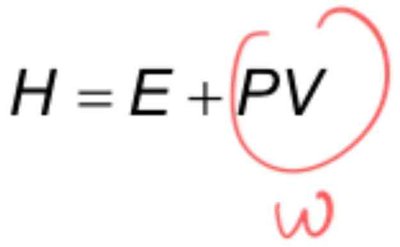
Enthalpy (H) is a thermodynamic quantity that accounts for heat flow at constant pressure. It is defined as:
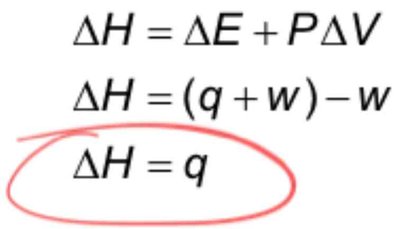
Change in enthalpy:
At constant pressure:

Enthalpy Change and Heat
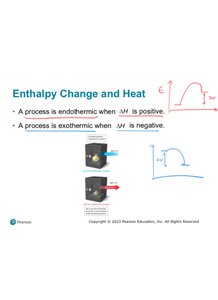
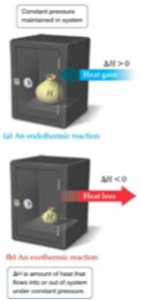
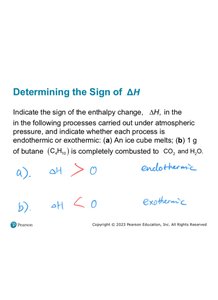
The sign of ΔH indicates whether a process is endothermic or exothermic.
ΔH > 0: Endothermic (heat absorbed)
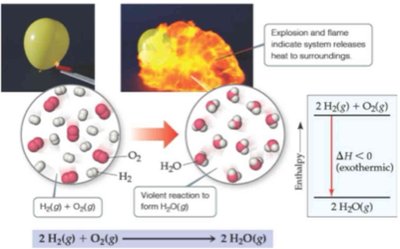
ΔH < 0: Exothermic (heat released)
Pressure-Volume Work
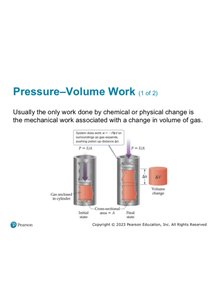
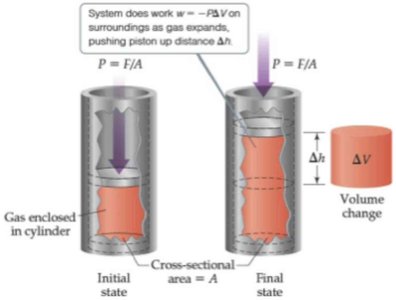
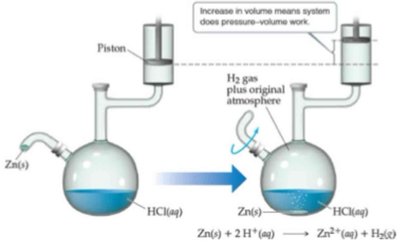
Pressure-volume work is the mechanical work associated with changes in the volume of a gas. The work done by the system is:
Work is negative when done by the system (expansion).
Enthalpy of Reaction
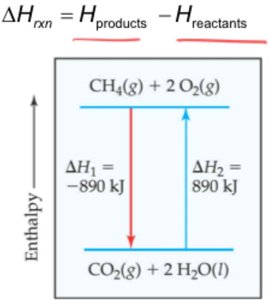
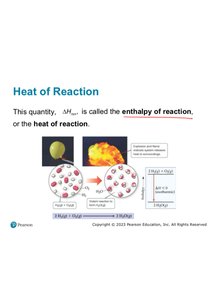
The enthalpy change for a reaction (ΔHrxn) is the difference between the enthalpy of products and reactants:
ΔHrxn is also called the heat of reaction.
Enthalpy Guidelines
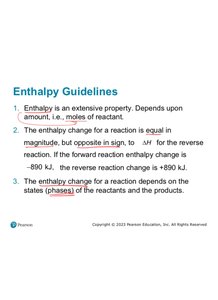
Enthalpy is an extensive property: It depends on the amount (moles) of reactant.
The enthalpy change for a reaction is equal in magnitude but opposite in sign for the reverse reaction.
The enthalpy change depends on the states (phases) of reactants and products.
Calorimetry
Measuring Heat Flow
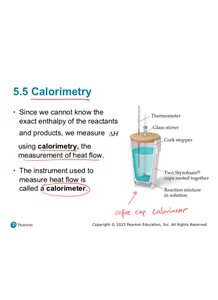
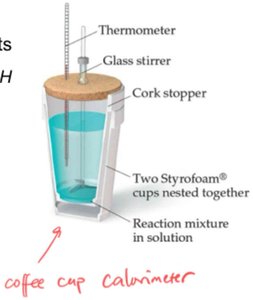
Calorimetry is the measurement of heat flow during a chemical reaction. The instrument used is called a calorimeter.
Coffee-cup calorimeter: Used for reactions at constant pressure.
Heat capacity: Energy required to raise the temperature of a substance by 1 K (or 1°C).
Specific heat: Heat capacity per gram.
Molar heat capacity: Heat capacity per mole.
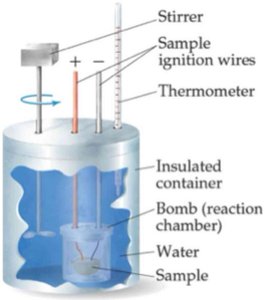
Bomb Calorimetry (Constant Volume)
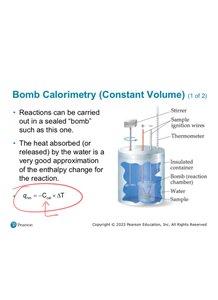
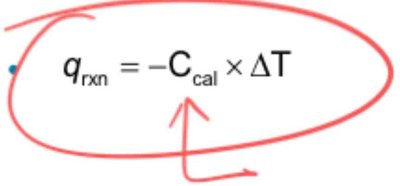
Bomb calorimetry is used for reactions at constant volume. The heat absorbed or released by the water is a good approximation of the enthalpy change for the reaction.
Measures change in internal energy (ΔE).
Summary Table: Types of Systems
Type of System | Energy Exchange | Matter Exchange |
|---|---|---|
Open | Yes | Yes |
Closed | Yes | No |
Isolated | No | No |
Summary Table: Sign Conventions for q, w, and ΔE
Quantity | Positive Sign | Negative Sign |
|---|---|---|
q (heat) | System gains heat | System loses heat |
w (work) | Work done on system | Work done by system |
ΔE | Net gain of energy by system | Net loss of energy by system |
