 Back
Chapter 6: Chemical Bonding II – Valence Bond and Molecular Orbital Theory
Study Guide - Smart Notes
 Tailored notes based on your materials, expanded with key definitions, examples, and context.
Chemical Bond Formation
Orbital Overlap and Bond Formation
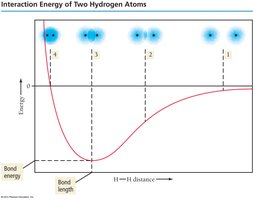
Chemical bonds form when atomic orbitals from different atoms overlap, allowing electrons to be shared or transferred. The interaction energy between atoms changes as they approach each other, leading to bond formation at an optimal distance.
Key Point 1: Atoms far apart have minimal interaction; as they approach, energy decreases until reaching a minimum (bond length).
Key Point 2: If atoms get too close, repulsion increases energy.
Example: The bond energy and bond length of H2 are determined by the optimal overlap of their 1s orbitals.
Valence Bond Theory and Hybridization
Unpaired Electrons and Bonding in CH4
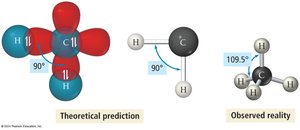
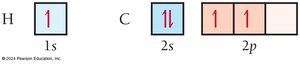
Valence bond theory explains molecular shapes and bonding by considering the overlap of atomic orbitals. Carbon's electron configuration suggests only two bonds, but in reality, it forms four bonds at 109.5° angles due to hybridization.
Key Point 1: Carbon has two unpaired electrons in its 2p orbitals, theoretically forming two bonds at 90°.
Key Point 2: Observed reality is four bonds at 109.5°, explained by hybridization.
Example: Methane (CH4) forms a tetrahedral structure.
Hybridization: Formation of Hybrid Orbitals
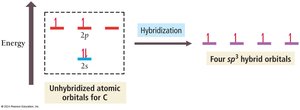
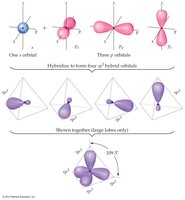
Hybridization is the mixing of atomic orbitals to form new, equivalent hybrid orbitals. The number of hybrid orbitals equals the number of atomic orbitals mixed.
Key Point 1: s and p orbitals can mix to form hybrid orbitals.
Key Point 2: Energy levels change; some orbitals become lower, others higher.
Example: Four sp3 hybrid orbitals are formed from one s and three p orbitals.
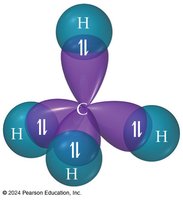
sp3 Hybridization: Tetrahedral Geometry
sp3 hybridization results in four degenerate orbitals arranged tetrahedrally, explaining the geometry of molecules like methane.
Key Point 1: One s and three p orbitals mix to form four sp3 orbitals.
Key Point 2: Tetrahedral geometry with bond angles of 109.5°.
Example: Methane (CH4) and water (H2O) exhibit tetrahedral electron domain geometry.
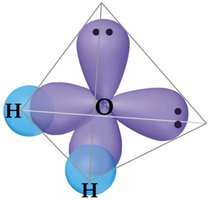
Hybrid Orbitals and Lone Pairs
Hybrid orbitals can accommodate both bonding pairs and lone pairs, affecting molecular geometry.
Key Point 1: Lone pairs occupy hybrid orbitals, influencing shape.
Key Point 2: Water (H2O) has two bonding and two non-bonding domains, resulting in a bent molecular geometry.
Example: Electron domain geometry is tetrahedral, but molecular geometry is bent.
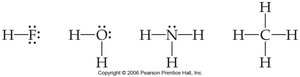
sp2 Hybridization: Trigonal Planar Geometry
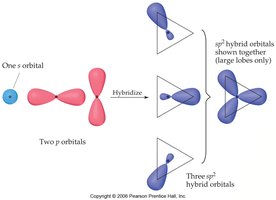
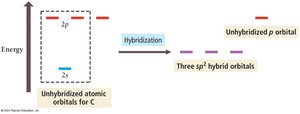
sp2 hybridization involves mixing one s and two p orbitals, resulting in three degenerate orbitals arranged in a trigonal planar geometry.
Key Point 1: Three sp2 hybrid orbitals form, with one unhybridized p orbital remaining.
Key Point 2: Trigonal planar geometry with bond angles of 120°.
Example: Boron trifluoride (BF3) and formaldehyde (CH2O).
Multiple Bonds: Sigma and Pi Bonds
Types of Orbital Overlap
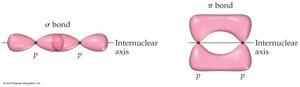
Multiple bonds arise from different types of orbital overlap. Sigma (σ) bonds are formed by head-on overlap, while pi (π) bonds are formed by side-on overlap.
Key Point 1: Single bonds are always σ bonds.
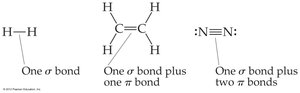
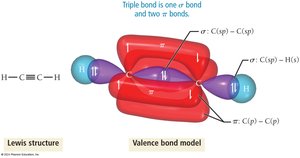
Key Point 2: Double bonds consist of one σ and one π bond; triple bonds have one σ and two π bonds.
Example: Ethylene (C2H4) has a double bond (σ + π); acetylene (C2H2) has a triple bond (σ + 2π).
Hybridization and Multiple Bonds
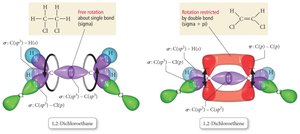
Hybrid orbitals participate in σ bonds, while unhybridized p orbitals form π bonds. The presence of π bonds restricts rotation around the bond axis.
Key Point 1: π bonds lock the geometry, preventing free rotation.
Key Point 2: σ bonds allow free rotation.
Example: 1,2-dichloroethene exhibits restricted rotation due to its double bond.
sp Hybridization: Linear Geometry
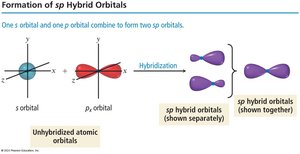
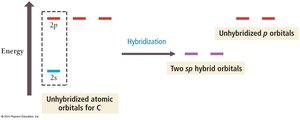
sp hybridization involves mixing one s and one p orbital, resulting in two degenerate orbitals arranged linearly.
Key Point 1: Two sp hybrid orbitals form, with two unhybridized p orbitals remaining.
Key Point 2: Linear geometry with bond angles of 180°.
Example: Acetylene (C2H2) forms a triple bond between carbons.
Molecular Orbital (MO) Theory
Introduction to MO Theory
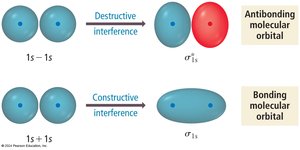
Molecular orbital theory describes bonding in terms of orbitals that belong to the entire molecule, not individual atoms. Atomic orbitals combine to form molecular orbitals, which can be bonding or antibonding.
Key Point 1: MO theory uses wave functions to describe electron distribution.
Key Point 2: Bonding orbitals stabilize the molecule; antibonding orbitals destabilize it.
Example: H2 forms a stable molecule with electrons in a bonding orbital; He2 does not form due to equal numbers of electrons in bonding and antibonding orbitals.
MO Diagrams and Bond Order
MO diagrams show the arrangement of electrons in molecular orbitals. Bond order indicates the strength and number of bonds.
Key Point 1: Bond order = (number of electrons in bonding MOs - number in antibonding MOs)/2.
Key Point 2: Higher bond order means stronger, shorter bonds.
Example: H2 has bond order 1; O2 has bond order 2.
Resonance and Delocalized Bonding
Resonance Structures and Delocalization
Resonance occurs when electrons are delocalized across multiple atoms, leading to structures that cannot be represented by a single Lewis structure.
Key Point 1: Delocalized π bonds are spread over several atoms, stabilizing the molecule.
Key Point 2: All atoms involved must be in the same plane.
Example: Benzene (C6H6) and nitrate (NO3-) exhibit resonance.
Semiconductors and Band Theory
Band Gap and Semiconductor Properties
Semiconductors are materials whose properties are determined by the energy gap (band gap) between the valence and conduction bands. Doping alters these properties by introducing impurities.
Key Point 1: Band gap (Eg) determines whether a material is a semiconductor, insulator, or conductor.
Key Point 2: n-type doping adds electrons; p-type doping creates holes.
Example: ZnO is a white semiconductor; CdS is yellow.
Band gap (eV) | Color | Example |
|---|---|---|
>3.0 | White | ZnO |
3.0 – 2.5 | Yellow | CdS |
2.5 – 2.3 | Orange | GaP |
2.3 – 1.8 | Red | HgS |
< 1.8 | Black | CdSe |
Summary Table: Hybridization and Molecular Geometry
Atomic Orbital Set | Hybrid Orbital Set | Geometry | Examples |
|---|---|---|---|
s + p | sp | Linear | BeCl2, CO2 |
s + 2p | sp2 | Trigonal planar | BF3, CH2O |
s + 3p | sp3 | Tetrahedral | CH4, NH3, H2O |
s + 3p + d | sp3d | Trigonal bipyramidal | PCl5 |
s + 3p + 2d | sp3d2 | Octahedral | SF6 |
Additional info: This guide expands on the lecture notes by providing full academic context, definitions, and examples for each topic. All images included are directly relevant to the explanation of the adjacent paragraph.
