 Back
Chapter 6: Electronic Structure of Atoms – Study Notes
Study Guide - Smart Notes
 Tailored notes based on your materials, expanded with key definitions, examples, and context.
Electronic Structure of Atoms
The Wave Nature of Light
Electromagnetic radiation, also known as radiant energy, exhibits wave-like properties. Common examples include visible light, radio waves, and infrared radiation. Understanding the wave nature of light is fundamental to the study of atomic structure.
Wavelength (\(\lambda\)): The distance between two consecutive wave peaks.
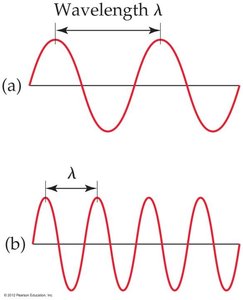
Frequency (\(\nu\)): The number of complete wavelengths passing a point per second, measured in hertz (Hz).
Speed of Light (\(c\)): All electromagnetic radiation travels at \(3.00 \times 10^8\) m/s in a vacuum.

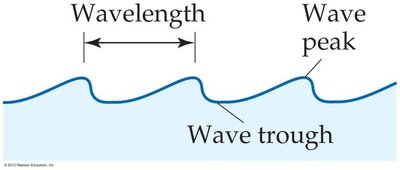
The relationship between wavelength and frequency is inverse:
\(c = \lambda \nu\)
High frequency corresponds to short wavelength, and vice versa.
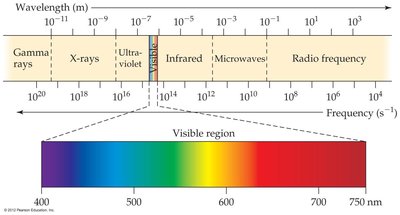
Electromagnetic Spectrum: The spectrum includes gamma rays, X-rays, ultraviolet, visible, infrared, microwaves, and radio waves. Frequency and wavelength are inversely related across the spectrum.
Quantized Energy and Photons
The wave model of light cannot explain certain phenomena, such as the quantization of energy and the photoelectric effect.
Quantization of Energy (Planck): Electromagnetic energy is absorbed or emitted in discrete units called quanta.
\(E = h\nu\), where \(h = 6.626 \times 10^{-34}\) J·s is Planck's constant.
Energy can only be absorbed or emitted in whole-number multiples of \(h\nu\).
Photoelectric Effect (Einstein): Light energy is quantized in photons. When photons strike a metal surface, electrons are emitted if the photon energy is sufficient.
\(E_{\text{photon}} = h\nu\)
Line Spectra and the Bohr Model
When radiation is separated into its component wavelengths, a spectrum is produced. A continuous spectrum contains all wavelengths, while a line spectrum contains only specific wavelengths.




The Bohr model explains the line spectra of hydrogen by proposing quantized electron energy levels. Electrons can only occupy certain orbits with specific energies.
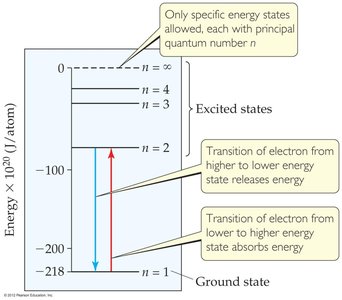
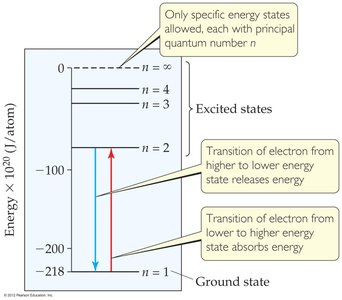
Energy is emitted or absorbed as electrons transition between energy levels.
\(E_{\text{photon}} = h\nu\)
Bohr's equation for energy levels:
Change in energy for transitions:
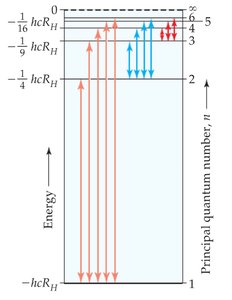
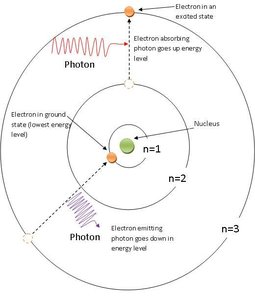
If \(\Delta E\) is negative, energy is emitted; if positive, energy is absorbed.
The Rydberg Equation
The Rydberg equation predicts the wavelengths of spectral lines in hydrogen:
Where \(R_H = 1.0968 \times 10^7\) m-1, \(n_1 < n_2\)

The Wave Behavior of Matter
Louis de Broglie proposed that particles such as electrons exhibit wave-like properties. The wavelength of a particle is given by:
Where \(m\) is mass and \(v\) is velocity.
Quantum Mechanics and Atomic Orbitals
Erwin Schrödinger developed quantum mechanics, which describes electrons as wave functions (\(\psi\)). The probability of finding an electron is given by \(\psi^2\).
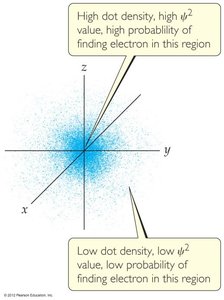
Quantum mechanics uses four quantum numbers to describe orbitals:
Principal quantum number (n): Indicates the energy level and size of the orbital.
Angular momentum quantum number (l): Defines the shape of the orbital (s, p, d, f).
Magnetic quantum number (ml): Specifies the orientation of the orbital.
Spin quantum number (ms): Describes the spin of the electron (+1/2 or -1/2).
Representations of Orbitals
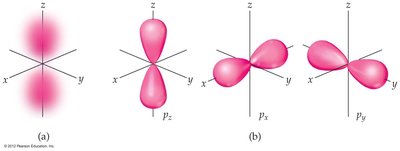
Orbitals have characteristic shapes and are described by quantum numbers. The radial probability function gives the likelihood of finding an electron at a certain distance from the nucleus.
Quantum Numbers and Orbital Classification
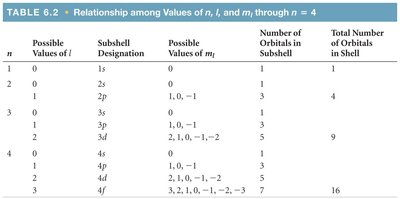
The relationship among quantum numbers determines the number and types of orbitals in each shell.
n | Possible Values of l | Subshell Designation | Possible Values of ml | Number of Orbitals in Subshell | Total Number of Orbitals in Shell |
|---|---|---|---|---|---|
1 | 0 | 1s | 0 | 1 | 1 |
2 | 0, 1 | 2s, 2p | 0; -1, 0, 1 | 1; 3 | 4 |
3 | 0, 1, 2 | 3s, 3p, 3d | 0; -1, 0, 1; -2, -1, 0, 1, 2 | 1; 3; 5 | 9 |
4 | 0, 1, 2, 3 | 4s, 4p, 4d, 4f | 0; -1, 0, 1; -2, -1, 0, 1, 2; -3, -2, -1, 0, 1, 2, 3 | 1; 3; 5; 7 | 16 |
Electron Configurations
Electron configuration describes the distribution of electrons among orbitals. The Aufbau principle states that orbitals are filled in order of increasing energy. The Pauli exclusion principle states that no two electrons in an atom can have the same set of four quantum numbers. Orbitals with the same energy are called degenerate.
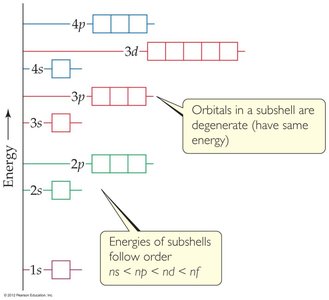
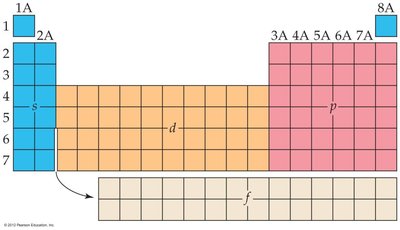
Hund's Rule: Electrons occupy empty degenerate orbitals with the same spin to minimize repulsion.
Noble-Gas Notation and Core/Valence Electrons
Electron configurations can be condensed using noble-gas notation, which highlights valence electrons. Valence electrons are in the highest energy levels and participate in bonding, while core electrons are in lower energy levels and do not participate in bonding.
Example: Al: [Ne] 3s2 3p1
Cl: [Ne] 3s2 3p5 (7 valence electrons, 10 core electrons)
Electron Configuration of Ions and Isoelectronic Series
When forming ions, electrons are removed from the highest energy orbital (highest n) for cations, and added to the lowest energy orbital for anions. Isoelectronic series are groups of atoms/ions with identical electron configurations.
Example: N3-, O2-, F-, Na+, Mg2+, Al3+ all have [Ne] configuration.
Summary: The electronic structure of atoms is governed by the wave nature of light, quantization of energy, and quantum mechanical principles. Understanding these concepts is essential for predicting atomic behavior and chemical bonding.
