 Back
Chapter 6: Gases – Properties, Laws, and Molecular Theory
Study Guide - Smart Notes
 Tailored notes based on your materials, expanded with key definitions, examples, and context.
Gases: Properties and Pressure
Characteristics of Gases
Gases are distinguished from liquids and solids by their ability to expand and fill their containers, their high compressibility, and their extremely low densities. These properties arise from the large distances between gas particles and their constant, rapid motion.
Expansion: Gases fill any available volume.
Compressibility: Gases can be compressed much more than liquids or solids.
Low Density: Gas particles are far apart, resulting in low mass per unit volume.
Pressure and Its Origin
Pressure is defined as the force exerted per unit area. In gases, pressure results from the collisions of gas molecules with the surfaces of their container. Atmospheric pressure is the weight of air per unit area.
Formula:
Gas Pressure: Depends on the number of gas particles, the volume of the container, and the average speed of the particles.

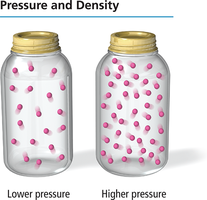
Gas Pressure and Particle Density
The pressure exerted by a gas is directly related to the density of gas particles in a given volume. Higher density means more frequent collisions and higher pressure.
Low Density: Fewer collisions, lower pressure.
High Density: More collisions, higher pressure.
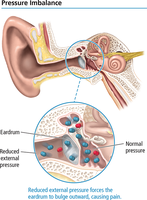
Pressure Imbalance in the Ear
If there is a difference in pressure across the eardrum, the membrane is pushed outward, causing pain. This is a practical example of gas pressure effects in biological systems.
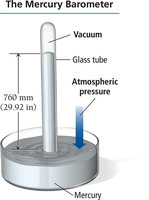
Measuring Pressure: The Barometer
A barometer is used to measure atmospheric pressure. It consists of an evacuated glass tube submerged in mercury. Atmospheric pressure pushes mercury up the tube, and the height of the mercury column is proportional to the pressure.
Standard atmospheric pressure: Supports a column of mercury 760 mm high.
Units of Pressure
mm Hg (millimeters of mercury) or torr: 1 mm Hg = 1 torr
Atmosphere (atm): 1 atm = 760 torr
Simple Gas Laws
Boyle’s Law: Pressure and Volume
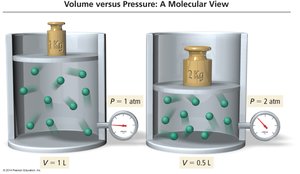
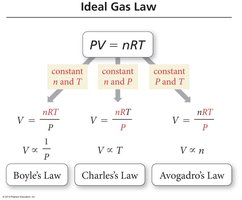
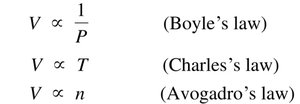
Boyle’s Law states that the volume of a gas is inversely proportional to its pressure at constant temperature and amount of gas. As pressure increases, volume decreases by the same factor.
Mathematical Expression:
Alternate Form:
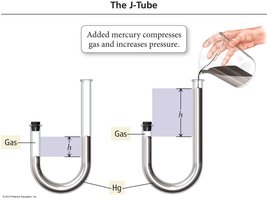
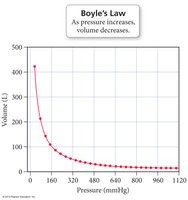
Molecular Interpretation: Decreasing volume increases collision frequency, raising pressure.
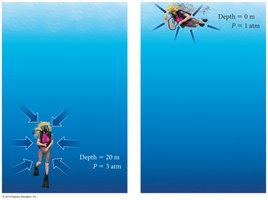
Application Example: Diving – At greater depths, pressure increases, and the volume of air in the lungs decreases. Rapid ascent can cause lung damage due to expanding air.
Charles’s Law: Volume and Temperature
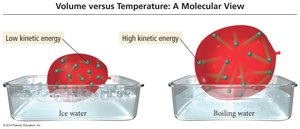
Charles’s Law states that the volume of a fixed amount of gas at constant pressure is directly proportional to its absolute temperature (in Kelvin).
Mathematical Expression:
Absolute Zero: The extrapolated volume reaches zero at -273.15°C (0 K).
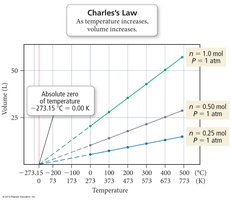
Example: Moving a balloon from ice water to boiling water causes it to expand as gas particles move faster and occupy more space.
Avogadro’s Law: Volume and Amount
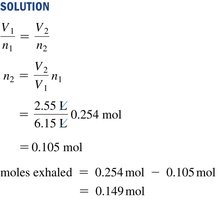
Avogadro’s Law states that the volume of a gas at constant temperature and pressure is directly proportional to the number of moles of gas.
Mathematical Expression:
Equal volumes of gases contain equal numbers of molecules.
The Ideal Gas Law
Combining Gas Laws
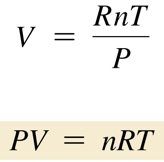
The relationships described by Boyle’s, Charles’s, and Avogadro’s laws are combined in the Ideal Gas Law, which relates pressure, volume, temperature, and amount of gas.
Ideal Gas Law:
R (Gas Constant): 0.08206 L·atm/(mol·K)
Standard Conditions and Molar Volume
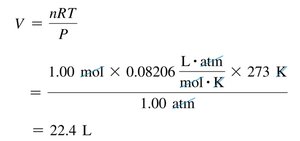
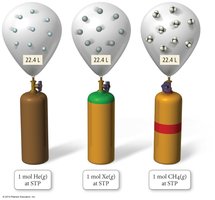
Standard Temperature and Pressure (STP) is defined as 0°C (273 K) and 1 atm. At STP, one mole of any ideal gas occupies 22.4 L, known as the molar volume.
Calculation:
For 1 mol at STP:
Density and Molar Mass of Gases
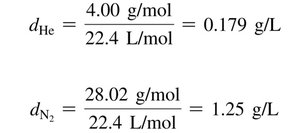
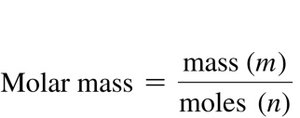
The density of a gas at STP can be calculated using its molar mass and the molar volume. Density is generally given in g/L.
Density Formula:
Molar Mass Formula:
Mixtures of Gases and Partial Pressures
Mixtures of Gases
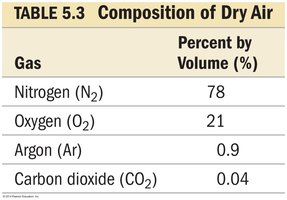
Many gas samples are mixtures, such as air. The total pressure is the sum of the partial pressures of each component.
Gas | Percent by Volume (%) |
|---|---|
Nitrogen (N2) | 78 |
Oxygen (O2) | 21 |
Argon (Ar) | 0.9 |
Carbon dioxide (CO2) | 0.04 |
Dalton’s Law of Partial Pressures
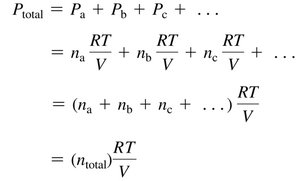
Dalton’s Law states that the total pressure of a gas mixture is the sum of the partial pressures of each component.
Mathematical Expression:
Partial Pressure Formula:
Mole Fraction and Partial Pressure
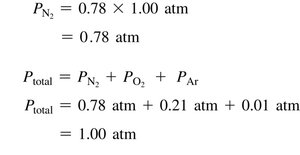
The mole fraction is the ratio of the number of moles of a component to the total number of moles in the mixture. The partial pressure of a component is its mole fraction times the total pressure.
Example: Nitrogen's partial pressure in air is
Kinetic Molecular Theory
Basic Principles
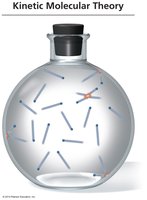
The kinetic molecular theory models gases as particles in constant motion, with negligible attractions and large distances between them. Collisions are elastic, and the average kinetic energy is proportional to temperature.
Elastic Collisions: No energy is lost; energy is transferred between particles.
Temperature: Higher temperature increases average kinetic energy and speed.
Gas Laws Explained by Kinetic Theory
Boyle’s Law: Decreasing volume increases collision frequency and pressure.
Charles’s Law: Increasing temperature increases kinetic energy and volume.
Avogadro’s Law: Increasing number of particles increases volume at constant pressure.
Dalton’s Law: Particles behave independently; total pressure is sum of partial pressures.
Temperature and Molecular Velocities
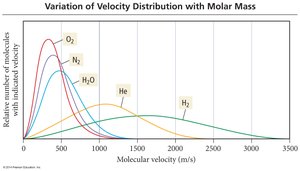
At a given temperature, all gases have the same average kinetic energy, but lighter molecules move faster than heavier ones.
Root Mean Square Speed:
Real Gases and Deviations from Ideal Behavior
Real Gas Behavior
Real gases deviate from ideal behavior at high pressures and low temperatures due to intermolecular attractions and the finite volume of gas particles.
van der Waals Equation: Accounts for molecular volume and intermolecular attractions.
van der Waals Equation:
PV/RT Plots
Plots of PV/RT versus pressure show deviations for real gases. At low pressures, intermolecular attractions dominate; at high pressures, molecular volume becomes significant.
*Additional info: The notes above expand on the original content, providing definitions, formulas, and examples for each major concept. Only images directly relevant to the explanation are included, and tables are recreated in HTML for clarity.*
