 Back
Chapter 6: Gases – Properties, Laws, and Molecular Theory
Study Guide - Smart Notes
 Tailored notes based on your materials, expanded with key definitions, examples, and context.
Gases: Properties and Behavior
Gas Pressure
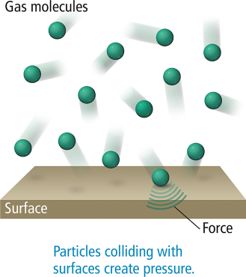
Gas pressure is a fundamental property resulting from the force exerted by gas molecules as they collide with surfaces. The pressure is defined as force per unit area and is a direct consequence of the constant, random motion of gas particles.
Definition: Pressure is the force exerted per unit area by gas molecules striking surfaces.
Mechanism: Each collision transfers momentum, creating a measurable force.
Example: A ball bouncing against a wall is analogous to a gas molecule colliding with a container wall.
Pressure and Density
The pressure exerted by a gas depends on the number of gas particles in a given volume. Higher density of gas particles results in higher pressure, while lower density results in lower pressure.
Key Point: As the number of gas particles increases in a fixed volume, the pressure increases.
Relationship: Pressure is directly proportional to particle density.
Example: Two jars, one with fewer particles (lower pressure) and one with more particles (higher pressure).
Pressure Imbalance in the Ear
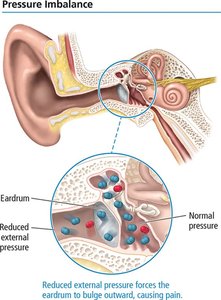
Pressure differences across membranes, such as the eardrum, can cause discomfort or pain. Reduced external pressure forces the eardrum to bulge outward.
Key Point: Pressure imbalance can cause physical effects, such as pain in the ear.
Example: Rapid altitude changes can lead to ear discomfort due to pressure differences.

Measuring Gas Pressure
The Mercury Barometer
A barometer is used to measure atmospheric pressure. It consists of an evacuated glass tube submerged in mercury. Atmospheric pressure supports a column of mercury, typically 760 mm high at sea level.
Key Point: Atmospheric pressure is measured by the height of mercury supported in a barometer.
Formula: 1 atm = 760 mm Hg = 101,325 Pa = 14.7 psi = 29.92 in Hg = 760 torr

The Manometer
A manometer measures the pressure of a gas in a container. It is a U-shaped tube partially filled with liquid, with one side connected to the gas and the other open to the atmosphere. The height difference indicates the pressure relative to atmospheric pressure.
Key Point: The height difference (h) in a manometer is proportional to the pressure difference.
Application: Used to measure gas pressure in laboratory settings.

Simple Gas Laws
Boyle’s Law: Pressure and Volume
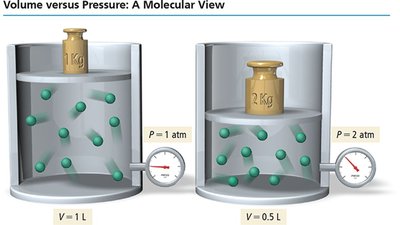
Boyle’s Law describes the inverse relationship between the pressure and volume of a gas at constant temperature and amount.
Statement: The pressure of a gas is inversely proportional to its volume.
Equation: or
Graph: Pressure vs. Volume is a curve; Pressure vs. 1/Volume is a straight line.


Molecular Interpretation of Boyle’s Law
As the volume of a gas decreases, gas molecules collide with surfaces more frequently, resulting in greater pressure.
Key Point: Decreasing volume increases collision frequency and pressure.
Example: Compressing a gas in a piston increases its pressure.
Boyle’s Law and Diving
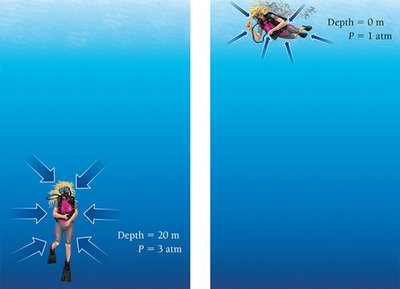
Boyle’s Law is important in diving. For every 10 meters of depth, a diver experiences approximately one additional atmosphere of pressure. Rapid ascent can cause the volume of air in the lungs to expand, potentially causing injury.
Key Point: Always exhale when rising to prevent lung damage.
Example: At 20 meters depth, pressure is about 3 atm; rising to the surface reduces pressure to 1 atm, tripling the volume of air in the lungs.
Charles’s Law: Volume and Temperature
Charles’s Law states that the volume of a fixed amount of gas at constant pressure increases linearly with increasing temperature (in kelvins).
Statement: The volume of a gas is directly proportional to its absolute temperature.
Equation: or
Absolute Zero: The temperature at which the volume extrapolates to zero is called absolute zero (0 K).
Avogadro’s Law: Volume and Amount (Moles)
Avogadro’s Law states that the volume of a gas is directly proportional to the number of moles of gas at constant pressure and temperature.
Statement: Equal volumes of gases contain equal numbers of molecules at the same pressure and temperature.
Equation: or
The Ideal Gas Law
Ideal Gas Law
The ideal gas law combines the relationships of Boyle’s, Charles’s, and Avogadro’s laws into a single equation.
Equation:
Variables: P = pressure (atm), V = volume (L), n = moles, R = gas constant (0.0821 L·atm·mol-1·K-1), T = temperature (K)
Application: Allows calculation of any one variable if the other three are known.
Standard Conditions and Molar Volume
Standard temperature and pressure (STP) are defined as 0°C (273 K) and 1 atm. At STP, one mole of any ideal gas occupies 22.4 L.
Key Point: Molar volume at STP is 22.4 L for any ideal gas.
Equation:
Density of Gases
The density of a gas is the ratio of its mass to its volume, typically expressed in g/L. At STP, density is directly proportional to molar mass.
Equation: (at STP)
Application: Helium balloons float because helium is less dense than air.
Mixtures of Gases and Partial Pressures
Mixtures of Gases
Many gas samples are mixtures, such as air, which contains nitrogen, oxygen, argon, and carbon dioxide. The total pressure is the sum of the partial pressures of each component.
Dalton’s Law:
Partial Pressure: The pressure exerted by each gas in a mixture.
Mole Fraction
The mole fraction is the ratio of the number of moles of a component to the total number of moles in the mixture. The partial pressure of a component is its mole fraction times the total pressure.
Equation:
Partial Pressure:
Kinetic Molecular Theory
Basic Postulates
The kinetic molecular theory models gases as particles in constant motion, with negligible size and no intermolecular attractions. Collisions are perfectly elastic.
Key Points:
Gas molecules are negligibly small compared to the distance between them.
Average kinetic energy is proportional to temperature in kelvins.
Collisions are elastic; no energy is lost.
Temperature and Molecular Velocities
At a given temperature, all gases have the same average kinetic energy. Lighter molecules move faster than heavier ones.
Equation:
Root Mean Square Velocity:
Diffusion and Effusion
Diffusion is the spreading of gas molecules from high to low concentration. Effusion is the escape of gas molecules through a small hole into a vacuum. The rate of effusion is inversely proportional to the square root of molar mass.
Graham’s Law:
Real Gases
Deviation from Ideal Behavior
Real gases deviate from ideal behavior at high pressure and low temperature due to intermolecular attractions and the finite volume of molecules.
Van der Waals Equation: Accounts for molecular volume (b) and intermolecular attractions (a).
Equation:
Summary Table: Common Pressure Units
Unit | Abbreviation | Average Air Pressure at Sea Level |
|---|---|---|
Pascal | Pa | 101,325 Pa |
Pounds per square inch | psi | 14.7 psi |
Torr | torr | 760 torr |
Inches of mercury | in Hg | 29.92 in Hg |
Atmosphere | atm | 1 atm |
Summary Table: Vapor Pressure of Water
Temperature (°C) | Pressure (mm Hg) |
|---|---|
0 | 4.58 |
5 | 6.54 |
10 | 9.21 |
15 | 12.79 |
20 | 17.55 |
25 | 23.48 |
30 | 31.86 |
35 | 42.23 |
40 | 55.40 |
45 | 71.97 |
50 | 92.6 |
55 | 118.2 |
60 | 149.6 |
65 | 187.5 |
70 | 233.7 |
75 | 289.1 |
80 | 355.1 |
85 | 433.6 |
90 | 525.8 |
95 | 633.9 |
100 | 760.0 |
Additional info: These notes expand on the original slides and textbook excerpts, providing definitions, equations, and examples for each major concept. Images included are directly relevant to the explanation of the adjacent paragraph, reinforcing key points visually.
