 Back
BackChapter 6: Gases – Properties, Laws, and Applications
Study Guide - Smart Notes
 Tailored notes based on your materials, expanded with key definitions, examples, and context.
Gases: Properties and Behavior
Nature of Gases
Gases are composed of particles (atoms or molecules) that move rapidly and randomly in straight lines until they collide with the walls of their container or with each other. These collisions are responsible for the pressure exerted by gases.
Low Density: Gases have much lower densities than solids or liquids due to the large amount of empty space between particles.
Compressibility: Gases can be compressed easily because their particles are far apart.
Expansion: Gases expand to fill the shape and volume of their container.
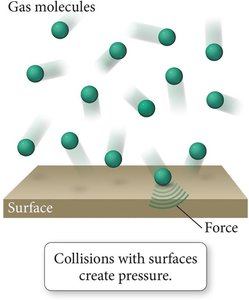
Gas Pressure
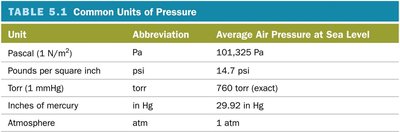
Pressure is defined as the force exerted per unit area by gas molecules as they strike the surfaces around them. The SI unit of pressure is the pascal (Pa), but other common units include atmospheres (atm), torr, and pounds per square inch (psi).
Pressure Formula: , where P is pressure, F is force, and A is area.
Gas pressure depends on the number of particles, the volume of the container, and the average speed (temperature) of the particles.
Unit | Abbreviation | Average Air Pressure at Sea Level |
|---|---|---|
Pascal (1 N/m2) | Pa | 101,325 Pa |
Pounds per square inch | psi | 14.7 psi |
Torr (1 mmHg) | torr | 760 torr (exact) |
Inches of mercury | in Hg | 29.92 in Hg |
Atmosphere | atm | 1 atm |
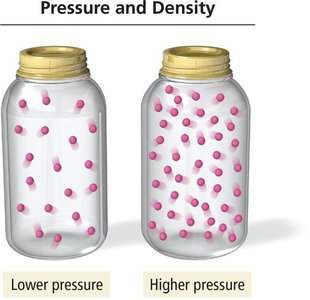
Pressure and Density
The pressure exerted by a gas is directly related to the density of its particles. Higher density means more collisions and higher pressure.
Lower density (fewer particles per volume) results in lower pressure.
Higher density (more particles per volume) results in higher pressure.
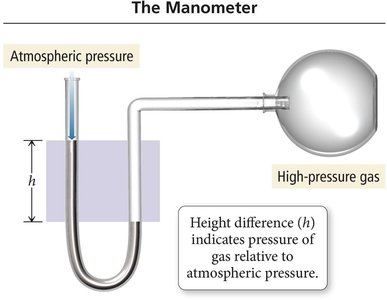
Measuring Gas Pressure
The Manometer
A manometer is a device used to measure the pressure of a gas in a container. It consists of a U-shaped tube filled with a liquid (often mercury). The difference in liquid height indicates the pressure difference between the gas and the atmosphere.
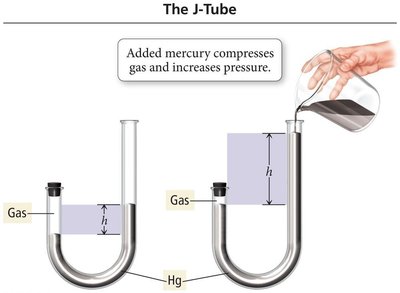
The J-Tube
The J-tube is used to study the relationship between gas volume and pressure. Adding mercury increases the pressure on the trapped gas, allowing for the observation of pressure-volume relationships.
The Simple Gas Laws
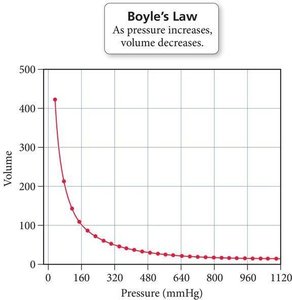
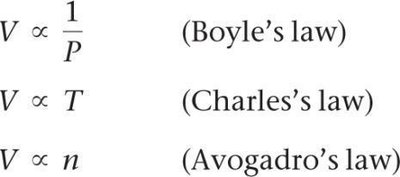
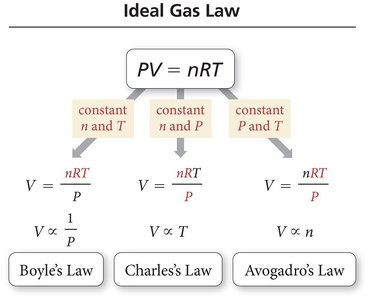
Boyle’s Law: Pressure and Volume
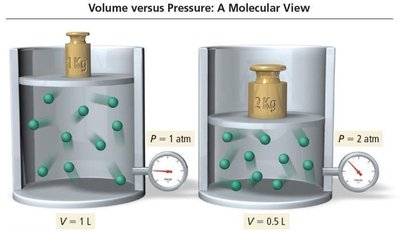
Boyle’s Law states that the volume of a fixed amount of gas is inversely proportional to its pressure at constant temperature.
Mathematical Form: or
As pressure increases, volume decreases, and vice versa.
Application: Boyle’s Law and Diving
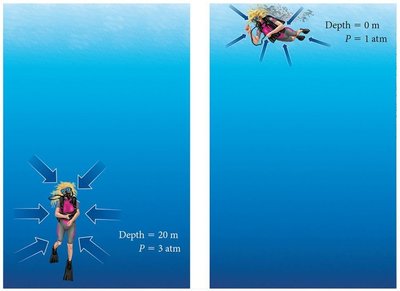
Boyle’s Law explains why divers must exhale when rising to the surface. As external pressure decreases, the volume of air in the lungs increases, which can cause injury if not released.
Charles’s Law: Volume and Temperature
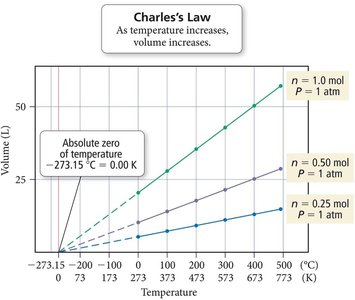
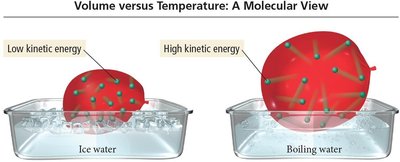
Charles’s Law states that the volume of a fixed amount of gas at constant pressure is directly proportional to its temperature in kelvins.
Mathematical Form:
As temperature increases, volume increases linearly.
Absolute zero (0 K or -273.15°C) is the theoretical temperature at which a gas would have zero volume.
Avogadro’s Law: Volume and Amount (Moles)
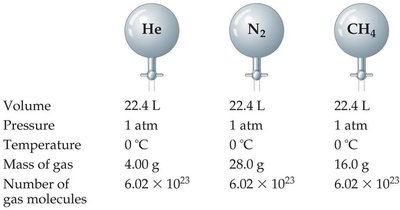
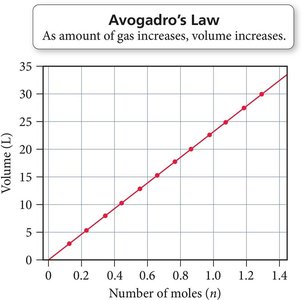
Avogadro’s Law states that the volume of a gas is directly proportional to the number of moles of gas at constant temperature and pressure.
Mathematical Form:
Equal volumes of gases at the same temperature and pressure contain equal numbers of molecules.
Summary of Simple Gas Laws
Law | Relationship |
|---|---|
Boyle's Law | |
Charles's Law | |
Avogadro's Law |
The Ideal Gas Law
Combining the Gas Laws
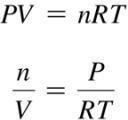
The Ideal Gas Law combines Boyle’s, Charles’s, and Avogadro’s laws into a single equation:
P: Pressure (atm)
V: Volume (L)
n: Amount (mol)
R: Gas constant (0.08206 L·atm/mol·K)
T: Temperature (K)
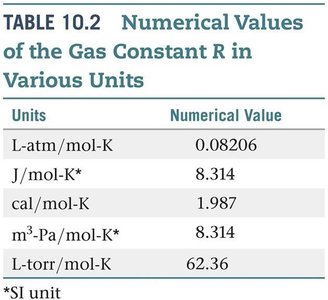
Units | Numerical Value |
|---|---|
L·atm/mol·K | 0.08206 |
J/mol·K | 8.314 |
cal/mol·K | 1.987 |
m3·Pa/mol·K | 8.314 |
L·torr/mol·K | 62.36 |
Standard Temperature and Pressure (STP) and Molar Volume
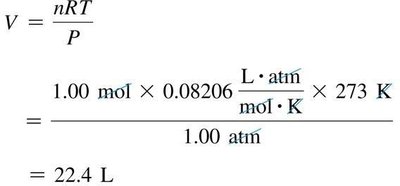
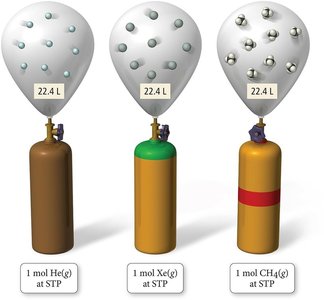
STP is defined as a temperature of 273 K (0°C) and a pressure of 1 atm. At STP, one mole of any ideal gas occupies a volume of 22.4 L, known as the molar volume.
Density and Molar Mass of Gases
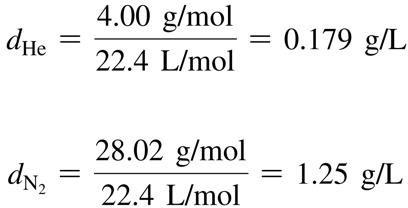
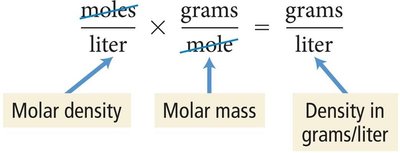
The density of a gas at STP can be calculated using its molar mass and the molar volume (22.4 L at STP):
Mixtures of Gases and Partial Pressures
Mixtures of Gases
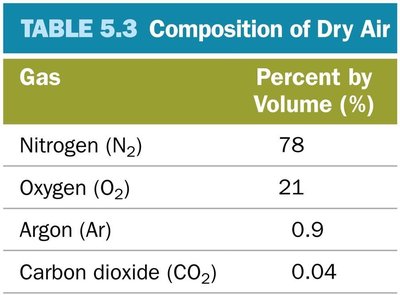
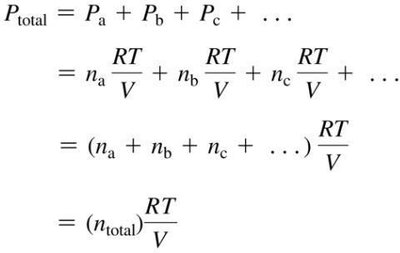
Many gases, such as air, are mixtures. The total pressure of a gas mixture is the sum of the partial pressures of each component, as described by Dalton’s Law of Partial Pressures:
Gas | Percent by Volume (%) |
|---|---|
Nitrogen (N2) | 78 |
Oxygen (O2) | 21 |
Argon (Ar) | 0.9 |
Carbon dioxide (CO2) | 0.04 |
Mole Fraction and Partial Pressure
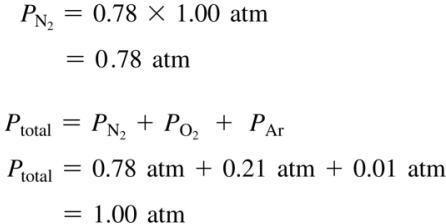
The mole fraction of a component in a mixture is the ratio of its moles to the total moles. The partial pressure of a gas is its mole fraction times the total pressure.
For example, nitrogen makes up 78% of air, so its partial pressure in 1 atm air is 0.78 atm.
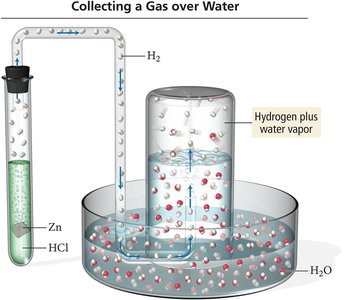
Collecting Gases Over Water
Vapor Pressure of Water
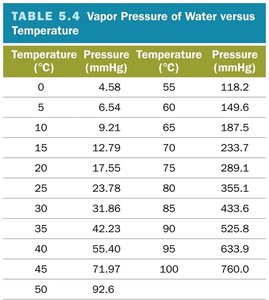
When collecting gases over water, the total pressure includes both the gas and water vapor. The vapor pressure of water depends on temperature and must be subtracted to find the pressure of the dry gas.
Temperature (°C) | Pressure (mmHg) |
|---|---|
0 | 4.58 |
25 | 23.78 |
50 | 92.6 |
Kinetic Molecular Theory
Postulates of Kinetic Molecular Theory
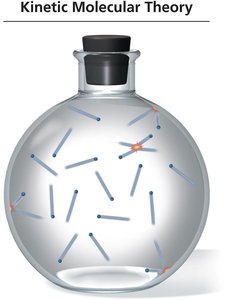
The kinetic molecular theory explains the behavior of gases based on the motion of their particles:
Gas particles are in constant, random motion.
Collisions between particles and with container walls are perfectly elastic (no energy lost).
The average kinetic energy of gas particles is proportional to the temperature in kelvins.
There is negligible attraction or repulsion between particles.
Diffusion and Effusion
Definitions
Diffusion: The process by which gas molecules spread out from high to low concentration.
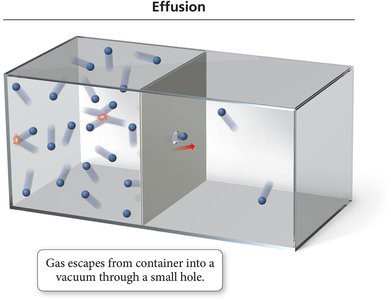
Effusion: The process by which gas molecules escape through a small hole into a vacuum.
Graham’s Law of Effusion
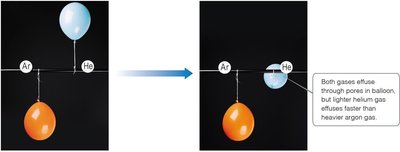
Graham’s Law states that the rate of effusion of a gas is inversely proportional to the square root of its molar mass:
Lighter gases effuse faster than heavier gases.
Additional info: These notes cover the core concepts of gases in general chemistry, including properties, measurement, gas laws, mixtures, and kinetic theory, with relevant equations and visual aids for enhanced understanding.
