 Back
BackChapter 6: Gases – Properties, Laws, and Applications
Study Guide - Smart Notes
 Tailored notes based on your materials, expanded with key definitions, examples, and context.
An Overview of the Physical States of Matter
Familiar Properties of Gases
Gases are one of the fundamental states of matter, characterized by their ability to expand, compress, and fill any container. Their physical properties are generally similar across different gases.
Low density: Gases have much lower densities compared to solids and liquids.
Compressibility and expansibility: Gases can be compressed or expanded easily.
Complete filling of containers: Gases take the shape and volume of their containers.
Mixing: Gases mix freely with each other.
Thermal expansion: Gases expand when heated and contract when cooled.
Pressure: Gases exert pressure on the walls of their containers, which increases with the amount of gas, temperature, or decreased volume.

Physical Properties of Gases
The Four Key Variables
The behavior of gases is described by four interrelated physical properties:
Pressure (P): The force exerted per unit area by gas particles colliding with container walls.
Volume (V): The space occupied by the gas.
Temperature (T): Measured in Kelvin, it reflects the average kinetic energy of gas particles.
Amount (n): The quantity of gas, measured in moles.
These properties are mathematically related, and changes in one can affect the others.
Pressure and Its Measurement
Definition of Pressure
Pressure is defined as the force applied per unit area:
Atmospheric pressure is the force exerted by the weight of the atmosphere on the Earth's surface.
Barometers
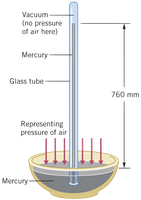
A barometer is an instrument used to measure atmospheric pressure. The Torricelli barometer is a classic example, consisting of a mercury-filled tube inverted in a dish of mercury. Atmospheric pressure supports a column of mercury, and the height of the column is proportional to the pressure.
Manometers
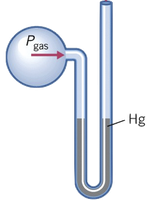
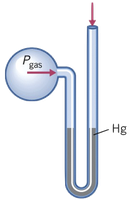
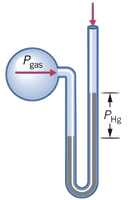
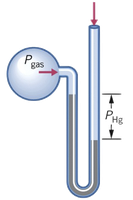
Manometers are used to measure the pressure of gases in closed systems. An open-end manometer consists of a U-shaped tube partially filled with mercury, with one end open to the atmosphere and the other connected to the gas sample.
Interpreting Manometer Readings
If the mercury levels are equal, .
If the mercury is higher on the open side, .
If the mercury is higher on the gas side, .
Units of Pressure
Pascals (Pa): SI unit; 1 atm = 101,325 Pa
Atmospheres (atm): 1 atm = 760 mmHg = 760 torr
Millimeters of mercury (mmHg) and Torr: 1 mmHg ≈ 1 torr
Pounds per square inch (psi): 1 atm = 14.7 psi
The Simple Gas Laws
Boyle’s Law (Pressure-Volume Law)
For a fixed amount of gas at constant temperature, the pressure and volume are inversely related:
If the volume decreases, the pressure increases, and vice versa.


Biological Application: Breathing
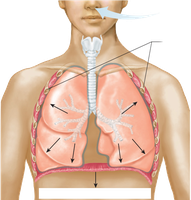
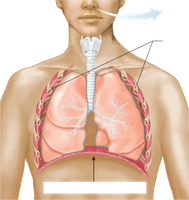
During inhalation, the rib cage expands and the diaphragm lowers, increasing lung volume and decreasing pressure, causing air to flow in. During exhalation, the rib cage contracts and the diaphragm rises, decreasing lung volume and increasing pressure, causing air to flow out.
Charles’s Law (Temperature-Volume Law)
At constant pressure, the volume of a gas is directly proportional to its Kelvin temperature:
If the temperature increases, the volume increases proportionally.


Gay-Lussac’s Law (Pressure-Temperature Law)
At constant volume, the pressure of a gas is directly proportional to its Kelvin temperature:
Avogadro’s Law (Volume-Mole Law)
At constant temperature and pressure, the volume of a gas is directly proportional to the number of moles:
At standard temperature and pressure (STP: 1 atm, 273 K), 1 mole of any gas occupies 22.4 L (standard molar volume).
The Ideal Gas Law
Combining the Simple Gas Laws
The ideal gas law combines all four variables into a single equation:
Where R is the universal gas constant ().
Applications of the Ideal Gas Law
Calculating moles, volume, pressure, or temperature for a given sample of gas.
Gas density: , where M is molar mass.
Molar mass determination: , where m is mass of gas.
Mixtures of Gases and Partial Pressures
Dalton’s Law of Partial Pressures
The total pressure of a mixture of gases is the sum of the partial pressures of each component:
The partial pressure of each gas is proportional to its mole fraction:
Where is the mole fraction of gas A.
Stoichiometry Involving Gases
Gas laws are often used in chemical reactions to relate the volumes, moles, or masses of reactants and products. At constant temperature and pressure, the volume ratios of gases are equal to their stoichiometric coefficients.
The Kinetic-Molecular Theory: A Model for Gases
Postulates of the Kinetic Theory
Gas particles are extremely small compared to the distances between them.
Gas particles are in constant, random motion, colliding elastically with container walls (causing pressure).
There are no attractive or repulsive forces between particles.
The average kinetic energy of gas particles is directly proportional to the Kelvin temperature.
Kinetic Theory Explains Gas Laws
Boyle’s Law: Decreasing volume increases collision frequency, raising pressure.
Charles’s Law: Increasing temperature increases kinetic energy, causing more frequent and forceful collisions, thus increasing volume at constant pressure.
Avogadro’s Law: Increasing the number of particles (at constant T and P) increases the volume needed to maintain constant pressure.
Kinetic Energy and Molecular Speed
At a given temperature, all gases have the same average kinetic energy. However, lighter molecules move faster than heavier ones at the same temperature.
Diffusion and Effusion of Gases
Definitions
Diffusion: The mixing of gas molecules due to random motion.
Effusion: The movement of gas molecules through a small hole into a vacuum.
Graham’s Law of Effusion
The rate of effusion of a gas is inversely proportional to the square root of its molar mass:
Lighter gases effuse and diffuse faster than heavier gases.
Real Gases: Deviations from Ideal Behavior
Why Real Gases Deviate
Real gas particles have finite volume and experience intermolecular forces.
At high pressures and low temperatures, these effects become significant, causing deviations from the ideal gas law.
The van der Waals Equation
The van der Waals equation modifies the ideal gas law to account for particle volume and intermolecular attractions:
a: Corrects for attractive forces (larger a = stronger attractions).
b: Corrects for particle volume (larger b = larger particles).
This equation provides a more accurate description of real gas behavior under non-ideal conditions.
