 Back
Chapter 6: Gases – Properties, Laws, and Applications
Study Guide - Smart Notes
 Tailored notes based on your materials, expanded with key definitions, examples, and context.
Gases: Properties and Behavior
Introduction to Gases
Gases are one of the fundamental states of matter, characterized by their ability to expand and fill any container, low density, and high compressibility. The behavior of gases can be explained by the kinetic molecular theory and described quantitatively using gas laws.
Kinetic Molecular Theory
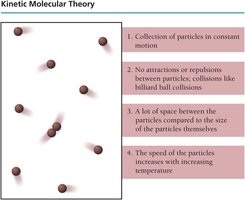
The kinetic molecular theory provides a model for understanding the physical properties of gases:
Particles in constant motion: Gas particles move rapidly in all directions.
No attractions or repulsions: Collisions between particles are elastic, like billiard balls.
Large spaces between particles: The volume of the particles themselves is negligible compared to the total volume of the gas.
Speed increases with temperature: As temperature rises, the average speed of the particles increases.
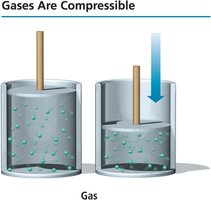
Compressibility of Gases
Gases are highly compressible due to the large amount of empty space between particles. When pressure is applied, the particles are forced closer together, reducing the volume.
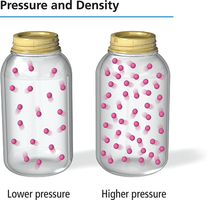
Pressure and Density
Gas pressure results from collisions of particles with the walls of their container. Increasing the number of particles or decreasing the volume increases the pressure and density of the gas.
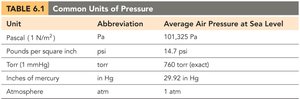
Common Units of Pressure
Pressure is measured in several units. The most common are:
Unit | Abbreviation | Average Air Pressure at Sea Level |
|---|---|---|
Pascal (1 N/m2) | Pa | 101,325 Pa |
Pounds per square inch | psi | 14.7 psi |
Torr (mmHg) | torr | 760 torr (exact) |
Inches of mercury | in Hg | 29.92 in Hg |
Atmosphere | atm | 1 atm |
Blood Pressure
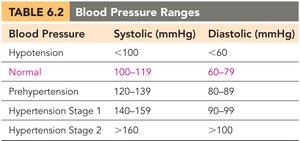
Blood pressure is the force exerted by circulating blood on the walls of blood vessels. It is measured in millimeters of mercury (mmHg) and is an important physiological parameter.
Blood Pressure | Systolic (mmHg) | Diastolic (mmHg) |
|---|---|---|
Hypotension | <100 | <60 |
Normal | 100–119 | 60–79 |
Prehypertension | 120–139 | 80–89 |
Hypertension Stage 1 | 140–159 | 90–99 |
Hypertension Stage 2 | >160 | >100 |

Pressure Unit Conversion
Pressure can be converted between units using conversion factors. For example, to convert from atm to mmHg:
1 atm = 760 mmHg
1 atm = 14.7 psi

Gas Laws
Boyle’s Law: Pressure and Volume
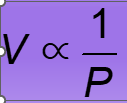
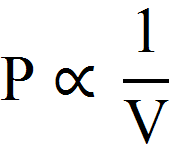
Boyle’s Law states that the volume of a gas is inversely proportional to its pressure at constant temperature and number of moles:
Mathematical form:
Equation: (at constant T and n)
 -
Molecular Interpretation of Boyle’s Law
As the volume of a gas decreases, the particles collide more frequently with the container walls, increasing the pressure.
Charles’s Law: Volume and Temperature
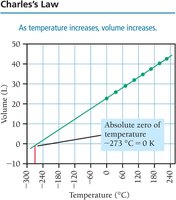
Charles’s Law states that the volume of a gas is directly proportional to its temperature (in Kelvin) at constant pressure and number of moles:
Mathematical form:
Equation: (at constant P and n)
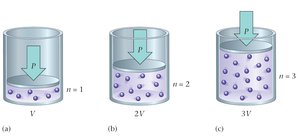
Avogadro’s Law: Volume and Moles
Avogadro’s Law states that the volume of a gas is directly proportional to the number of moles at constant temperature and pressure:
Mathematical form:
Equation: (at constant T and P)
The Combined Gas Law
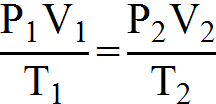
The combined gas law relates pressure, volume, and temperature for a fixed amount of gas:
Equation:
The Ideal Gas Law
The ideal gas law combines Boyle’s, Charles’s, and Avogadro’s laws into a single equation:
Equation:
R (ideal gas constant): 0.0821 L·atm/(mol·K)
All quantities must be in the correct units: P (atm), V (L), n (mol), T (K).
Standard Temperature and Pressure (STP) and Molar Volume
At STP (0°C, 1 atm), one mole of any ideal gas occupies 22.4 L. This is known as the molar volume of a gas.
Density and Molar Mass of Gases
The density of a gas at STP can be calculated using its molar mass and the molar volume (22.4 L):
Density (g/L) = Molar mass (g/mol) / 22.4 L
Mixtures of Gases and Partial Pressures
Partial Pressure and Dalton’s Law
In a mixture, each gas exerts a pressure independently of the others. The total pressure is the sum of the partial pressures:
Dalton’s Law:
Partial pressure: , where is the mole fraction of component i.
Kinetic Molecular Theory: Temperature and Molecular Velocities
Temperature and Kinetic Energy
The average kinetic energy of gas molecules is proportional to the temperature in Kelvin. Lighter molecules move faster than heavier ones at the same temperature.
Diffusion and Effusion
Diffusion is the mixing of gases due to molecular motion. Effusion is the escape of gas through a small hole. Graham’s law relates the rates of effusion to molar mass:
Graham’s Law:
Real Gases and Deviations from Ideal Behavior
Real Gases
At high pressures and low temperatures, real gases deviate from ideal behavior due to intermolecular attractions and the finite volume of particles. The van der Waals equation modifies the ideal gas law to account for these factors:
van der Waals equation:
a and b are constants specific to each gas.
