 Back
Chapter 6: Thermochemistry – Energy, Heat, Work, and Enthalpy
Study Guide - Smart Notes
 Tailored notes based on your materials, expanded with key definitions, examples, and context.
Thermochemistry
Energy, Heat, Work, and the First Law
Thermochemistry studies the energy changes that occur during chemical reactions and physical transformations. The central concepts include energy, heat, work, and the first law of thermodynamics, which governs energy conservation.
System: The part of the universe under study (e.g., reacting chemicals).
Surroundings: Everything outside the system that can exchange energy with it.
Universe: System + surroundings.
Energy (E): The capacity to do work or transfer heat.
Work (w): Energy transfer when a force moves matter through a distance. Work on the system is positive; work by the system is negative.
Heat (q): Energy transferred due to a temperature difference.
Kinetic and Potential Energy
Kinetic energy is the energy of motion, while potential energy is associated with position or composition. Internal energy is the sum of all microscopic kinetic and potential energies within a system.
Kinetic energy (E_k):
Potential energy (E_p): Includes gravitational, electrostatic, and chemical potential energy.
Internal energy (E):
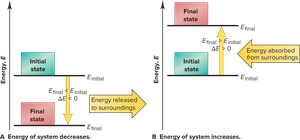
Sign Conventions for q, w, and ΔE
Energy accounting is always from the system's perspective. The change in internal energy is:
q > 0: Heat enters the system; q < 0: Heat leaves the system.
w > 0: Work done on the system; w < 0: Work done by the system.
Energy Units
Energy is measured in joules (J) in the SI system. The calorie (cal) is also used, especially in food energy.
1 cal = 4.184 J
1 Cal (dietary) = 1000 cal = 1 kcal
Conservation of Energy and the First Law of Thermodynamics
Energy can change form and move between system and surroundings, but the total energy remains constant. This is the first law of thermodynamics:
Energy Transfer as Mechanical Work
Mechanical work involves energy transfer by moving matter. For example, lifting a book increases its gravitational potential energy, and dropping it converts this to kinetic energy and eventually to internal energy and sound.
Expansion Work
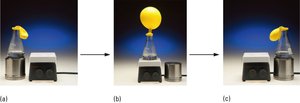
When a gas expands against an external pressure, it does work on the surroundings. The sign of work depends on the direction of energy transfer.
Expansion: w < 0 (system does work)
Compression: w > 0 (surroundings do work on system)
Free expansion (P_ext = 0): w = 0
Factors Affecting Internal Energy
Internal energy depends on temperature, amount, chemical identity, and physical state. At the same temperature, ideal-gas particles have the same average translational kinetic energy regardless of molar mass.
Change in Internal Energy
The change in internal energy is calculated as:
ΔE > 0: System gains energy
ΔE < 0: System loses energy
The First Law for a Chemical System
The first law relates heat and work to changes in internal energy:
Heat and work are path functions; ΔE is a state function.
Temperature and Thermal Energy
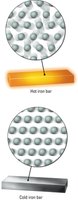
Temperature reflects the average random kinetic energy of particles, while thermal energy is the total microscopic energy associated with particle motion and interactions.
Heat and Thermal Equilibrium
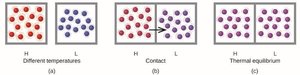
Heat is energy transferred due to a temperature difference. Energy flows spontaneously from hotter to cooler objects until thermal equilibrium is reached.
Heat Capacity, Enthalpy, and Calorimetry
Heat capacity is the energy required to change an object's temperature by 1°C. Specific heat capacity is per gram, and molar heat capacity is per mole.
Heat capacity (C): Units: J°C⁻¹
Specific heat capacity (c): Units: J g⁻¹°C⁻¹
Molar heat capacity (C_m): Units: J mol⁻¹°C⁻¹
For a sample with mass m:
For an amount n in moles:
Practice: Heating a Metal
Example: How much energy is required to heat 500.0 g of iron from 22°C to 55°C? Use and .
Heat Flow and Process Sign
Heat flow can be endothermic (heat enters the system, q > 0) or exothermic (heat leaves the system, q < 0). Examples include melting (endothermic) and freezing (exothermic).
Enthalpy and Constant Pressure
Enthalpy (H) is a state function related to internal energy and pressure-volume work:
At constant pressure:
At constant volume:
At constant pressure:
State Functions and Path Independence
State functions depend only on the current state, not the path taken. Examples: E, H, P, V, T. Path functions: q and w.
Thermochemical Equations and Bond Enthalpies
A thermochemical equation is a balanced chemical equation with physical states and enthalpy change. The sign of ΔH indicates whether the reaction is exothermic or endothermic.
Multiplying the equation multiplies ΔH by the same factor.
Reversing the equation reverses the sign of ΔH.
Physical states affect ΔH.
Practice: Thermochemical Stoichiometry
Example: 2 Al(s) + Fe₂O₃(s) → Al₂O₃(s) + 2 Fe(s), ΔH° = -851.5 kJ. Calculate heat released for 10.0 g Al reacting completely.
Calorimetry: Measuring Heat Transfer
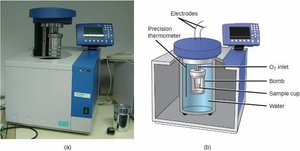
Calorimetry measures heat transfer during reactions. Two common calorimeters are coffee-cup (constant pressure) and bomb calorimeter (constant volume).
Coffee-cup calorimeter:
Bomb calorimeter:
Coffee-Cup Calorimetry
The solution and calorimeter are the surroundings. The heat transfer is calculated as:
If cup heat capacity is negligible,
Bomb Calorimetry
Bomb calorimetry is used for combustion reactions at constant volume. The heat transfer is calculated as:
At constant volume,
Average Bond Enthalpy
Average bond enthalpy is the energy required to break one mole of a specified bond in gas-phase molecules. Breaking bonds requires energy (positive D), while forming bonds releases energy.
Bond-enthalpy calculations estimate reaction enthalpy.
Hess's Law and Standard Enthalpies of Formation
Hess's law states that if chemical equations add to give a target reaction, their enthalpy changes add in the same way. Enthalpy is a state function, so the path does not affect ΔH.
Retain physical states; cancel species only when formula and state both match.
Standard Enthalpy of Formation
The standard enthalpy of formation (ΔH°f) is the enthalpy change when 1 mol of a substance forms from its elements in their standard states.
Formation equation: H₂(g) + ½ O₂(g) → H₂O(l), ΔH°f[H₂O(l)] = -285.83 kJ mol⁻¹
ΔH°f = 0 for an element in its standard state.
Reaction Enthalpy from Formation Enthalpies
Reaction enthalpy can be calculated from standard enthalpies of formation:
Example: For CH₄(g) + NH₃(g) → HCN(g) + 3 H₂(g):
