 Back
Chapter 7: Chemical Reactions and Chemical Quantities – Structured Study Notes
Study Guide - Smart Notes
 Tailored notes based on your materials, expanded with key definitions, examples, and context.
Chemical Reactions and Chemical Quantities
Climate Change and Combustion of Fossil Fuels
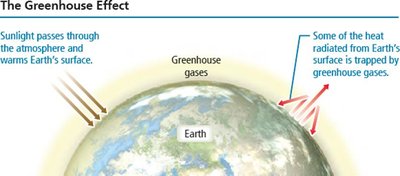
The combustion of fossil fuels is a major source of greenhouse gases, which play a critical role in Earth's climate system. Greenhouse gases allow sunlight to enter the atmosphere and warm Earth's surface, but they also trap some of the heat radiated from the surface, preventing it from escaping into space.
Greenhouse Effect: Sunlight passes through the atmosphere, warming the surface. Greenhouse gases trap some outgoing heat, maintaining Earth's temperature.
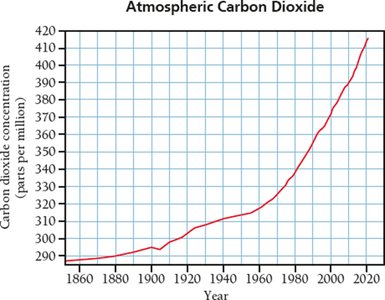
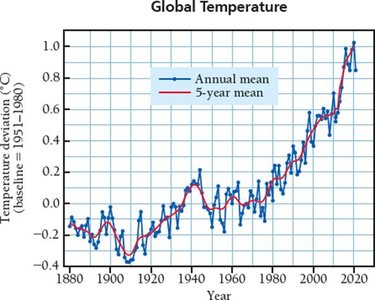
Global Warming: Since 1880, atmospheric temperature has risen by about 0.9°C, while CO2 levels have increased by 37%.
Physical and Chemical Changes in Matter
Understanding the distinction between physical and chemical changes is fundamental in chemistry. Physical changes alter only the state or appearance of a substance, while chemical changes alter its composition.
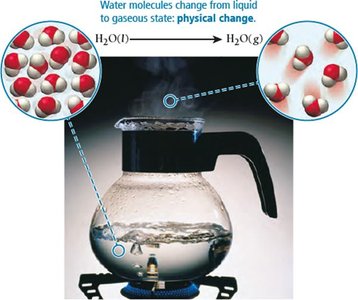
Physical Change: Changes in state (solid, liquid, gas) or appearance without changing the chemical identity. Example: Boiling water (H2O(l) → H2O(g)).
Chemical Change: Changes that result in new substances through the rearrangement of atoms. Example: Rusting of iron (4 Fe + 3 O2 → 2 Fe2O3).
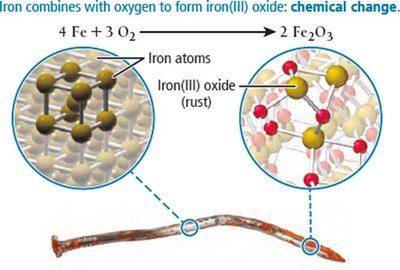
Identifying Physical vs. Chemical Changes
Physical changes do not alter the chemical identity, while chemical changes produce new substances. For example, evaporation and frost formation are physical changes, while burning is a chemical change.
Visualizing Molecular Changes
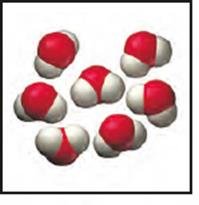
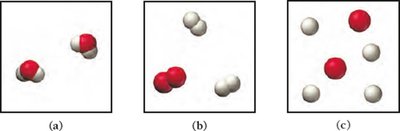
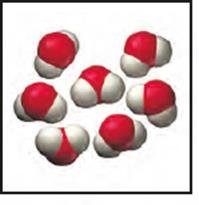
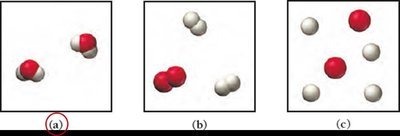
Diagrams can help visualize the molecular changes during physical and chemical processes. For example, water molecules remain unchanged during vaporization, but their arrangement changes.
Writing and Balancing Chemical Equations
Chemical Equations: Shorthand for Reactions
Chemical equations represent the reactants and products involved in a reaction, including their physical states and relative quantities.
Reactants: Substances consumed in the reaction.
Products: Substances formed in the reaction.
States: (g) gas, (l) liquid, (s) solid, (aq) aqueous.
Law of Conservation of Mass and Balancing Equations
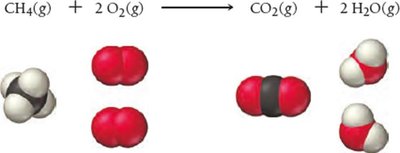
Balancing chemical equations ensures the number of atoms of each element is the same on both sides, reflecting the law of conservation of mass.
Stoichiometry: The study of quantitative relationships between reactants and products.
Steps for Balancing Chemical Equations
Write the unbalanced (skeletal) equation.
Balance atoms in complex substances first.
Balance atoms in pure elements last.
If fractions are present, multiply to clear them.
Check that all atoms are balanced.
Example: Balancing Cobalt(III) Oxide and Carbon
Balanced equation:
Example: Combustion of Butane
Balanced equation:
Balancing Equations with Polyatomic Ions
Balance polyatomic ions as units if they appear on both sides. Example: Reaction between strontium chloride and lithium phosphate.
Reactant | Product |
|---|---|
3 SrCl2 (aq) | Sr3(PO4)2 (s) |
2 Li3PO4 (aq) | 6 LiCl (aq) |
Stoichiometry: Quantitative Relationships in Reactions
Stoichiometric Ratios
The coefficients in a balanced equation specify the relative amounts in moles of each substance involved.
Mole-to-Mole Conversion: Use stoichiometric ratios to convert between moles of reactants and products.
Example:
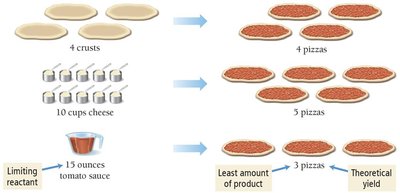
Stoichiometry in Everyday Life: Pizza Analogy
Just as the number of pizzas depends on the amount of each ingredient, the amount of product in a chemical reaction depends on the quantities of reactants.

Mole-to-Mass and Mass-to-Mass Conversions
Stoichiometric ratios can be used to convert between mass and moles of reactants and products.
General Strategy:

Example: Photosynthesis Stoichiometry
Plants convert CO2 and H2O into glucose and O2.
Given mass of CO2, calculate mass of glucose produced using molar masses and stoichiometric ratios.
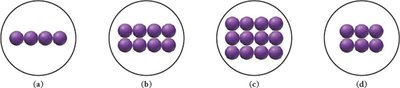
Limiting Reactant, Theoretical Yield, and Percent Yield
Limiting Reactant
The limiting reactant is the reactant that is completely consumed first, limiting the amount of product formed.
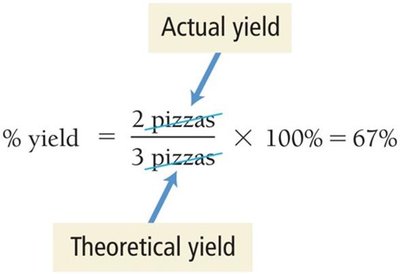
Theoretical Yield: Maximum amount of product that can be made based on the limiting reactant.
Actual Yield: Amount of product actually produced.
Percent Yield:
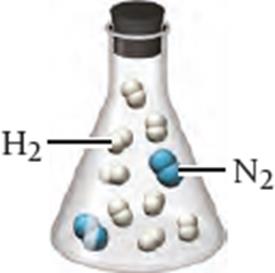
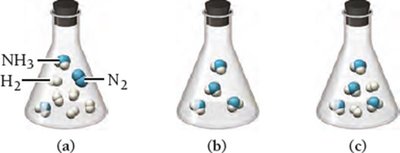
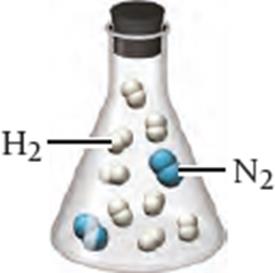
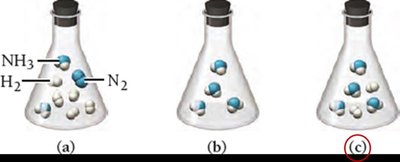
Visualizing Limiting Reactant in Chemical Reactions
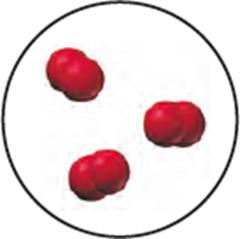
Diagrams can illustrate which reactant is limiting and which is in excess after a reaction has gone to completion.
Combustion Reactions
Definition and Examples
A combustion reaction involves a substance reacting with oxygen to form one or more oxygen-containing compounds, often releasing heat.
Example: Combustion of methane
Alkali Metal and Halogen Reactions
Alkali Metals
Alkali metals (Group 1A) react vigorously with nonmetals, especially halogens and water.
Reaction with Halogens:
Reaction with Water:
Halogen Reactions
Halogens (Group 7A) are highly reactive nonmetals that form 1- anions and react with metals and hydrogen.
Reaction with Metals:
Reaction with Hydrogen:
Summary Table: Key Stoichiometric Concepts
Concept | Definition | Example |
|---|---|---|
Physical Change | Change in state/appearance, not composition | Boiling water |
Chemical Change | Change in composition, new substances formed | Rusting iron |
Limiting Reactant | Reactant completely consumed, limits product | Tomato sauce in pizza analogy |
Theoretical Yield | Maximum product from limiting reactant | 3 pizzas from 15 oz. sauce |
Actual Yield | Product actually obtained | 2 pizzas after losses |
Percent Yield | Efficiency of reaction | 67% yield in pizza analogy |
Practice and Application
Apply stoichiometric calculations to determine limiting reactants, theoretical and actual yields, and percent yield.
Balance chemical equations for reactions involving ionic compounds, combustion, alkali metals, and halogens.
Additional info: These notes expand on the original slides and examples, providing definitions, equations, and context for each topic. All images included are directly relevant to the adjacent explanations and reinforce key concepts.
