 Back
Chapter 7: Chemical Reactions and Chemical Quantities – Study Guide
Study Guide - Smart Notes
 Tailored notes based on your materials, expanded with key definitions, examples, and context.
Chemical Reactions and Chemical Quantities
Learning Goals
This chapter focuses on understanding and applying the principles of chemical reactions and stoichiometry. Students will learn to distinguish between physical and chemical changes, write and balance chemical equations, perform stoichiometric calculations, identify limiting and excess reactants, and calculate theoretical and percent yields.
Identify physical and chemical changes
Write and balance chemical equations
Perform stoichiometry calculations
Determine limiting and excess reactants
Calculate theoretical and percent yields
Physical and Chemical Changes
Definitions and Properties
Physical changes do not alter the composition of a substance, while chemical changes result in the formation of new substances through the rearrangement of atoms.
Physical change: No change in composition (e.g., melting, boiling, dissolving)
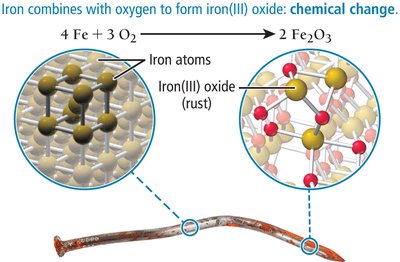
Chemical change: Atoms rearrange to form different substances (e.g., rusting, combustion)
Physical property: Odor, taste, color, appearance, melting point, boiling point, density
Chemical property: Corrosiveness, flammability, acidity, toxicity
Example: Rusting of iron is a chemical change where iron reacts with oxygen to form iron(III) oxide.
Writing and Balancing Chemical Equations
Components of Chemical Equations
Chemical equations represent the reactants and products involved in a reaction, including their physical states. Balancing equations ensures the conservation of mass.
Reactants: Substances consumed in the reaction
Products: Substances formed in the reaction
Reaction arrow: Indicates the direction of the reaction
Phase labels: Indicate physical state (see Table 7.1 below)
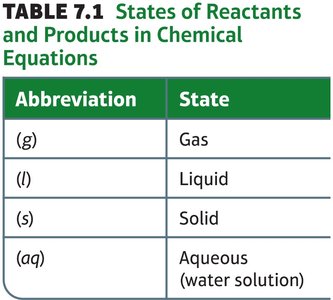
Abbreviation | State |
|---|---|
(g) | Gas |
(l) | Liquid |
(s) | Solid |
(aq) | Aqueous (water solution) |
Balancing Equations
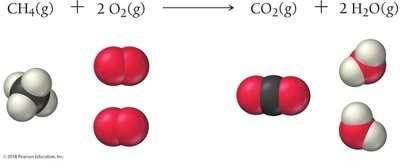
Balancing chemical equations involves adjusting coefficients to ensure equal numbers of each atom on both sides of the equation.
Example: Combustion of methane
Stoichiometry in Chemical Reactions
Stoichiometric Relationships
Stoichiometry uses the coefficients in balanced equations to relate the amounts of reactants and products in moles.
Mole-to-mole conversion: Use coefficients as conversion factors
Mass-to-mass conversion: Convert mass to moles, use mole ratio, convert back to mass
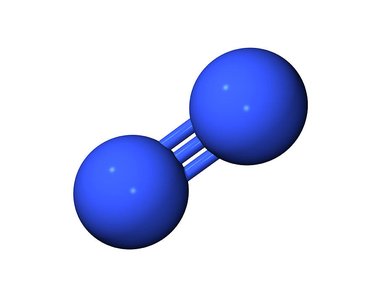
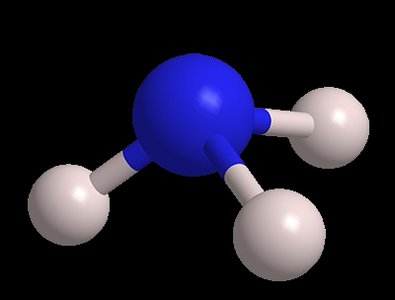
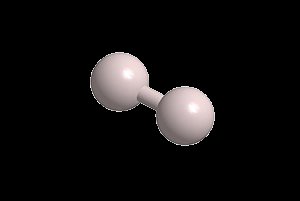
Example: Formation of ammonia
Stoichiometry Example: S'mores Analogy
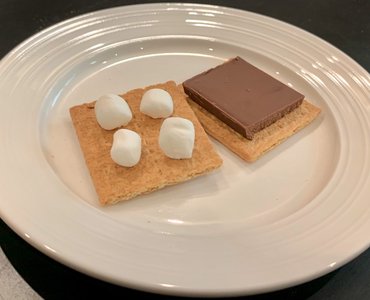
Stoichiometry can be illustrated using everyday analogies, such as making s'mores. The ratio of ingredients determines the maximum number of s'mores that can be made.
2 graham crackers + 1 chocolate + 4 mini-marshmallows → 1 s’more
Limiting Reactant, Theoretical Yield, and Percent Yield
Key Terms
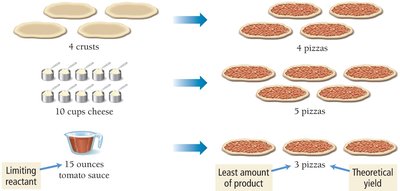
Limiting reactant: The reactant that is completely consumed first, limiting the amount of product formed
Excess reactant: The reactant that remains after the limiting reactant is used up
Theoretical yield: The maximum amount of product that can be formed from the limiting reactant
Actual yield: The amount of product actually obtained from the experiment
Percent yield:
Limiting Reactant Example: Pizza Analogy
The limiting reactant determines the maximum number of products (e.g., pizzas) that can be made. The reactant that produces the least amount of product is the limiting reactant, and the theoretical yield is based on this amount.
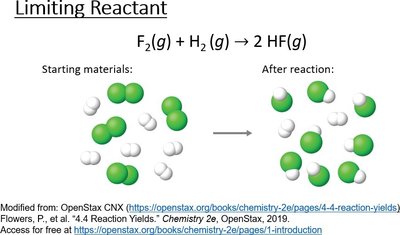
Limiting Reactant Example: Chemical Reaction
In the reaction , the limiting reactant determines the maximum amount of HF produced.
Types of Chemical Reactions
Combustion Reactions
Combustion reactions involve a substance reacting exothermically with oxygen to produce one or more oxygen-containing compounds.
Example:
Other Reaction Types
Alkali metals: React vigorously with water and halogens
Halogens: React with metals and hydrogen to form salts and acids
Practice Problems and Applications
Sample Calculations
Given masses of reactants, determine the limiting reactant, theoretical yield, and percent yield
Use molar masses and stoichiometric ratios for conversions
Summary Table: States of Matter in Chemical Equations
Abbreviation | State |
|---|---|
(g) | Gas |
(l) | Liquid |
(s) | Solid |
(aq) | Aqueous (water solution) |
Additional info:
Practice problems reinforce concepts of limiting reactant, theoretical yield, and percent yield.
Visual analogies (s'mores, pizza) help clarify stoichiometric relationships.
